What's inside
As an Amazon Associate I earn from qualifying purchases. This post may contain affiliate links at no extra cost to you.
A heavy workbench is useful only when it stays put during sawing, planing, sanding, and assembly. The right casters let you move it for cleaning or repositioning, then lock it firmly enough for normal work. The wrong ones create a bench that rolls under load, rocks on uneven concrete, or slowly shifts when you apply hand-tool force.
For most serious shop benches, the best choice is a set of retractable or lift-up casters. These raise the bench’s feet off the floor only when you need to move it. When retracted, the bench rests on its normal legs or leveling feet rather than on small wheels. If cost is the main concern, heavy-duty swivel casters with total-lock brakes can work, but they require more care during setup.
As an Amazon Associate we earn from qualifying purchases at no extra cost to you.
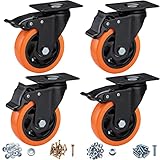
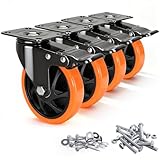


What to Look for in Locking Workbench Casters
Start with the loaded weight of the bench, not its empty weight. Include the top, drawers, vise, tools, dust-collection fittings, and anything likely to remain stored inside. A bench that weighs 500 pounds empty can easily exceed 800 pounds in service.
Use the caster manufacturer’s rated capacity, then leave a margin. For a four-caster setup, do not simply divide the bench weight by four. Floors are uneven, and one wheel can briefly carry more than its share. A practical target is a total rated capacity at least 1.5 times the expected loaded weight. For an 800-pound bench, that means at least 1,200 pounds total, or 300 pounds per caster.
Look for polyurethane wheels rather than hard steel or cheap plastic. Polyurethane rolls more quietly, resists shop chemicals, and is less likely to damage a finished concrete floor. A wheel diameter of 3 to 4 inches is suitable for most benches. Larger 5-inch wheels roll more easily over cracks, cords, and sawdust, but they add height and can make the bench less stable.
Wheel width matters as well. Narrow wheels turn more easily but concentrate the load. Wider wheels provide better support and are less likely to sink into damaged concrete or a soft floor coating.
The Main Caster Types
| Caster type | Best use | Advantages | Limitations |
|---|---|---|---|
| Lift-up or retractable | Heavy benches used for hand work | Bench rests on feet when lowered; excellent stability | More expensive and harder to install |
| Total-lock swivel | General-purpose mobile benches | Simple installation; locks wheel and swivel | Can still rock on uneven floors; brakes are not a substitute for feet |
| Rigid casters plus swivels | Long benches moved in straight lines | Tracks well and resists sideways movement | Less maneuverable in a crowded shop |
| Economy plate casters | Light benches and occasional movement | Low price and easy to find | Small wheels, weak brakes, and faster wear under heavy loads |
Retractable systems are the strongest recommendation for a woodworking bench with a vise. They commonly use a foot pedal or lever to lift the bench slightly, allowing it to roll. Release the mechanism and the bench drops onto fixed feet. This avoids relying on a tiny brake shoe to resist planing forces.
If you choose regular casters, search for heavy-duty locking swivel casters with a published load rating. “Heavy duty” by itself is not a specification. Check the wheel diameter, plate dimensions, bolt spacing, and actual capacity.
Brake Design and Stability
A total-lock brake should lock both the wheel and the swivel. A wheel-only brake prevents rolling but still allows the caster to pivot, which can let the bench twist when you push against it. This distinction is particularly important on a bench with a front vise.
Even a total-lock brake has limits. Brakes are designed to stop a cart from rolling, not to turn a wheeled bench into a fixed foundation. A hard push from a hand plane can overcome the brake, especially on dusty concrete. Four swivel casters also allow small amounts of movement because the wheels and mounting plates flex.
For a regular caster installation, add substantial leveling feet if possible. One approach is to mount casters slightly higher than the feet, then use threaded feet or drop-down pads to carry the bench during work. Alternatively, use retractable workbench casters designed for this arrangement.
Sizing and Installation
Measure the available mounting area before ordering. Plate casters often need a flat section roughly 3 to 4 inches square, plus room for bolts and a wrench. If the legs are narrow, bolt a hardwood or steel mounting plate across the bottom instead of forcing the caster onto a weak edge.
Use through-bolts whenever the leg design allows it. Grade 5 bolts with washers and lock nuts are a sensible minimum for a heavy bench. Wood screws can work in thick hardwood, but they can loosen after repeated rolling. If you must use screws, use structural screws of the correct diameter and embed them deeply into sound wood.
Install the casters so the load is centered over the wheel, not hanging far outside the leg. An offset caster increases leverage on the mounting fasteners and can split a narrow leg. Before tightening everything, check that all four wheels touch the floor at the same time. A bench with one caster carrying little load can suddenly rock when weight shifts.
Expect casters to raise the bench. A 4-inch wheel does not add exactly 4 inches, because the mounting plate and swivel assembly add height too. Measure the total installed height and compare it with your preferred work surface. A bench that becomes 2 inches too tall can make planing and assembly uncomfortable.
Floor Conditions and Shop Layout
Casters work best on smooth concrete, sealed floors, or durable vinyl. They struggle on thick rubber mats, broken concrete, expansion joints, and floors covered in long curls or heavy sawdust. A 3-inch wheel may stop at a small threshold that a 5-inch wheel crosses easily.
Keep the travel path clear of dust-collection hoses, extension cords, and offcuts. A mobile bench can pull a hose from a separator or drag a power cord across a sharp edge. If the bench includes a dust collector or electrical equipment, provide enough slack for movement and use a locking plug where appropriate.
Practical Buying Recommendations
For a 300- to 500-pound bench that moves only occasionally, a set of four 4-inch polyurethane total-lock casters is usually enough. Choose a combined rated capacity around 750 to 1,000 pounds. The cheaper option is fine when the bench has a low center of gravity, a smooth floor, and no heavy planing work.
For a 500- to 1,000-pound bench, particularly one with a vise and drawers, choose retractable casters or casters paired with drop-down leveling feet. Search for workbench caster kits with leveling feet. The added cost buys stability rather than merely smoother movement.
For an extra-long bench, consider two rigid casters and two swivel casters, or a retractable system with a central lift bar. Four swivels maneuver well but can feel loose when the bench is pushed sideways. Whatever system you buy, test it loaded before trusting it during heavy work. Roll it, brake it, push on the vise, and check every fastener after the first few uses.