As an Amazon Associate I earn from qualifying purchases. This post may contain affiliate links at no extra cost to you.
The first real decision for a new TIG welder is whether the machine outputs AC as well as DC, because that single fact decides whether aluminium is on your project list or permanently off it. After that come the beginner questions that listings answer unevenly: is pulse control included, does a foot pedal come in the box or as an extra purchase, and will the machine run on the voltage your garage already has.
This guide is for first-time TIG buyers learning on steel who may want aluminium later, and for stick welders adding a second process. Every pick was chosen from its Amazon listing title and stated contents: process type, pulse, input voltage and included torch or pedal gear. The four machines below are all AC/DC dual-voltage units, so the differences that matter are output headroom, what is included, and how each one treats a learner.
Quick Picks
As an Amazon Associate we earn from qualifying purchases
Product
Best for
Key spec from title
AHP AlphaTIG 203Xi
Learning aluminium and steel on one machine
AC/DC TIG with pulse, 110/220V
Everlast PowerTIG 200DV
A dual-voltage pulse unit from a TIG specialist brand
200-amp AC/DC pulse, 110/220V
LOTOS TIG200ACDC
Buyers who want the pedal and regulator included
Foot pedal and argon regulator in the box
PrimeWeld TIG225X
The most output headroom of this group
225 amps, CK17 flex torch included
How to Choose
Decide on AC/DC before anything else
DC TIG welds steel and stainless well, but aluminium needs AC output to break up the oxide layer as you weld. Every machine in this roundup is an AC/DC unit, which is the right default for a beginner who does not yet know where the hobby leads. If you are certain aluminium will never interest you, a DC-only machine is a legitimate saving; if there is any doubt, buy the AC/DC unit once rather than replacing a DC machine within a year.
Treat pulse as a learning aid, not a luxury
Pulse control cycles the output between a high and a low level, which averages down the heat going into thin material. For a beginner, that means fewer blown-through edges on thin sheet and more time to watch the puddle without it running away. Three of the four picks here state pulse in their listings. It is not essential for thick steel, but on the thin panels and tubing most learners start with, it is the feature that forgives shaky torch technique while your hands catch up.
Check what is actually in the box
TIG listings differ quietly in their contents, and the extras change what you spend next. A foot pedal gives you amperage control mid-weld, which most learners come to rely on; one pick here includes a pedal and an argon regulator, while others include a torch only. Torch style matters too: a flex-head torch angles into joints a rigid neck handles badly. Read the listing’s stated contents line by line, and budget for whatever is missing, especially the regulator and a tungsten assortment, before comparing machines on output alone.
Match input voltage and headroom to your shop
All four picks run on dual voltage, stated as 110/220V or 110/220 in their listings, so each can start on a household outlet and move to a heavier circuit later. Output headroom is the other half of the decision: a 200-amp class machine covers the steel and aluminium thickness most home shops see, while the 225-amp pick adds room for thicker sections. Beginners rarely need the maximum, but buying slightly above your expected work avoids running any machine at its limit constantly.
The 4 Best Options
AHP AlphaTIG 203Xi
Top Pick
AHP AlphaTIG 203Xi
Best for: Beginners who want AC for aluminium and DC for steel in one first machine.
Beginners who want AC for aluminium and DC for steel in one first machine.
Watch out for
The Amazon listing is the 2024 revision of this model while the maker also markets a newer version, so check that the revision named on the listing page is the one you intend to buy.
The AlphaTIG 203Xi is the pick for learners who want one machine that covers steel and aluminium from day one. Its listing title states AC and DC TIG plus stick welding, pulse, and dual voltage in a single unit, which is the full beginner checklist in one box. The IGBT inverter design keeps it in the modern, portable class rather than the transformer era. AHP has sold this model line for years, so settings advice and owner experience are easy to find when you get stuck on your first beads.
Everlast PowerTIG 200DV
Runner-Up
Everlast PowerTIG 200DV
Best for: Learners who want a TIG-specialist brand and the standard 200-amp AC/DC feature set.
Learners who want a TIG-specialist brand and the standard 200-amp AC/DC feature set.
Watch out for
Confirm the torch and any pedal arrangement on the listing before ordering, since the title emphasises the machine itself; budget separately for the regulator and consumables your setup still needs.
The PowerTIG 200DV comes from a brand that sells TIG machines as its main business, and its listing is correspondingly direct: 200-amp AC/DC output, pulse, and dual voltage. That combination suits a learner who plans to practise seriously on both steel and aluminium and wants a machine that will not be the limiting factor for a long while. It is the straightforward, no-gimmicks pick of this group: the stated specification is exactly the set of features a first AC/DC welder should have, at the 200-amp level most home work needs.
LOTOS TIG200ACDC
LOTOS TIG200ACDC
Best for: First-time buyers who want the pedal and regulator included rather than bought separately.
First-time buyers who want the pedal and regulator included rather than bought separately.
Watch out for
LOTOS sells a similarly named sibling model that adds pulse, and the two are easy to confuse; check the model name on the listing carefully so the machine that arrives is the one you compared.
The TIG200ACDC earns its place on what arrives in the box: its listing title states a foot pedal and an argon regulator are included, the two extras beginners most often forget to budget for. The machine itself is a 200-amp AC/DC unit with a square wave inverter, so it welds aluminium as well as steel and adds DC stick as a backup process. For a first setup, opening one box and having the pedal under your foot on the first evening is worth a great deal while you learn puddle control.
PrimeWeld TIG225X
PrimeWeld TIG225X
Best for: Beginners whose planned work includes thicker sections and who want to avoid upgrading soon.
Beginners whose planned work includes thicker sections and who want to avoid upgrading soon.
Watch out for
Recent checks of this listing have disagreed, with one source showing it in stock and another finding no featured offer, so confirm a live offer on this exact listing before ordering.
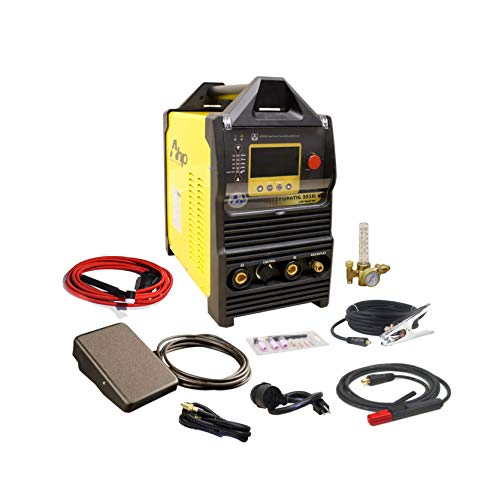
The TIG225X is the headroom pick: 225 amps of AC/DC TIG output with pulse, plus stick welding, in an IGBT inverter unit. Its listing states a CK17 flex torch and cable are included, and a flex head is a genuine help when you are learning to keep a consistent torch angle in corners and joints. Choose it if your project list already includes thicker aluminium or steel sections and you would rather learn on a machine you will not outgrow quickly, accepting that the extra output is capacity you will grow into.
Which One Fits Your Situation
You want to learn on aluminium from your first project
Any of these four will do it, since every pick is an AC/DC machine. The AlphaTIG 203Xi and the PowerTIG 200DV are the natural starting points: both state pulse alongside AC output, and pulse helps a new welder manage heat on aluminium while torch control is still developing. Pick between them on included contents and the brand support you prefer.
Your garage only has a household-voltage outlet
All four picks state dual voltage, so none of them locks you out. Start on the lower input, keep your early practice to thinner material, and treat the move to a heavier circuit as a later upgrade rather than a barrier to beginning. The dual-voltage specification is exactly what makes these sensible first machines for a home garage.
You want pedal control without a second order
The TIG200ACDC is the one pick whose listing states a foot pedal is included, along with the argon regulator. If your plan is to unbox a machine and start practising the same weekend, that contents list removes the two most common delays. The other three are still good machines; you will simply be ordering the pedal and regulator separately.
You plan to grow into thicker material
The TIG225X gives you 225 amps to grow into, the most output in this group, and its included flex torch suits the joint work that thicker projects involve. The trade-off is that you are learning on a bigger machine than your first welds need, so be disciplined about setting output for the material in front of you, not the machine’s maximum.
Common Mistakes
Buying a DC-only TIG welder and discovering later that it cannot weld aluminium.
Assuming a foot pedal and regulator are included when the listing never states them.
Confusing similarly named models, such as a pulse version and its non-pulse sibling.
Judging a beginner machine on maximum amps instead of pulse, AC output and included gear.
Forgetting the running costs beyond the machine: argon, tungsten, filler rod and a decent helmet.
Frequently Asked Questions
Do beginners really need AC TIG?
Only if aluminium is or might be part of your plans. AC output is what lets a TIG welder clean and weld aluminium properly, so a DC-only machine closes that door. Because most beginners cannot predict their second year of projects, an AC/DC machine like every pick here is the safer first purchase.
What does pulse do for a new TIG welder?
Pulse cycles the output between high and low levels, lowering the average heat into the workpiece. On thin sheet and tubing, that gives a learner more time to read the puddle and feed filler before the edge blows through. It is a training aid as much as a production feature, and it is worth having from the start.
Is a foot pedal necessary to learn TIG?
Not strictly, but it makes learning easier: the pedal lets you raise and lower amperage during the weld instead of committing to one setting. Many beginners learn torch control faster with one. If your chosen machine does not state a pedal in its contents, as only the LOTOS does here, plan to add one rather than assuming it is in the box.
Can these machines stick weld as well?
Yes. Each listing here includes stick welding alongside TIG: the AHP and PrimeWeld state TIG and stick, and the LOTOS states DC stick explicitly. That makes any of them a reasonable single purchase for a small shop that also does occasional repair work with electrodes, though a dedicated stick session will still feel like a different craft.
J
JD's Woodworks Editorial Team
We compare specs, warranty terms, long-term owner feedback and street pricing before anything earns a spot. Rankings are never paid.
Affiliate disclosure. As an Amazon Associate we earn from qualifying purchases at no extra cost to you. Prices accurate as of the date shown.
The best welding gear bags compared: backpacks and a wide-mouth tool bag with helmet storage, tough fabrics and room for gloves, jackets and hand tools.
Find the best tool laser engraver for your woodworking shop with five machines compared on power, bed size, enclosure, air assist, and safety features.
A best christmas tree laser cutter guide comparing four diode and CO2 machines for wooden and acrylic ornaments, with work area, beam power and safety.
Find the best woodwork table saw for your shop: four current models compared by rip capacity, motor power, fence design, and stand, with a buying guide.
Compare the best two stage dust collectors for weekend woodworking projects, with cyclone separation, canister filters, drum sizes and inlet specs compared.



 PrimeWeld TIG225X