As an Amazon Associate I earn from qualifying purchases. This post may contain affiliate links at no extra cost to you.
This class hides its real decision inside one number. Two of the three generators below reach 18,000 as a peak figure, the short burst available for motor starts, while the third carries 18,000 as its running figure, the output it sustains for hours. A buyer sizing a transfer switch against running loads who mixes those bases up will buy the wrong machine with complete confidence, so this guide states each model’s basis exactly as its own listing states it.
The pool is the honest shape of the class on Amazon US: two fuel variants of one Westinghouse platform, dual fuel and tri-fuel, plus the Generac. They suit whole-home backup through a transfer switch, farm and outbuilding cover, and long-outage households choosing between stored propane, a natural gas line and gasoline. Every figure below, watts, tank size, runtime and weight, comes from the specifications in each model’s Amazon product name and listing data.
Quick Picks
As an Amazon Associate we earn from qualifying purchases.
Product
Best for
Key spec from title
Westinghouse WGen14500DFc
Fuel flexibility with gasoline and propane on one platform
18,000 peak watts, dual fuel, 713cc V-Twin engine
Westinghouse WGen14500TFc
A natural gas line joins the fuel list for long outages
18,000 peak watts, tri-fuel, digital data center
Generac GP18000EFI
The highest stated running output in this pool
18,000 running watts, 816cc EFI engine
How to Choose
Separate peak watts from running watts before anything else
Peak, or starting, watts are available for seconds while a motor spins up; running watts are what the machine delivers all night. The two Westinghouse models state 18,000 peak watts and 14,500 running watts on gasoline. The Generac states the mirror image: 18,000 running watts and 22,500 starting watts. Neither basis is a trick, but they are not interchangeable, and a load plan built on a peak figure will overload the machine within the first hour. Add up the running loads you truly need, then compare that total against running watts only.
Fuel choice decides your outage logistics
The dual fuel Westinghouse runs on gasoline or propane, the tri-fuel adds natural gas, and the Generac is gasoline only. Stored propane suits properties that already keep a tank; natural gas removes refueling from a long outage entirely, at the cost of a fixed hookup point; gasoline gives the longest stated runtimes per tank here but needs fresh fuel and safe storage. Tank sizes are close, 10.5 gallons on the dual fuel and 10.57 on the tri-fuel, so the fuel decision is about supply, not capacity.
Transfer-switch readiness is an outlet question
Whole-home backup lives or dies on the outlet panel. Both Westinghouse models state a transfer-switch-ready L14-30R 30-amp outlet and a 14-50R 50-amp outlet among their seven outlets, which covers the two common inlet arrangements. The Generac’s listing copy in this pool emphasizes its engine and power technology rather than an outlet list, so confirm the exact panel on its live listing against your inlet box before ordering. A generator that cannot plug into your transfer setup is a large, loud extension-cord problem.
Accept that portable describes the wheels, not the carry
These machines weigh 348, 405 and 427 lb. Portable here means a wheeled unit that rolls from storage to its pad, not something two people lift into a truck bed at short notice. Plan a permanent, flat, outdoor position with the transfer inlet within cable reach, and think through delivery and unloading before the outage does it for you. Weight also argues for the remote electric start both Westinghouse models state: nobody wants to wrestle a recoil starter on a 400 lb machine in the rain.
The 3 Best Options
Westinghouse WGen14500DFc
Top Pick
Westinghouse WGen14500DFc
Best for: Homes and farms that store propane and want transfer-switch backup with a second fuel in reserve.
The dual fuel Westinghouse states its basis plainly: 18,000 starting watts and 14,500 running watts on gasoline, from a 713cc OHV V-Twin engine. Propane gives it a second fuel for properties that store gas already, and the 10.5 gallon tank carries a stated runtime of up to 11 hours. Remote electric start with a key fob, a CO sensor and stated harmonic distortion under 5 percent round out a package aimed at transfer-switch backup, and its seven outlets include both common inlet styles.
Watch out for: At 405 lb it needs a planned pad and a second person for unloading and positioning; decide the spot before delivery day, not during the first outage.
Westinghouse WGen14500TFc
Runner-Up
Westinghouse WGen14500TFc
Best for: Homes with a natural gas line at the generator pad that want refuel-free runtime through long outages.
Homes with a natural gas line at the generator pad that want refuel-free runtime through long outages.
Watch out for
A retailer mirror states a longer runtime at light load; plan fuel and expectations around the Amazon listing figure of up to 12 hours, not the mirror’s number.
The tri-fuel sibling keeps the same stated output basis, 18,000 peak watts and 14,500 running watts on gasoline, and adds natural gas to the fuel list, which changes long-outage planning completely: a home with a gas line never refuels. Its 10.57 gallon tank carries a stated runtime of up to 12 hours per the Amazon copy, and the digital data center, remote electric start and CO sensor carry over. At 348 lb it is also the lightest machine in this pool, though light is a relative term here.
Watch out for: A retailer mirror states a longer runtime at light load; plan fuel and expectations around the Amazon listing figure of up to 12 hours, not the mirror’s number.
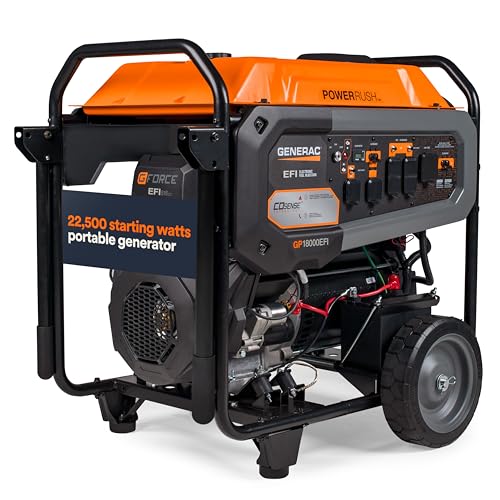
Generac GP18000EFI
Generac GP18000EFI
Best for: Whole-home backup sized on running loads, where sustained output matters more than fuel variety.
Whole-home backup sized on running loads, where sustained output matters more than fuel variety.
Watch out for
Its 18,000 watts are running watts, the opposite basis from the two Westinghouse headlines; size your load plan on that basis and never average the three figures together.
The Generac is the output leader of this pool on the basis that matters most: its 18,000 figure is running watts, sustained output, with 22,500 starting watts above it for motor loads. The 816cc engine uses electronic fuel injection, and the listing credits its TruePower technology for the quality of the output. Electric start with the battery included, COsense technology, low-oil shutdown and an hour meter suit a machine that sits in reserve and must simply work, first pull, after months of waiting.
Watch out for: Its 18,000 watts are running watts, the opposite basis from the two Westinghouse headlines; size your load plan on that basis and never average the three figures together.
Which One Fits Your Situation
Whole-house backup through a transfer switch
Start from running watts. The Generac’s 18,000 running watts give the largest sustained budget for a panel full of household loads, while either Westinghouse covers a typical home at 14,500 running watts with both common inlet outlets stated. Add your true running loads first, including the well pump and air handler, then let that total, not the headline, pick the machine.
A property that already stores propane
The WGen14500DFc fits the existing infrastructure: propane from the tank you already keep, gasoline as the second fuel, and remote start for a machine parked at the pad. Its stated 11-hour runtime on a 10.5 gallon tank suits overnight cover, and the sub-5-percent THD figure is the one stated power-quality number in this pool for sensitive electronics.
A natural gas line at the pad
Choose the WGen14500TFc. Natural gas turns a long outage into a non-event for fuel: no cans, no tank swaps, no runtime math at 2 a.m. The tri-fuel design still accepts gasoline and propane if the gas supply is ever interrupted, and at 348 lb it is the easiest of the three to position during installation.
Long outages with mixed fuel stores
The tri-fuel Westinghouse again: three fuels mean the outage plan degrades gracefully, from the gas line to the propane tank to stored gasoline, in whatever order the week demands. Its stated 12-hour tank runtime is the longest in the pool per the Amazon copy, which stretches each gasoline fill between the other two sources.
Common Mistakes
Sizing a transfer-switch plan from peak watts; a machine stating 18,000 peak delivers 14,500 running, and a load plan built on the bigger number overloads it in the first hour.
Assuming all three headlines mean the same thing; the Generac’s 18,000 is running output while the Westinghouse pair quote 18,000 as peak, and comparing them directly inverts the ranking.
Ignoring the outlet panel until installation day; transfer readiness depends on the stated L14-30R and 14-50R outlets matching your inlet, which is a listing check, not an assumption.
Planning to move a 400 lb generator when the power fails; these machines need a permanent pad position decided in advance, with the cable run already measured.
Trusting the longest runtime figure found anywhere; a retailer mirror quotes the tri-fuel model higher, and fuel planning should rest on the Amazon listing’s stated figure.
Frequently Asked Questions
Is 18,000 watts the running output on all three machines?
No, and the difference is the point of this class. The Generac GP18000EFI states 18,000 running watts with 22,500 starting watts. Both Westinghouse models state 18,000 as starting, or peak, watts with 14,500 running watts on gasoline. Each listing uses the same headline number on a different basis, so the running figure is the only honest comparison.
Which fuels can each generator use?
The WGen14500DFc is dual fuel, gasoline and propane. The WGen14500TFc is tri-fuel, adding natural gas. The Generac GP18000EFI is gasoline only. Fuel choice usually follows what the property already stores or pipes: a propane tank favors the dual fuel, a gas line favors the tri-fuel, and neither favors the gasoline-only machine.
Can these generators connect to a home transfer switch?
The two Westinghouse models state it directly: both list a transfer-switch-ready L14-30R 30-amp outlet and a 14-50R 50-amp outlet. The Generac’s captured copy does not enumerate its outlet panel, so confirm the panel on its live listing against your inlet box before ordering. Matching the outlet to the inlet is the whole installation.
How long will they run on a tank of fuel?
By their own listings: the dual fuel Westinghouse states up to 11 hours from its 10.5 gallon tank, the tri-fuel states up to 12 hours from 10.57 gallons, and the Generac states up to 9 hours at 50 percent load. Runtime falls as load rises on every machine here, so treat these as best-case planning figures.
J
JD's Woodworks Editorial Team
We compare specs, warranty terms, long-term owner feedback and street pricing before anything earns a spot. Rankings are never paid.
Affiliate disclosure. As an Amazon Associate we earn from qualifying purchases at no extra cost to you. Prices accurate as of the date shown.
Table saws under the 1500 mark compared: the Grizzly G0771Z and Shop Fox W1837 hybrid saws with cast iron tables, 2 HP motors and T-square fences, specs from their listings.
Table saws for fine woodworking compared: the SawStop Professional Cabinet Saw and Powermatic PM1000, judged on fence precision, table flatness and vibration from listing specs.
Table saw combos explained: saws sold with a stand and accessories in one listing, what to check in the box, and which bundle fits your shop or jobsite.
Compare the best planer digital thickness gauges and digital readout kits for portable planers, with fit, resolution and mounting checks before you buy.
Model table saws for scale modelling and hobby work compared: the precision Proxxon FET 37070 and the compact Saker mini table saw, with specs taken from their Amazon listings.
Three CoreXY 3D printers for product development, each with the architecture stated on its listing: an enclosed multicolor machine, a large-format enclosed model and a heated-chamber model.