As an Amazon Associate I earn from qualifying purchases. This post may contain affiliate links at no extra cost to you.
The choice that actually matters with a gasoline portable generator is not the brand on the tank. It is whether the machine only has to keep a refrigerator cold and a few lights on, or whether it also has to start a well pump, a furnace blower or a central air conditioner when the grid goes down. That one answer decides the wattage class, whether you need 240-volt output, and how the generator connects to your house, so it should come before any model name.
OUR TOP PICK
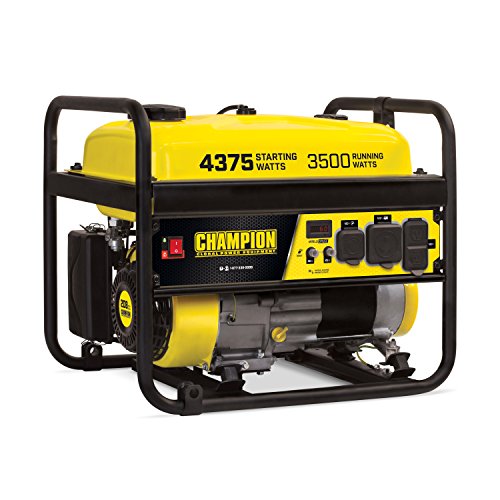
Champion Power Equipment 100555 4375-Watt RV Ready Portable Generator
This roundup is for three kinds of buyers: homeowners who want outage backup without paying for a standby system, RV owners who need a 30-amp outlet at sites without hookups, and workshop or jobsite users who run power tools away from a wall socket. Every pick below is a gasoline-only portable generator from a current Amazon listing, and each one was chosen from the numbers on that listing: running watts, outlet types, fuel tank size and rated runtime.
Quick Picks
As an Amazon Associate we earn from qualifying purchases
Start With Running Watts, Not the Big Number on the Box
Every listing in this category leads with starting watts, the brief surge a generator can deliver while a motor spins up. The figure that decides what stays on all evening is running watts, and the gap between the two is wide: the largest machine here surges to 13,000 watts but sustains 10,500. Add up the running draw of everything you plan to power at once, then check the starting draw of the biggest motor in that list, because a refrigerator or pump that fits the running total can still trip the generator when its compressor kicks on.
Decide Whether Your Loads Need 240 Volts
Voltage splits this roundup in half. Two of the four machines output 120 volts only, which is plenty for extension-cord loads, RVs and power tools. The other two add 240-volt output, and that is what a well pump, an electric water heater or a transfer switch feeding both legs of a breaker panel requires. If your outage plan involves anything hardwired, a 120-volt-only generator cannot run it no matter how many watts it makes, so settle the voltage question before comparing anything else on the spec sheet.
Match the Outlets to the Way Power Reaches the House
Outlet panels look similar in photos and behave very differently in an outage. A TT-30R socket plugs straight into an RV. A 30-amp twist-lock outlet pairs with a transfer switch or a generator inlet box, and a 50-amp 14-50R outlet can carry close to a whole house through the right cord and interlock. Plain household duplex outlets mean extension cords through a cracked window. Read the panel list on the listing, picture the exact cord you would run at midnight in the rain, and buy the machine whose panel matches that picture.
Tank Size and Runtime Set Your Refueling Schedule
Runtime claims are quoted at half load or quarter load, never at full tilt, so compare them on the same basis. In this group the spread runs from about eight hours to seventeen, and the difference decides whether you are refueling at 3 a.m. during a storm. A bigger tank helps, but so does a smaller load: the largest generator here stretches a tank to seventeen hours at quarter load. Open-frame gasoline models are also loud, roughly vacuum-cleaner territory and up, which matters if the machine sits near a bedroom window or a neighbor’s fence.
The 4 Best Options
Champion Power Equipment 100555 4375-Watt RV Ready Portable Generator
Top Pick
Champion Power Equipment 100555 4375-Watt RV Ready Portable Generator
Best for: RV owners who also want a simple, California-legal backup unit at home.
The 100555 is the pick built around an RV outlet rather than a house panel. Its TT-30R socket takes a camper’s shore-power cord directly, the output covers a roof air conditioner plus the small loads inside, and CARB compliance means it can be sold and used in California, which not every open-frame model can claim. At home it works as a lighter-duty backup for a refrigerator, lights, a sump pump and device charging, run through extension cords. Starting is recoil only, which keeps the machine simple and removes a battery from the maintenance list.
WEN 56475 4750-Watt Portable Generator with Electric Start
Runner-Up
WEN 56475 4750-Watt Portable Generator with Electric Start
Best for: workshops and jobsites that want electric start and a mixed outlet panel in a mid-size frame.
WEN’s 56475 suits the buyer who will actually move the generator often: to a jobsite in the morning, around a workshop in the afternoon, out of the garage during an outage. Electric start with a recoil backup removes the pull-cord struggle in cold weather, and the included wheel kit matters on a machine in this weight class. The panel is unusually flexible for the size, mixing two household outlets with a 30-amp twist-lock and an RV socket, so the same unit can feed tools on site and a camper on the weekend.
DuroMax XP5500E Gas Powered Portable Generator
DuroMax XP5500E Gas Powered Portable Generator
Best for: homes on a transfer switch that need 240V for a well pump plus the usual outage essentials.
The XP5500E is where this list turns toward real house backup. Its 120/240-volt output and 30-amp twist-lock outlet are made for a transfer switch or inlet box, and the MX2 switch lets you choose between splitting power across both voltages or sending the full output to the 120-volt side for one heavy load. Electric start, a voltmeter and GFCI household outlets round out a panel designed to be used in the dark. It will not run a whole house, but it covers the circuits most people actually miss: furnace, well pump, refrigerator and lights.
DuroMax XP13000E Gas Powered Portable Generator
DuroMax XP13000E Gas Powered Portable Generator
Best for: whole-house backup through a 50-amp inlet, including central air conditioning.
Starting watts: 13,000
Running watts: 10,500
Engine: 500cc DuroMax OHV, 4-stroke, cast iron sleeve
The XP13000E is the closest thing in this roundup to a standby generator on wheels. With 10,500 running watts and a 50-amp outlet, it can carry a house through an inlet box and interlock, including a central air conditioner alongside the refrigerator, well pump and lights. Push-button electric start matters at this size, and the 8.3-gallon tank is sized to match the output. What it is not is handy: at 236 pounds it lives where it is parked, and moving it is a two-person job even with the wheel kit fitted.
Which One Fits Your Situation
Your RV Is Your Weekend Plan and Your Backup Plan
If the generator’s main job is to sit behind a camper and occasionally back up a few home essentials, take the Champion 100555. The TT-30R outlet connects the way RV power is meant to connect, the output starts a roof air conditioner, and CARB compliance keeps it legal at California campgrounds and homes. You give up electric start and 240 volts, and for this use neither one matters much.
You Run Tools Away From the Building
For a workshop, a renovation site or a farm corner with no power, the WEN 56475 fits the routine. Electric start ends cold-morning pull-cord fights, the wheel kit gets it across gravel and grass, and the panel runs two tool circuits at once with a twist-lock spare. Its 3,750 running watts handle a table saw or a compressor, just not both starting at the same moment.
Your House Has a Well Pump and a Transfer Switch
If losing power also means losing water, the DuroMax XP5500E is the smallest machine here that solves the problem properly. Its 240-volt output feeds the pump through a transfer switch, the MX2 switch concentrates power when one 120-volt load needs everything, and 4,500 running watts cover the furnace, refrigerator and lights around it. Plan on refueling during long outages, because the tank is modest.
You Want the Whole House, Air Conditioning Included
When the goal is to live normally through a multi-day outage, the XP13000E is the only pick here with the output to do it. The 50-amp outlet and 10,500 running watts carry central air plus the rest of the house through an inlet box. Accept the trade-offs before ordering: two-person moves, real noise, and a fuel habit that demands several stored cans.
Common Mistakes
Sizing by starting watts and discovering the running total is smaller than the loads you planned for.
Buying a 120V-only generator when the well pump or transfer switch in your plan needs 240V.
Running the generator in a garage, on a porch or under a window, where carbon monoxide can reach the house.
Backfeeding a panel through a dryer outlet instead of using a transfer switch or a listed interlock kit.
Storing the machine for a year with untreated gasoline in the tank and carburetor, then expecting it to start in a storm.
Frequently Asked Questions
Can a portable gas generator run central air conditioning?
Yes, but only the largest class here does it comfortably. A central air conditioner’s starting surge is the biggest single load in most homes, so the generator needs 240-volt output and enough running watts left over for everything else. The XP13000E was built for that job; the three smaller machines are better matched to window units or no air conditioning at all.
How far will a tank of gasoline actually go?
Listings rate runtime at half load or quarter load, and real outages land somewhere in between. In this group that means roughly nine to twelve hours for the mid-size machines and about eight hours at half load for the largest, stretching much longer when loads stay light. Shutting off heavy loads overnight is the easiest way to stretch a tank until morning.
Is a conventional gas generator safe for a laptop or TV?
Most modern electronics tolerate conventional generator power for outage use, and millions of homes run them this way. The power is less clean than inverter output, though, so if the machine’s main job is feeding sensitive audio gear, medical devices or a home server full-time, an inverter generator is the better tool. For fridges, pumps, tools and lights, it is a non-issue.
Can I leave the generator running outside in the rain?
It has to run outside, well away from doors and windows, because of carbon monoxide, but it should not sit in direct rain either. A purpose-made generator tent or an open-sided canopy keeps water off the panel while preserving airflow. Never solve the weather problem by moving it into a garage with the door open; that is exactly how carbon monoxide accidents happen.
J
JD's Woodworks Editorial Team
We compare specs, warranty terms, long-term owner feedback and street pricing before anything earns a spot. Rankings are never paid.
Affiliate disclosure. As an Amazon Associate we earn from qualifying purchases at no extra cost to you. Prices accurate as of the date shown.
Miter saw vs table saw: compare crosscuts, rip cuts, accuracy, space, and value to choose the right saw for your shop and your first woodworking projects.
Compare five solar portable generators for shops, campsites, and outages, covering battery size, output, solar charging, outlets, and what to check first.
The best portable CNC machines for small shops and shared spaces, compared by footprint, weight, work area, and setup. Compact benchtop picks for wood, acrylic, and soft metal.
Find the best Penn Industries dust collector on Amazon: the PSI Woodworking DC3XX blower and the DC725 tabletop unit, compared on airflow, pressure, and shop fit.
Compare five large stationary horizontal metal band saws for fabrication shops on cutting capacity, motor, power supply, blade speed, and mitering before buying.
Find the best mortising chisel bits for clean square mortises in this guide: hollow-chisel sets and singles compared by size, shank, steel, and machine fit.
Find the best drill press base for your shop. Compare rolling stands and mobile bases by capacity, footprint, casters, locking, and setup before you buy.
Find the best dewalt planer dw734 blades for your 12-1/2-inch thickness planer. Compare OEM and aftermarket 3-knife sets, steel types, and fit before you buy.



 DuroMax XP13000E Gas Powered Portable Generator









