What's inside
As an Amazon Associate I earn from qualifying purchases. This post may contain affiliate links at no extra cost to you.
Fine dust is the material a one-car shop’s cleanup routine often misses. A shop vacuum may collect dust at a sander or saw, but airborne particles can linger and settle on tools, shelves and your lungs. A ceiling-hung air filtration unit helps capture that suspended dust. It does not replace source collection, a respirator or ventilation.
As an Amazon Associate we earn from qualifying purchases at no extra cost to you.
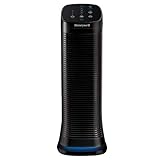


What an air filter can—and can’t—do
An air filtration unit draws room air through filters, typically a coarse prefilter followed by a finer filter, then returns the cleaned air to the shop. It is useful for the dust that escapes tool ports or gets stirred up during cleanup. It is not a substitute for a dust collector connected to the tool: by the time an overhead filter captures a cloud, you may already have breathed some of it.
Buy one only after improving source capture. Connect sanders and saws to a suitable dust collector or shop vacuum, use a well-fitting respirator for dusty work, and avoid blowing settled dust around with compressed air. For hazardous materials such as lead paint or asbestos, an ordinary shop air cleaner is not a safe cleanup plan.
Size the unit for the shop
Start with the room’s volume. A typical one-car shop measuring 12 by 20 feet with an 8-foot ceiling contains 1,920 cubic feet of air. At six air changes per hour, it needs roughly 192 cubic feet per minute of delivered airflow: 1,920 × 6 ÷ 60. At eight air changes, the target is 256 CFM.
Use the manufacturer’s airflow rating at the speed you can tolerate, not just the highest advertised setting. A dirty filter, restrictive filter media and a low fan setting all reduce actual airflow. Since brands do not always test or report performance the same way, treat air-change calculations as a screening guide, not a guarantee. If the shop has a high ceiling, add its real volume to the calculation; do not assume a typical garage ceiling.
Compare the main options
| Option | Best fit | Main trade-off |
|---|---|---|
| Ceiling-hung shop air cleaner | Regular woodworking in a compact shop | Good room-air turnover, but it cannot capture dust at the tool |
| Portable HEPA air scrubber | Dusty work in a specific area or occasional cleanup | Can provide strong filtration, but costs more and takes floor space |
| DIY fan and furnace filter | Light, occasional use on a tight budget | Filter fit, airflow and particle performance are less certain |
For frequent sanding or cutting, a purpose-built ceiling-mounted shop air filtration unit is usually the most practical choice. Look for published airflow, replacement-filter availability and a washable or replaceable prefilter. A timer or remote control is convenient, but not worth compromising on filter access or airflow.
Filter types and maintenance
Many workshop units use pleated fine filters rather than certified HEPA filters. A HEPA filter is tested to capture at least 99.97% of particles 0.3 microns in size, but the complete unit must also seal properly around the filter. A HEPA label on a replacement filter alone does not prove that a fan-and-box assembly performs like a tested HEPA air cleaner.
For routine wood dust, a well-sealed shop unit with a fine final filter can be a reasonable balance of cost, airflow and availability. If you need verified HEPA performance—for example, for a specific contamination-control job—choose a sealed portable HEPA air scrubber with published performance data. These units can be expensive, and their filters may cost more to replace. Check replacement prices before buying.
Inspect filters regularly. A loaded prefilter reduces airflow and can make a unit sound as if it is running normally while cleaning less air. Follow the maker’s cleaning instructions; do not wash a filter unless it is explicitly washable. When changing dusty filters, wear a respirator and bag the old filter rather than shaking it out in the shop.
Placement and safe installation
Mount a ceiling unit where its intake and outlet have clear paths through the room. Avoid tucking it tightly against a wall, shelving or a tall cabinet. A poor location can make the unit recirculate the same small pocket of air while dust remains at the opposite end. If it has directional outlets, aim circulation across the work area without blowing directly at an active dust plume.
Secure overhead equipment to framing or a suitable structural support, not drywall alone. Check the unit’s weight and mounting instructions, and leave access to remove filters. Run it during dusty work and for a period afterward; a timer can help, but there is no universal wait time because room volume, airflow and particle load vary. Do not point an exhaust fan so it pulls dusty air through the breathing zone on its way out.
When the cheaper option is enough
A DIY box-fan filter can be acceptable for occasional, low-dust tasks if you understand its limits. Use a fan rated for continuous operation and a filter that fits snugly without bypass gaps; replacing a filter is pointless if air simply flows around it. A common furnace filter’s MERV rating describes particle-capture performance under a test method, not the airflow of your assembled box. Restrictive filters can cut fan output, and ordinary box fans are not necessarily designed for high-resistance filters.
If you sand or machine wood most weeks, the convenience and more predictable filter fit of a purpose-built unit are usually worth the extra cost. Whichever route you choose, judge it by practical results: less lingering haze and less fine dust settling on horizontal surfaces, while continuing to capture dust at the tool. An air cleaner is the last layer in a dust-control setup, not the first.