What's inside
As an Amazon Associate I earn from qualifying purchases. This post may contain affiliate links at no extra cost to you.
A dust-collector remote is useful when the collector sits across the shop, behind a machine, or in a corner you can’t reach without stepping over stock. The right choice depends less on the remote’s advertised range than on the collector’s switch, motor load, and how reliably the signal reaches your work area.
As an Amazon Associate we earn from qualifying purchases at no extra cost to you.

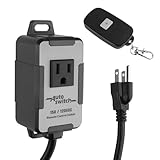

Check the collector before shopping
Look at the collector’s switch and manual first. A remote can only control the machine safely if its receiver is compatible with the collector’s electrical load and switching arrangement. Note the motor’s voltage and amperage, and whether the collector uses a magnetic starter or electronic control. A plug-in receiver rated only for a small household load may not be suitable for a dust-collector motor, even if its outlet fits.
Some remotes operate a receiver that plugs between the wall outlet and collector. Others use a receiver wired into a control circuit, which is a better fit for certain larger machines but may require an electrician. Don’t bypass an overload, magnetic starter, or other factory protection to make a remote work. If the manual does not clearly support remote switching, contact the manufacturer or a qualified electrician.
Choose a control style
| Type | Best for | Trade-off |
|---|---|---|
| Plug-in radio-frequency remote | A compatible, smaller collector with an accessible outlet | Simple to add, but the receiver’s motor rating and outlet arrangement can limit compatibility |
| Wired-in receiver | A larger collector or one controlled by a magnetic starter | Can integrate more cleanly, but installation and compatibility need more care |
| Infrared remote | A setup with a clear line of sight to the receiver | Walls, machines, and stored material can block the signal |
| Smart plug or app control | Only equipment specifically rated for the motor and intended switching method | Convenient, but Wi-Fi dependence and unsuitable plug ratings are real concerns |
For most shops, radio frequency (RF) is more practical than infrared because it does not require aiming at the receiver. That does not make every RF remote reliable through walls or metal ductwork. Concrete, steel cabinets, and the collector’s own housing can reduce range. If the machine is at the far end of a crowded shop, test the actual signal path rather than trusting a range figure measured in open space.
What to buy
For a collector with a compatible plug and a clearly adequate motor rating, a basic RF unit is often enough. Compare the receiver’s voltage, current rating, and motor-load rating against the collector’s nameplate and instructions; don’t rely on a high-looking wattage figure alone. Search for a dust-collector remote control, then verify that the listing gives electrical ratings and explains how the receiver connects. A low-cost unit is fine when those details check out and the signal reaches the work area.
If the collector uses a starter or has a heavier motor, look for a remote kit intended for dust-collection equipment or compatible control circuits rather than adapting a generic outlet switch. A wireless dust-collector control kit may suit that job, but the word “wireless” is not a compatibility guarantee. Confirm the wiring diagram and supported starter type. Use an electrician if the instructions call for work inside the machine or its electrical enclosure.
For two or more machines, consider a system that can control separate receivers without accidentally starting the wrong one. Check how pairing works and whether adjacent remotes can interfere. If you want to operate a collector from several stations, see whether the system supports multiple transmitters; buying a second transmitter that cannot pair with the receiver is a common avoidable mistake.
Place the receiver for reliable range
Mount or position the receiver where its antenna is not pressed against a steel cabinet or buried behind the collector. Keep it clear of hot surfaces, moving parts, and places where chips or dust can clog a vent. If the signal drops out, try moving the receiver a few feet or rotating it before replacing the remote. A small placement change can help more than buying a unit with a larger claimed range.
Test from the places where you actually use the machines: beside the table saw, at the planer, and near the shop entrance if that is where you start work. Repeat the test with doors closed and typical equipment in place. If it works only when you stand near the collector, the remote has not solved the hard-to-reach problem.
Use it without creating a new hazard
A remote is a convenience, not a substitute for dust-control checks. Before switching on, confirm that the blast gate for the tool in use is open and that the duct and filter are clear. A collector started against a closed gate or blocked filter can move little useful air while making noise and heating the motor.
Keep a manual means of stopping the collector accessible. A lost transmitter, dead battery, or failed receiver should not leave you with no practical way to shut down equipment. Replace the remote battery when response becomes inconsistent, and label transmitters if several people share the shop. Test the stop function periodically, and don’t treat a remote’s wireless signal as an emergency-stop system.
Make the buying decision
Choose a basic plug-in RF remote when the collector is modest in size, the receiver is explicitly rated for its motor, and the signal works from your normal operating positions. Spend more attention—not necessarily more money—on electrical compatibility and receiver placement. For a larger collector, magnetic starter, or multi-station setup, buy a purpose-designed control kit and get help with installation when the wiring is unclear. If your current switch is already within easy reach, the cheaper option may be no remote at all.