What's inside
As an Amazon Associate I earn from qualifying purchases. This post may contain affiliate links at no extra cost to you.
Why a Planer Needs More Than Basic Dust Collection
A thickness planer produces large chips quickly. Unlike a table saw, it does not create a fine stream of dust that a small shop vacuum can handle comfortably. A planer can fill a 20-gallon bag in minutes, clog a filter, or eject chips across the floor if the collection system is undersized.
The most useful upgrade is usually a proper 4-inch collection line connected to a dust collector, followed by improvements that keep the airflow moving: a short hose, a wide-open blast gate, a cyclone separator, and a clean filter. The goal is not just higher advertised CFM. It is enough airflow at the planer hood to carry chips before they settle in the hose.
As an Amazon Associate we earn from qualifying purchases at no extra cost to you.

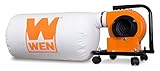
As a practical target, plan on roughly 400 CFM at the machine for a typical portable or benchtop planer. Larger planers with wider cutterheads may benefit from 500 to 700 CFM. Check the planer manual first, since some chip-ejection hoods have unusually small outlets or specific hose requirements.
Start With a Full-Size Hose and Fittings
If your planer has a 4-inch dust port, use a 4-inch hose all the way to the collector. Reducing it to 2-1/2 inches to match a shop vacuum can work for occasional light cuts, but it creates a major restriction when the planer is making chips continuously. A short reducer at the machine is less harmful than running a long small hose across the shop.
Use smooth-wall or semi-rigid hose where possible. Cheap flexible hose has ridges that increase resistance and can catch damp chips. Keep the run under 10 feet if you can, and avoid sharp bends. Two wide-radius bends are usually better than one tight loop.
A 4-inch dust collection hose is a worthwhile first purchase when the existing hose is narrow, kinked, or too long. Secure it with proper clamps rather than relying on friction-fit connections. Any leak on the suction side reduces the airflow available at the planer.
Match the Collector to the Planer
A small shop vacuum is convenient, but its high vacuum and low volume characteristics are better suited to sanders, routers, and handheld tools. A dedicated dust collector moves more air through a 4-inch line, which is what a planer needs. A single-stage collector can work well if its filter is kept clean and the hose run is short.
| Collection setup | Best use | Main limitation |
|---|---|---|
| Shop vacuum with 2-1/2-inch hose | Occasional planing, short cuts, small benchtop planer | Low airflow for large chip volume; filter clogs quickly |
| 1 to 1-1/2 hp single-stage collector | Most home workshops with one machine running at a time | Needs a clean filter and short, open duct path |
| 2 hp or larger collector with 4-inch ducting | Frequent planing, wider machines, longer duct runs | More cost, noise, floor space, and electrical demand |
| Cyclone with external filter | Regular use and high chip volume | Highest price and installation complexity |
Do not choose solely by the CFM number printed on the box. Those figures are often measured with no hose or filter attached. A collector rated at 1,200 CFM may deliver much less through a restrictive duct system. Static pressure, filter area, duct diameter, and the condition of the filter matter just as much.
Add a Cyclone or Chip Separator
A cyclone separator is one of the best upgrades for a planer because it removes heavy chips before they reach the collector filter. This keeps the filter from loading up and makes airflow more consistent during a long board run. It also means you empty a container rather than repeatedly opening the collector bag.
For planer use, choose a separator with a sturdy container and enough capacity for the volume you produce. A 10-gallon bucket may fill surprisingly fast. A 20- or 30-gallon drum is more practical if you regularly thickness several boards at once.
A cheap separator is fine when you use the planer occasionally and can tolerate stopping to empty it. The trade-off is that many low-cost designs lose more airflow than a well-designed cyclone. Keep the inlet and outlet at the intended sizes, seal the lid carefully, and support a plastic container so it cannot collapse under vacuum.
Look for a dust collector cyclone separator when the collector filter clogs after only a few boards or when chips are filling the filter bag. A separator will not fix an undersized collector, but it will prevent the filter from becoming the bottleneck.
Improve the Planer Hood and Chip Path
Inspect the planer’s dust hood before buying a larger collector. Some hoods have a narrow internal opening, a flap that does not open fully, or a port that is partly blocked by a molded seam. Remove loose packing material and confirm that the hood is firmly attached. Do not enlarge or modify it if doing so could weaken the guard or affect cutterhead safety.
Make sure the hose does not pull the hood sideways. A strained hood can open a gap around the cutterhead and spray chips into the shop. A simple overhead support, hook, or short rigid section can keep the hose aligned without putting its weight on the planer.
Use one blast gate near the planer if the collector serves several machines. Close the other gates while planing. Leaving multiple branches open can cut airflow at the planer enough to cause a pileup, especially with a modest collector.
Maintain Airflow and Control the Hazards
Clean the filter before it looks blocked. A loaded filter can reduce airflow dramatically, and the first warning may be chips backing up inside the hood. Use the collector’s cleaning mechanism, shake-out feature, or an approved compressed-air procedure outdoors. Do not blow fine dust around an occupied workshop.
Empty the chip container before it reaches the inlet. A full container can restrict the cyclone outlet or allow chips to be pulled into the filter. Check for leaks around the lid, hose couplers, blast gates, and collection bags.
Planer chips are bulky, but they can still create a fire and respiratory hazard. Wear hearing protection and eye protection, and use a properly rated respirator when emptying containers or cleaning filters. Keep ignition sources away from accumulated dust. If you install metal ducting, bond and ground the system where appropriate, but do not treat grounding as a substitute for housekeeping or safe dust disposal.
For many home shops, the sensible upgrade path is a 4-inch hose, a dedicated collector, and a cyclone separator. Buy the larger collector only when the planer is wide, used frequently, or connected through a long duct run. Good hose routing and a clean filter often improve a modest system more than a larger motor attached to restrictive plumbing.