
What's inside
As an Amazon Associate I earn from qualifying purchases. This post may contain affiliate links at no extra cost to you.
Best Electric Hand Planers for Doors, Edges, and Trim Work
For most door-fitting and trim jobs, choose a 3-1/4-inch corded electric hand planer with a clearly indexed depth knob, a reversible dust outlet, and a fence or chamfer guide; the Makita KP0810 is a strong all-around option, while the Bosch PL2632K suits users who want a wider 3-1/4-inch cut and included guide accessories.
Three planers compared
These models share the common 3-1/4-inch planing width but differ in cut capacity, weight, and how their accessories support controlled work. Specifications below are manufacturer-published; verify the exact package before buying, since included accessories can vary by market.
As an Amazon Associate we earn from qualifying purchases at no extra cost to you.
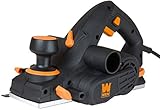
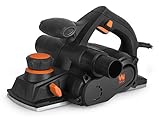
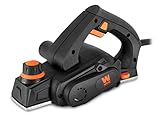

| Model | Width | Maximum cut depth | Approx. weight | Useful fitting feature |
|---|---|---|---|---|
| Makita KP0810 | 3-1/4 in. | 5/32 in. | 7.3 lb | Depth adjustment in 0.1 mm increments; dual chip outlets |
| Bosch PL2632K | 3-1/4 in. | 3/32 in. | 6.3 lb | Reversible chip direction; included edge guide and chamfer groove |
| DeWalt DCP580 | 3-1/4 in. | 5/64 in. | 6.7 lb, bare tool | Cordless operation; depth adjustment in 1/256-in. increments |
Weights are approximate and can differ with the measuring method and configuration. The DeWalt DCP580 is a 20V MAX cordless tool, so battery weight is additional. Its runtime depends on battery capacity, cut depth, wood, and how continuously the planer is used; there is no single meaningful runtime figure for every job.
Best for doors: Makita KP0810
The KP0810’s small depth increments make it easier to approach a marked fit gradually instead of taking one risky, deep pass. Its maximum 5/32-inch cut is useful for rough stock removal, but that is not a sensible target for final door fitting. Take light passes near the scribe line, check the reveal, and stop before the edge reaches the desired size. Dual chip outlets give more flexibility for directing shavings, although the dust bag or extractor connection still needs to match the work area.
Best for guided trim and chamfers: Bosch PL2632K
The Bosch is a practical choice when repeatable edge work matters more than maximum cut depth. Its included edge guide and chamfer groove help keep the tool aligned on a board or door edge. A guide improves consistency, but it cannot correct a twisted edge or a fence that is set out of square. Check the setup on scrap first, especially before chamfering visible trim. Its 3/32-inch maximum depth is ample for controlled fitting and ordinary cleanup.
Best cordless choice: DeWalt DCP580
The DCP580 is convenient when a cord would snag around a door, ladder, or installed trim. Its fine depth increments are helpful for shaving a sticking door in small stages. The trade-off is dependence on charged batteries and the added cost and weight of a battery system. Its 5/64-inch maximum cut is less suited to removing substantial stock quickly. For frequent shop work, a corded model avoids battery changes; for scattered installation tasks, cordless convenience may outweigh that limitation.
Choose by job, not just by maximum depth
| Your situation | Better fit | Why |
|---|---|---|
| Occasional door adjustment; tight budget | A corded 3-1/4-in. planer with a lockable depth knob and available edge guide | Typically costs less than adding a cordless tool and batteries; prioritize stable adjustment over extra power. |
| First planer; mostly trim and small corrections | Bosch PL2632K | Guide accessories help with alignment, and its more modest maximum cut encourages controlled work. |
| Regular door fitting and rough-board cleanup | Makita KP0810 | Fine adjustment and greater maximum cut capacity cover both careful trimming and heavier stock removal. |
| Work across rooms or at installation sites | DeWalt DCP580 | No cord to manage; a compatible battery platform can make it convenient for short, mobile jobs. |
| Small shop with limited dust control | A model with reversible or selectable chip ejection plus a well-fitted extractor | Shavings can be directed away from a wall or workpiece; extraction is more effective than relying on an open outlet. |
Prices change with sales, kit contents, and region. As a broad market guide, established corded 3-1/4-inch planers commonly fall around $100–$250, while cordless bare tools are often about $180–$300 before battery and charger costs. Treat these as general ranges, not fixed quotes.
Set up a planer for a clean door fit
-
Confirm the interference. Close the door slowly and mark the exact high spot. Check hinge screws, door alignment, and seasonal swelling before removing material; planing the wrong edge can hide a hinge or frame problem rather than solve it.
-
Remove the door and secure it. Support it on padded, stable work supports so the edge is accessible without rocking. Keep the planer’s base flat and make sure the work cannot shift during a pass.
-
Set a shallow cut. Begin around 1/64 to 1/32 inch for fitting. The tool’s maximum capacity is not a recommended starting depth. Make a test pass on scrap of similar material to confirm the depth setting and chip direction.
-
Plane with the grain where possible. Start with the front shoe flat, move steadily, and keep even pressure on the front and rear handles. Near the end of the edge, support the planer so it does not tip and dig into the corner. If grain direction changes or tear-out appears, reduce the cut and reassess the approach.
-
Check the fit between passes. Rehang or carefully test the door after a small amount of removal. Stop when it clears and the reveal is acceptable; excessive clearance is difficult to undo.
What matters in a head-to-head comparison
Depth adjustment and repeatability
Fine markings are useful only if the knob holds its setting and the sole remains stable. A planer’s indicated increment describes adjustment resolution, not a guarantee that every pass removes exactly that amount. Wood hardness, feed speed, blade condition, and pressure all affect the result. For fitting, use the scale to repeat settings, then verify the actual cut on scrap.
Chip ejection and cleanup
Planers produce bulky shavings that can clog an outlet, obscure a layout line, or collect around a motor intake. A reversible outlet helps direct debris away from the user, but check whether the model uses a bag, adapter, or extractor connection and whether that accessory is included. Clear jams only with the tool unplugged or its battery removed. Do not push fingers or tools into an outlet while the cutter is exposed.
Chamfer guides and edge control
A guide fence is useful for keeping a narrow edge straight, while a V-shaped groove in the front shoe can help create a small chamfer. Neither replaces a square setup: confirm the fence angle and its fasteners before cutting. For a visible trim edge, take a test pass on matching scrap and avoid leaning the tool, which can produce a bevel that widens along the length.
Ownership costs and wear points
Blades are the main consumable. They dull or chip sooner when they hit nails, grit, or hidden fasteners, and worn blades leave a rough surface even when the depth setting is unchanged. Many models use reversible carbide blades; confirm the replacement type and whether sharpening or replacement is intended before purchase. Keep a spare set available if downtime matters.
After use, unplug the tool or remove its battery, then brush shavings from the shoe, outlet, and accessible cutter area according to the manual. Avoid forcing packed chips through the outlet or storing the planer with debris against the blades. Check that the fence, depth control, and blade fasteners remain secure. A clean, sharp planer cuts more predictably and is less likely to tempt the operator into pressing harder to compensate for poor results.
Bottom line
Choose the Makita KP0810 for a versatile corded planer with fine adjustment and more stock-removal capacity, the Bosch PL2632K for guided edge and chamfer work, or the DeWalt DCP580 when cordless access is the deciding factor. For door fitting, the best choice is the one you can set accurately, support steadily, and use for light, check-as-you-go passes—not the model with the largest maximum cut.