
What's inside
As an Amazon Associate I earn from qualifying purchases. This post may contain affiliate links at no extra cost to you.
The best hand held band saw for most buyers is the Milwaukee M18 FUEL Deep Cut Band Saw for large stock, the Milwaukee M18 Compact Band Saw or DEWALT DCS371 for lighter one-handed work, and a corded 10-amp class saw when long cutting sessions matter more than mobility.
As an Amazon Associate we earn from qualifying purchases at no extra cost to you.
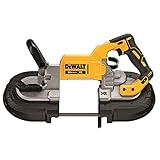


Handheld band saws compared at a glance
The table below focuses on the specifications that affect real buying decisions: maximum stock size, blade format, tool weight, and power source. Battery runtime is an estimate because material thickness, blade condition, pressure, and battery size change results substantially.
| Model | Power | Maximum capacity | Blade size | Approx. tool weight | Practical runtime or duty |
|---|---|---|---|---|---|
| Milwaukee M18 FUEL Deep Cut 2729-20 | 18V cordless | 5 x 5 inches | 44-7/8 x 1/2 x 0.020 inches | 13.7 lb bare | About 30–60 minutes of intermittent cutting with a 5.0Ah battery |
| Milwaukee M18 Compact 2429-20 | 18V cordless | 3-1/4 x 3-1/4 inches | 32-7/8 x 1/2 x 0.020 inches | 6.75 lb bare | About 20–40 minutes of intermittent cutting with a 5.0Ah battery |
| DEWALT DCS371B | 20V MAX cordless | 2-1/2 x 2-1/2 inches | 32-7/8 x 1/2 x 0.020 inches | 8.0 lb bare | About 25–45 minutes of intermittent cutting with a 5.0Ah battery |
| Makita XBP02Z | 18V cordless | 4-3/4 x 4-3/4 inches | 44-7/8 x 1/2 x 0.020 inches | 15.0 lb bare | About 30–60 minutes of intermittent cutting with a 5.0Ah battery |
| Bosch 6240N | 10-amp corded | 4-3/4 x 4-3/4 inches | 44-7/8 x 1/2 x 0.020 inches | 13.5 lb | Continuous duty while connected to power |
| WEN 94396 | 10-amp corded | 5 x 5 inches | 44-7/8 x 1/2 x 0.020 inches | 14.5 lb | Continuous duty while connected to power |
Weights are approximate bare-tool or listed-tool figures and can vary with accessories. Cordless kits cost more initially, but the battery platform may matter more than the saw itself if you already own compatible packs.
Best choices by cutting situation
Best for large pipe, angle iron, and resawing: Milwaukee M18 FUEL Deep Cut
The Milwaukee 2729-20 is the strongest all-around choice when a portable saw must handle large sections. Its 5 x 5-inch throat accepts substantial pipe, channel, angle stock, and lumber. The brushless motor, variable-speed trigger, LED light, and adjustable blade tracking make it better suited to repeated fabrication work than a small compact saw.
Its disadvantages are size and balance. At nearly 14 pounds before adding a battery, it is tiring to hold in midair for long cuts. For woodworking, it can make rough portable resaw cuts in boards that fit within its capacity, but it does not replace a benchtop or floor-standing bandsaw for accurate, repeatable curves. Use a guide, support the work, and expect to clean up the cut at a jointer, planer, or sander.
Best compact Milwaukee hand band saw: M18 Compact 2429-20
The Milwaukee M18 Compact is the most convenient Milwaukee hand held band saw for electrical, plumbing, and small-shop work. Its 3-1/4-inch capacity and roughly 6.75-pound bare weight make it easier to control with one hand than a deep-cut model. It is particularly useful for cutting conduit, threaded rod, small tubing, and thin bar stock where a reciprocating saw would leave a rougher, more vibration-prone cut.
Its smaller blade limits woodworking applications. It is suitable for narrow curve cutting and trimming stock, but the reduced throat cannot handle wide boards or large resaw work. Choose it when access and low fatigue matter more than maximum capacity.
Best lighter alternative: DEWALT DCS371B
The DEWALT DCS371B occupies a similar category but has a 2-1/2-inch cutting capacity. It is a sensible choice for buyers already invested in DEWALT 20V MAX batteries and for tasks involving conduit, cable tray components, small square tube, and metal brackets.
The smaller capacity is the key tradeoff. It is easier to maneuver than a deep-cut saw, but it cannot substitute for one when the work routinely exceeds 2-1/2 inches. As with the compact Milwaukee, buy it for controlled portability rather than maximum material removal.
Best for cordless deep-cut work with a Makita battery platform: Makita XBP02Z
The Makita XBP02Z offers a 4-3/4-inch capacity and accepts the same 44-7/8-inch blade class used by many full-size portable band saws. It is useful for larger stock and long fabrication sessions, particularly when a buyer already owns Makita 18V LXT batteries and chargers.
At about 15 pounds bare, it is not the best choice for prolonged overhead work. Its larger frame provides capacity, but portability does not mean light weight. Consider a hanging hook, auxiliary support, or a portable stand if the saw will be used repeatedly in one location.
Best for unlimited cutting time: Bosch 6240N or WEN 94396
A corded saw is the better value for a fixed workshop, production bench, or long cutting session near an outlet. The Bosch 6240N and WEN 94396 are both 10-amp class tools with approximately 4-3/4- to 5-inch capacity and 44-7/8-inch blades. They avoid battery charging, battery replacement costs, and the performance drop that occurs as a pack discharges.
The WEN typically sits in the lower general market price range, while the Bosch generally commands more. Exact prices vary, but corded portable band saws commonly range from about $150 to $350; cordless bare tools are often around $180 to $350, with complete kits costing more. A cord, however, limits work on a jobsite and can become a snag hazard.
How to match capacity and runtime to the job
- For resawing: choose at least a 4-3/4- or 5-inch throat, support the board on both sides, and use a coarse blade appropriate for the material. A handheld saw is best for rough breakdown cuts, not furniture-grade straightness.
- For curve cutting: prioritize a narrow, controllable frame and a blade suited to the curve radius. Compact models are easier to steer, but a jigsaw is usually more convenient for thin sheet goods and tight wood curves.
- For one-handed shop tasks: stay near the 7- to 8-pound bare-tool range if cuts are short and stock is small. The lighter Milwaukee and DEWALT models reduce wrist fatigue.
- For frequent large cuts: select a deep-cut model and keep a second battery charged. A corded tool may be cheaper over several years if the work is always indoors.
A useful runtime calculation is based on battery energy. An 18V, 5.0Ah battery stores approximately 90 watt-hours before losses. If a saw averages 500 watts while the motor is actively loaded, the theoretical cutting time is 90 ÷ 500 = 0.18 hour, or about 11 minutes of continuous loaded cutting. Because the blade is not under full load during setup, repositioning, and light passes, that same battery may support roughly 20–60 minutes of intermittent work. This explains why manufacturer runtime claims can differ sharply from workshop experience.
Blade choice matters more than motor power
Most saws in this comparison use a 1/2-inch-wide blade about 0.020 inches thick. Tooth pitch determines whether the cut is smooth and whether the blade survives. A fine-tooth blade suits thin-wall tubing and sheet material; a coarser blade clears chips more effectively in thick steel and wood.
Keep at least three teeth engaged in the material whenever possible. Too few teeth can catch and strip teeth, while too many teeth can clog and generate heat. For mixed metal stock, variable-pitch bi-metal blades are a practical general-purpose choice. For wood, use a blade designed for wood rather than assuming a metal-cutting blade will produce a clean result.
Ownership realities and common mistakes
The blade is normally the first consumable to wear. Dull teeth increase cutting force, heat, battery drain, and the risk of wandering. Replace a blade when it requires excessive pressure, produces discolored teeth, or begins binding despite correct tracking and tension.
- Brush chips from the wheels and blade guides after use; packed debris can alter tracking.
- Do not force the saw through stock. Let the blade establish the cut while maintaining steady, moderate pressure.
- Support long material so its weight does not twist the blade at the end of the cut.
- Check blade tension and tracking after installing a new blade.
- Disconnect corded tools and remove the battery before servicing or changing blades.
- Wear eye protection and keep hands clear of the blade path; never treat a one-handed design as permission to cut unsupported material.
Final buying recommendation
Choose the Milwaukee M18 FUEL Deep Cut when 5-inch capacity and cordless mobility are the priority. Choose the Milwaukee M18 Compact or DEWALT DCS371B for light, frequent one-handed cuts and easier handling. Choose the Makita XBP02Z if its larger capacity fits your Makita battery system. For a workshop that cuts continuously near an outlet, the Bosch 6240N or WEN 94396 delivers the most predictable duty cycle. The right hand held bandsaw is therefore determined less by peak speed than by the largest stock you cut, how long you hold the tool, and whether battery freedom is worth the added cost.