As an Amazon Associate I earn from qualifying purchases. This post may contain affiliate links at no extra cost to you.
A home fabrication project usually comes down to one question: how thick is the metal you cut most weeks, and what power and air can your garage actually supply? An inverter plasma cutter that is too small will leave ragged edges on plate and brackets, while one that is too large will demand a bigger compressor and a heavier circuit than a home shop can justify. The real decision is matching output, input voltage, and air supply to the work on your bench, not chasing the highest amperage on the box.
This guide is for home fabricators building metal furniture, brackets, gates, automotive parts, and garden structures in a garage or small workshop. It also suits first-time buyers who want a machine that starts cleanly on painted or rusty stock without a steep learning curve. The five cutters below were chosen from names and specifications on Amazon product pages, all inverter machines with dual voltage input and pilot arc starting.
Quick Picks
As an Amazon Associate we earn from qualifying purchases.
Product
Best for
Key spec
YESWELDER CUT-50DS
Simple first cutting with a clear display
50 amp output with large digital display
HITBOX HBC5500P
Deeper clean cuts on a 220 volt supply
55 amp output with 12 mm clean cut
LOTOS APEX LTP5600CD
Cutting without a separate compressor
56 amp output with built-in compressor
bestarc BTC500DP
Visible air feedback on a budget
50 amp output with built-in air sensor
YESWELDER CUT-65DS PLUS
Thicker plate and extra cutting modes
65 amp output with 4-in-1 modes
How to Choose
Match amperage to the metal you cut most
Amperage decides how thick a cutter can slice cleanly in one pass, so start from your usual material rather than the thickest piece you might ever meet. A 50 amp inverter cutter handles sheet metal, angle iron, and plate up to about half an inch with a clean edge, which covers most brackets, frames, and furniture parts. If you regularly cut plate thicker than that, or you cut long straight runs where edge quality matters, a 55 or 65 amp machine keeps its speed up and leaves less slag to grind off. Check the clean cut figure on the listing, not the maximum severance figure, because the clean cut is what your finished project will show.
Check your power supply and compressor first
Every inverter plasma cutter in this guide runs on dual voltage, but the output you get depends on the outlet you plug into. On a standard household outlet a 50 amp machine may only deliver around 30 to 35 amps, which is fine for sheet and light angle but slow on thicker plate. A 220 volt circuit unlocks full output. The air supply matters just as much: most ask for roughly 5 to 6 cubic feet per minute at 65 to 75 PSI, so a small pancake compressor will cycle constantly and starve the arc. Confirm your compressor can hold that flow before you order, and fit a moisture trap so wet air does not wear out consumables.
Pilot arc starting is worth having at home
A pilot arc lets the torch fire without touching the tip to the metal, which makes starting on rusty, painted, expanded, or perforated stock far more forgiving. Contact start machines force you to drag the tip across the surface, and that wears tips quickly and makes piercing awkward. Non-high frequency blow-back starting is the version to look for in a home shop, because it avoids the electrical interference that high frequency starts can cause with nearby electronics. All five cutters here use a pilot arc, so the choice is really about how much control the panel gives you over post-flow cooling and trigger modes.
Weight, torch length, and consumables decide daily use
A cutter that lives on a shelf and comes out for weekend projects should be light enough to carry one-handed and small enough to store beside a welder. The machines here range from the mid-teens to just over 22 pounds, so think about whether you will carry it to a driveway job or keep it bolted to a cart. Torch lead length matters too: a short lead keeps you close to the machine and the compressor hose, while a longer lead lets you walk around a gate frame or a trailer bed. Finally, check that replacement tips, electrodes, and shields are easy to find, because a cutter with scarce consumables becomes expensive to run.
The 5 Best Options
YESWELDER CUT-50DS
Top Pick
YESWELDER CUT-50DS
Best for: Buyers who want a simple 50 amp cutter with a large display and widely available consumables.
The CUT-50DS is YESWELDER’s straightforward 50 amp entry in this guide, built around a large digital display that keeps current settings visible while you work. It runs on 110/220V dual voltage through an IGBT inverter, cuts 1/2 inch cleanly, and uses a non-touch pilot arc that starts on rusty or painted metal without dragging the tip. The listing names it a plasma cutting machine for daily use, and the compact black and red body suits a garage bench or a portable setup. Replacement consumables are widely available for this popular model, which matters when you are learning and going through tips faster than an experienced fabricator.
Watch out for: Check the torch and ground cable lengths on the listing, since they decide how far you can work from the machine.
HITBOX HBC5500P
Runner-Up
HITBOX HBC5500P
Best for: Fabricators who want a 55 amp cut and a deeper clean cut on a 220 volt supply.
Output: 55 amps
Input voltage: 110/220V dual voltage
Clean cut: 12 mm at 220V; 8 mm at 110V
Maximum severance cut: 21 mm at 220V; 10 mm at 110V
The HITBOX HBC5500P is the 55 amp option for fabricators who want a deeper clean cut without stepping up to a 65 amp machine. Its manual lists a 12 mm clean cut and a 21 mm maximum severance cut on a 220 volt supply, falling to 8 mm and 10 mm on a household outlet. A high-frequency non-touch pilot arc starts on rough, painted, and rusty surfaces, and 2T and 4T modes cover short cuts and long runs. The AG60 torch uses widely available consumables, and the preinstalled air filter regulator makes first setup quick. At 19.74 pounds it is easy to carry to a driveway job.
Watch out for: The manual lists much thinner cuts on a household outlet, so a 220 volt circuit is worth having.
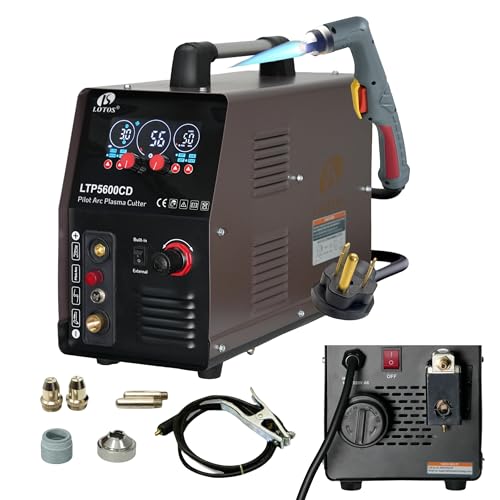
LOTOS APEX LTP5600CD
LOTOS APEX LTP5600CD
Best for: Home fabricators who want to cut without dragging out a separate compressor.
Output: 56 amps
Input voltage: 110/220V dual voltage
Clean cut: 5/8 inch with external air; about 1/2 inch with internal air
The LOTOS APEX LTP5600CD is the only cutter here with a built-in air compressor, so it cuts without a separate compressor. It delivers 56 amps on dual voltage, with a 5/8 inch clean cut and a 3/4 inch severance cut on external air, and about 1/2 inch on internal air alone. A non-touch pilot arc starts on painted and rusty metal, drag-cut support suits straight cuts along a guide, and the LED panel keeps settings visible. It is heavier than the others and hard on the circuit, so it suits a shop that values grab-and-go convenience over the lightest body.
Watch out for: The listing showed no featured offers in its last crawl, so confirm availability and the current listing before ordering.
bestarc BTC500DP
bestarc BTC500DP
Best for: Budget-conscious buyers who want a visible warning when air pressure drops.
The bestarc BTC500DP is a 50 amp pilot arc cutter built around feedback: a large LED display and built-in air sensor warn you when pressure is low before a bad cut ruins a workpiece. That matters where a small compressor can sag under load, because the sensor flags the problem early instead of a ragged edge revealing it. It cuts 1/2 inch cleanly and lists a 4/5 inch maximum cut, runs on 110/220V dual voltage, and offers 2T and 4T modes with post-flow control. Its tenth-generation version carries part number BTC500DP-10GEN-1122, and its compact body fits easily on a crowded workbench.
Watch out for: The model has been sold in several generations, so confirm the listing shows the tenth-generation version before ordering.
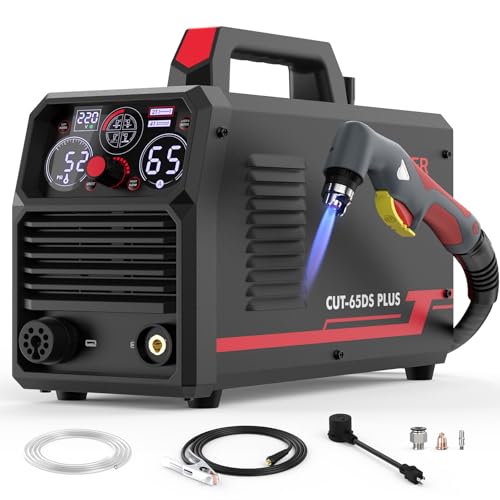
YESWELDER CUT-65DS PLUS
YESWELDER CUT-65DS PLUS
Best for: Serious home fabricators who cut thicker plate and want gouging and marking modes as well.
The CUT-65DS PLUS is the strongest cutter in this guide at 65 amps, and it adds four working modes the others lack: plate cutting, grid cutting, gouging, and marking. That range suits a home fabricator who cuts expanded metal, removes old welds, or marks layout lines as well as making straight cuts. The non-high frequency blow-back start and non-touch pilot arc keep starts clean on rough surfaces, while the digital display shows air pressure, voltage, and current with an error code system when something goes wrong. Overload and overheat protection plus an IP21 rating round out a machine built for heavier home shop sessions.
Watch out for: It is the heaviest machine here and needs a compressor that can sustain its higher air demand.
Which One Fits Your Situation
You are buying your first cutter for a small garage
Pick the YESWELDER CUT-50DS. Its large digital display makes settings easy to read while you learn, and 50 amps covers sheet metal, angle, and brackets without demanding a large compressor or a dedicated circuit. The non-touch pilot arc starts cleanly on painted or rusty stock without dragging the tip, and replacement consumables are widely available, which matters while you are still learning and going through tips quickly.
You cut plate and brackets most weekends
Pick the HITBOX HBC5500P. Its 12 mm clean cut at 220 volts is the deepest among the 50 and 55 amp machines here, so plate work stays fast and edges stay clean enough to weld without heavy grinding. The AG60 torch uses widely available consumables, and the preinstalled air filter regulator shortens setup. A 220 volt circuit is worth having to get the full cut depth, since the same machine only manages 8 mm cleanly on a household outlet.
You work with rusty, painted, or expanded metal
Pick the YESWELDER CUT-65DS PLUS. Its grid cutting mode is made for expanded and perforated stock, the pilot arc starts without touching dirty surfaces, and 65 amps keeps the cut moving where a smaller machine would stall. The digital display with error codes also helps you spot an air or power problem before it turns into a ruined piece.
You have no compressor yet
Pick the LOTOS APEX LTP5600CD. Its built-in compressor means you can start cutting with only a power outlet, no separate compressor to buy, store, or maintain. It still takes external air for its deepest 5/8 inch clean cut, so you can add a compressor later and keep the same machine. The drag-cut support and LED panel suit straight cuts along a guide, and the non-touch pilot arc handles painted and rusty stock.
Common Mistakes
Judging a cutter by its maximum severance cut instead of its clean cut, which is the thickness that actually leaves a usable edge.
Buying before checking the compressor, then discovering it cannot hold the flow and pressure the cutter needs.
Running a 50 amp machine on a household outlet and expecting full output, when that circuit only delivers a fraction of the rated amperage.
Feeding wet air into the torch, which wears consumables fast and degrades cut quality on every pass.
Ignoring consumable availability for the torch type, then finding tips and electrodes hard to source when the included set runs out.
Frequently Asked Questions
Do I need a separate air compressor for an inverter plasma cutter?
Four of the five cutters here need an external compressor, most asking 5 to 6 cubic feet a minute at 65 to 75 PSI, so check your compressor against the listing first. The LOTOS APEX LTP5600CD is the exception, with a built-in compressor for quick jobs, though it still takes external air for its deepest cuts. Fit a moisture trap, since dry air protects consumables and keeps edges cleaner.
Can I run an inverter plasma cutter on a standard household outlet?
Yes, all five machines here accept a standard household outlet through dual voltage input, but output drops on that circuit. A 50 amp cutter may only deliver around 30 to 35 amps at 110 volts, which suits sheet metal and light angle. For full output and thicker plate you need a 220 volt circuit, so match the outlet to the work you plan to do most.
What thickness can a 50-amp inverter cutter handle at home?
A 50 amp inverter cutter makes a clean cut up to about 1/2 inch on mild steel, and the HITBOX HBC5500P in this guide reaches 12 mm at 220 volts. Severance cuts run thicker, but those edges need heavy grinding before welding. If most of your work is thicker than half an inch, step up to a 55 or 65 amp machine instead of forcing a smaller cutter.
Is a pilot arc worth it for home fabrication?
Yes, a pilot arc is one of the most useful features for home work. It lets the torch fire without touching the tip to the metal, so starting on rusty, painted, or expanded stock is far easier and consumables last longer. Non-high frequency blow-back starting is the best version for a home shop, because it avoids interference with nearby electronics while keeping starts reliable.
J
JD's Woodworks Editorial Team
We compare specs, warranty terms, long-term owner feedback and street pricing before anything earns a spot. Rankings are never paid.
Affiliate disclosure. As an Amazon Associate we earn from qualifying purchases at no extra cost to you. Prices accurate as of the date shown.
Table saws under the 1500 mark compared: the Grizzly G0771Z and Shop Fox W1837 hybrid saws with cast iron tables, 2 HP motors and T-square fences, specs from their listings.
Table saws for fine woodworking compared: the SawStop Professional Cabinet Saw and Powermatic PM1000, judged on fence precision, table flatness and vibration from listing specs.
Table saw combos explained: saws sold with a stand and accessories in one listing, what to check in the box, and which bundle fits your shop or jobsite.
Compare the best planer digital thickness gauges and digital readout kits for portable planers, with fit, resolution and mounting checks before you buy.
Model table saws for scale modelling and hobby work compared: the precision Proxxon FET 37070 and the compact Saker mini table saw, with specs taken from their Amazon listings.
Three CoreXY 3D printers for product development, each with the architecture stated on its listing: an enclosed multicolor machine, a large-format enclosed model and a heated-chamber model.


 bestarc BTC500DP
 YESWELDER CUT-65DS PLUS









