
Key takeaways
- Compare the best machine vises for milling and CNC work, with jaw sizes, clamping force, accuracy ratings and mounting tips for benchtop and knee mills.
What's inside
As an Amazon Associate I earn from qualifying purchases. This post may contain affiliate links at no extra cost to you.
- Top Pick: Kurt DX4 CrossOver Vise
- Runner-up: Accusize Super-Lock Precision CNC Machine Vise
- Also consider: Tegara 440V CNC Precision Milling Vise
A machine vise is the workholding foundation of every milling setup. Unlike a bench vise, which is built for holding parts during filing, sawing, and assembly, a machine vise bolts directly to the mill table, presents precision-ground jaws parallel to the spindle, and clamps with a downward pull that keeps the workpiece seated flat instead of lifting it as the screw tightens.
The five vises below cover the main ways shops equip a mill: a premium American-made vise for repeat work, two mid-range precision vises for CNC and manual machines, a budget lock-down vise with a swivel base, and a cross-sliding vise for positioning work on a mill-drill. Each one is sized for benchtop and knee mills, and each is judged on jaw capacity, published accuracy, clamping design, and mounting.
As an Amazon Associate, we earn from qualifying purchases.
Table of Contents
- Quick Answer
- Kurt DX4 CrossOver Vise
- Accusize Super-Lock Precision CNC Machine Vise
- Tegara 440V CNC Precision Milling Vise
- Happybuy ACCU Lock Down Vise
- Grizzly G1064 Cross-Sliding Vise
- How to Choose
- Who Should Skip
- FAQ
- Final Verdict
- Product and ASIN Reference
Quick Answer
The Kurt DX4 CrossOver is the best machine vise for most milling and CNC work: its 4-inch jaws, ductile iron body, and pull-down clamping hold parts flat with 0.0005-inch repeatability. The Accusize Super-Lock is the strongest mid-range alternative, the Happybuy ACCU is the budget pick with a swivel base, and the Grizzly G1064 suits positioning work on a mill-drill.
Kurt DX4 CrossOver Vise

The DX4 is the premium pick in this roundup and the vise the others are measured against. Its CrossOver body is narrower than older Kurt designs, so the 4-inch vise fits the tables of smaller benchtop and knee mills without overhanging the edges, while the ductile iron casting keeps the mass needed to damp cutting vibration.
The clamping system uses a semi-spherical segment that pulls the movable jaw down as it closes, seating the workpiece against the vise bed instead of letting it ride up the fixed jaw. Kurt rates the design for repeatable clamping within half a thousandth of an inch, which is what makes the DX4 a practical choice for CNC work, fixture plates, and any job where parts swap in and out of the same setup all day.
Specs
- Jaw width: 4 in
- Jaw opening: 4.06 in
- Body material: ductile iron casting
- Clamping repeatability: 0.0005 in
- Weight: 28 lb
- Mounting: bolt-down base with locating keyway
Accusize Super-Lock Precision CNC Machine Vise
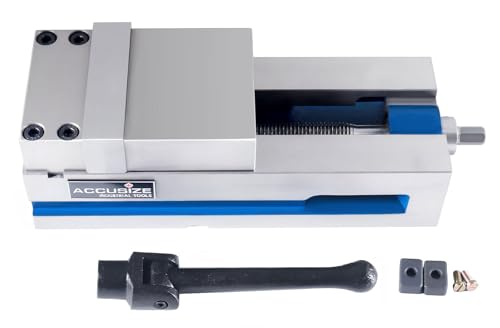
The Accusize FA23-5204 Super-Lock is the mid-range precision option, rated at 0.0002-inch accuracy in the listing specification. The Super-Lock mechanism places a semi-spherical segment behind the movable jaw so clamping force drives the jaw forward and down at the same time, which limits jaw lift and keeps thin parts flat on the bed.
A thrust bearing in the screw assembly reduces the handle effort needed to reach full clamping force, and the compact 11.811-inch overall length suits smaller mill tables where a full-size vise would crowd the travel. Jaw depth is 1.260 inches, so low-profile work sits close to the table. For shops running a benchtop CNC mill or doing careful manual work, this vise delivers near-premium numbers at a mid-range tier.
Specs
- Jaw width: 4 in
- Jaw opening: 3.937 in
- Jaw depth: 1.260 in
- Overall length: 11.811 in
- Rated accuracy: 0.0002 in
- Weight: 26 lb
- Screw design: thrust bearing with lock-down segment
Tegara 440V CNC Precision Milling Vise

The Tegara 440V (model 202-0991) is a ground-all-over precision vise built for CNC machining centers and manual mills. Its published clamping accuracy is 0.0004 inches, and the hardened, precision-ground jaw plates are replaceable, so a damaged plate does not end the vise’s service life.
Because the body surfaces are ground square and parallel, the 440V can be indicated in quickly and can also be mounted on its side for holding taller workpieces vertically, a flexibility fixed-orientation vises do not offer. It sits in the mid-range tier: more refined than the budget lock-down vises, with published accuracy figures that hold up for production work in small shops and for demanding hobby machining.
Specs
- Jaw width: 4 in
- Clamping accuracy: 0.0004 in
- Jaw plates: hardened steel, precision ground, replaceable
- Body: precision-ground on all mounting faces
- Mounting: bolt-down base, side mounting supported
- Model: 202-0991
Happybuy ACCU Lock Down Vise

The Happybuy ACCU 4-inch vise is the budget pick, built on the long-running QM-series lock-down design. The body is ductile iron rated at 80,000 PSI tensile strength, and the lock-down mechanism pulls the movable jaw downward as it tightens, the same anti-lift principle used by the premium vises in this roundup.
Published accuracy is 0.002 inches for parallelism and squareness, and maximum clamping force is 19 kN. A 360-degree swivel base is included, which helps when parts need to be angled on the table, though removing the base lowers the vise and adds rigidity for straight milling work. Like most vises in this tier, it ships in protective oil and should be cleaned and lightly oiled before the first setup.
Specs
- Jaw width: 4 in
- Jaw height: 1-1/4 in
- Maximum clamping force: 19 kN
- Body material: ductile iron, 80,000 PSI tensile strength
- Accuracy: 0.002 in parallelism and squareness
- Base: 360-degree swivel base included
Grizzly G1064 Cross-Sliding Vise

The Grizzly G1064 is the specialist in this group: a 4-inch vise mounted on a two-axis cross slide, so the clamped workpiece can be repositioned along both table axes with the slide handwheels instead of being unclamped and moved. That makes it useful on a mill-drill or drill press for hole patterns, slot alignment, and light positioning work.
The trade-off is rigidity. A cross slide stacks two dovetail slides under the jaws, so this vise is meant for drilling and light milling rather than heavy cuts, and it should not replace a lock-down vise for serious milling. Maximum jaw opening is 3-1/2 inches, and the unit weighs 22.2 pounds, light enough to move between machines in a small shop.
Specs
- Jaw width: 4 in
- Maximum jaw opening: 3-1/2 in
- Positioning: two-axis cross slide with graduated handwheels
- Overall size: 10.9 x 11.2 x 6.6 in
- Weight: 22.2 lb
- Best use: positioning for drilling and light milling
How to Choose
Start with jaw width and table fit. A 4-inch vise suits most benchtop mills and small knee mills; measure your table’s T-slot spacing and travel before ordering, because a vise that overhangs the table wastes travel and can foul the column at the extremes.
Next, look at the clamping design. Lock-down and pull-down mechanisms angle the movable jaw’s force downward, keeping parts seated on parallels; plain screw vises can lift work by a few thousandths, which ruins shallow facing cuts. Published accuracy figures tell the same story: precision CNC vises rate parallelism and repeatability in tenths of a thousandth, while budget lock-down vises rate around two thousandths, which is still fine for general machining.
Finally, decide on the base. A swivel base adds setup flexibility for angled work but costs height and a little rigidity; a fixed bolt-down base is the better default for milling. Cross-slide vises are positioning tools, so choose one only when repositioning under the spindle is the main job.
Who Should Skip
Skip this category entirely if your work is hand-tool woodworking at the bench: a front vise, face vise, or tail vise holds boards for planing and joinery far better than a machine vise, and the site’s bench vise guides cover those options. Also skip the cross-sliding model if you plan heavy milling cuts, since slide play will show up in the finish. And if your machine is a full-size machining center running 6-inch work, these 4-inch vises are undersized; step up to a 6-inch vise class instead.
FAQ
What size machine vise fits a benchtop mill?
Most benchtop mills pair well with a 4-inch vise. The jaw width should stay narrower than the table width, and the vise body should leave room for table travel in both directions. Check the T-slot spacing on your table against the vise’s mounting slots before ordering.
Can a machine vise be used on a drill press?
Yes, for drilling it works well and holds parts more rigidly than a typical drill press vise. The limitation is height: a machine vise is taller, which reduces the clearance between the drill chuck and the work on small presses. For dedicated drilling, a low-profile drill press vise or a cross-slide vise is often the better fit.
What is the difference between a machine vise and a bench vise?
A machine vise bolts to a machine table and is built around accuracy: ground jaws, a flat bed, and a clamping action that pulls work downward. A bench vise bolts to a workbench for holding parts during hand work such as filing and sawing, and its jaws are neither ground to the same tolerance nor designed to resist cutting forces from a spindle.
How do you mount a machine vise to a mill table?
The vise sits on the table and is fixed with T-nuts and studs or strap clamps through its base slots, aligned to the table’s X axis with a dial indicator swept along the fixed jaw. Many vises include a locating keyway on the underside; fitting keys that match your table slots speeds up repeat mounting.
Final Verdict
For a mill that earns its keep, the Kurt DX4 CrossOver is the vise to buy once: accurate, rigid, and sized for smaller tables. The Accusize Super-Lock and Tegara 440V deliver most of that precision in the mid-range tier, the Happybuy ACCU covers the budget end with a genuine lock-down design and swivel base, and the Grizzly G1064 fills the positioning niche on mill-drills. Match the vise to your table size and accuracy needs, and any of the five will hold work the way milling demands.
Related guides
More from Amazon
Programs that pair well with the guide above. Offers and eligibility are set by Amazon and may change.
A free business account with business pricing and bulk-buying tools for work, shop or home office.
Create a business accountFree shipping on eligible items, Prime Video and more. Eligible new members can start with a free trial.
Start a Prime free trialAudiobooks and podcasts to listen to on the go. Eligible new members can start with a free trial.
Try Audible freeAd-free music streaming. Eligible new subscribers can start with a free trial.
Try Music Unlimited freeAs an Amazon Associate we earn from qualifying purchases.


