
Our Top Picks
 POWERTEC 71395 Taper/Straight Line Jig for Table Saws32"40.55 x 8.66 x 2.36 inches8.82 poundsCheck on Amazon
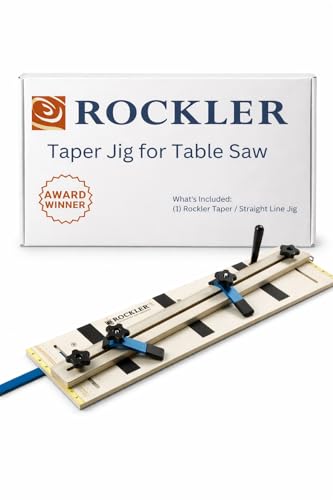 Rockler Taper Jig & Straight Line Wood Cutting31.6 x 7.75 inches7.87 x 36.22 x 1.18 Inches6.7 poundsCheck on Amazon
What's inside
As an Amazon Associate I earn from qualifying purchases. This post may contain affiliate links at no extra cost to you.
The real decision is not whether a jig can cut a taper. It is whether the jig can give one crooked board a true edge that every later cut can register against. Without that first straight edge, a rip fence has nothing honest to follow, so glue lines gap, wide panels refuse to sit flat, and each new pass copies the original bow. A jointing jig earns its bench space by clamping rough stock down, carrying it past the blade on a fixed path, and leaving an edge straight enough to build on.

This shortlist serves three kinds of buyers: saw owners who equipped a shop without a jointer, furniture makers who start from rough-sawn boards and need a reference edge before milling, and leg builders who want one jig that also cuts tapers. Both picks were chosen from the names and specifications on their Amazon product pages, and both are taper and straight-line jigs whose listings describe straightening board edges, not crosscut sleds or box joint jigs.
Quick Picks
As an Amazon Associate we earn from qualifying purchases.
| Product | Best for | Key spec from title |
|---|---|---|
| POWERTEC 71395 Taper/Straight Line Jig | Long boards and a complete hardware kit | Fits 3/4 inch wide by 3/8 inch deep miter slot |
| Rockler Taper/Straight Line Jig (21597) | Repeat tapers with indexed angle marks | Includes 36-inch miter bar |
How to Choose
Measure Your Miter Slot and the Distance to the Blade First
Every jig in this category hangs on two measurements, and guessing either one wastes a return. The first is the slot itself: both picks here run in a standard slot that is 3/4 inch wide and 3/8 inch deep, which covers most cabinet and contractor saws but excludes many compact and job site models with narrower or tabbed slots. The second is the distance from the inside edge of the right miter slot to the blade, because the jig base has to reach the cut line without hanging past it. POWERTEC prints three acceptable distance ranges in its listing, so measure with a tape before ordering and compare your number against the printed range, not against a photograph.
Judge the Clamping Before the Fence
Jointing fails when the board moves, not when the fence is a degree off. A crooked board wants to rock on its high spots, lift at the end of the cut, and creep sideways under blade pressure, so the hold-down system is the heart of the jig. Look for two clamps that press down near both ends of the stock, grip strips that stop lengthwise sliding, and a fence stop that keeps the trailing end from drifting. Both jigs here pair two hold-down clamps with abrasive grip strips and a push knob, which keeps hands on the jig body and away from the blade path while the board stays registered.
Match Base Length and Capacity to Your Stock
A 32 inch base sounds generous until a five foot board overhangs both ends and tips as it leaves the table. Base length decides how much of a board the jig supports through the cut, while the fence offset decides how wide a board can sit between the slot and the blade. With the miter bar fitted, width capacity is modest on both designs, which suits legs, rails and narrow boards. For a wide panel edge, the Rockler design removes its miter bar and runs against the rip fence instead, so width stops being the limit. Check your longest typical board against the base length, and your thickest stock against blade height, before choosing.
Indexing and Scales Decide How Repeatable the Jig Feels
Straightening one board forgives a loose setup; tapering four matching legs does not. Index marks that step in fixed increments let you set the same angle on Monday and find it again on Friday, while printed tape scales at both ends of the fence let you set a taper by start and finish width instead of by angle alone. The Rockler jig indexes its fence in one degree steps and adds two self-adhesive tape measures, and the POWERTEC kit includes the same style of tapes with a stop plate on the fence. If your work is mostly one-off edge straightening, either system is plenty; if you batch legs and rails, positive indexing saves real time.
The 2 Best Options
POWERTEC 71395 Taper/Straight Line Jig
The 71395 is the pick for buyers who want the jointing setup and the taper setup in one box, with the hardware count to prove it. Its 32 inch melamine-coated MDF base carries an adjustable fence with a stop plate, two hold-down clamps and grip strips, so a bowed board can be pinned flat and fed past the blade in one pass. The listing gives three slot-to-blade distance ranges instead of one, which widens the saws it fits, and the included tape measures let you set tapers by width. It suits furniture work where boards arrive rough and legs follow later.
Specs
- Brand: POWERTEC
- Model number: 71395
- Base: 32 x 7-7/8 inch MDF, 1/2 inch thick, melamine coating on both sides
- Miter bar: aluminum, 36 inch, for 3/4 inch wide by 3/8 inch deep miter slots
- Fence: adjustable, 32 inch long, with pre-assembled stop plate
- Hold-down clamps: 2, each 5-1/2 inch long
- Included: tapered knob, 4 star knobs, 2 self-adhesive tape measures, 3 abrasive grip strips, T-bolts and hardware
- Item weight: 8.82 pounds
- Overall dimensions: 40.55 x 8.66 x 2.36 inches
Best for: Furniture makers who joint rough boards and taper legs with one jig, and who want every clamp and scale included in the box.
Watch out for: Measure your slot-to-blade distance first, since the listing limits fit to three printed ranges, and confirm the listing shows stock before ordering, because availability on this page has been inconsistent in past crawls.
Rockler Taper/Straight Line Jig (21597)
Rockler’s jig is the older, simpler expression of the same idea, sold under item 21597 and built around a 36 inch miter bar and an indexed fence. Each index mark steps the fence one degree, so a taper you set for the first chair leg is still there for the fourth, and two hold-down clamps with grip strips keep rough stock from skating. Its party trick is range: pull the miter bar and the base runs against the rip fence as a straight-line ripping jig, which frees wide boards from the slot’s width limit. It suits methodical builders who set a jig once and repeat it.
Specs
- Brand: Rockler
- Item number: 21597
- Miter bar: 36 inch, adjustable fit with nylon set screws
- Fits: standard 3/4 inch wide by 3/8 inch deep miter slots
- Base: MDF with low-friction laminate surface
- Angle setting: indexing marks, one degree per mark
- Hold-down clamps: 2, with non-marring rubber caps
- Included: tapered knob handle, 2 tape measures, 3 abrasive grip strips
- Modes: taper cuts with miter bar fitted; straight-line ripping with miter bar removed
Best for: Builders who taper sets of legs and want an indexed setting they can return to, plus wide-board straightening with the bar removed.
Watch out for: It sells through the Rockler store on Amazon rather than from Amazon itself, so check the seller and stock on the listing, and expect to trim the base edge to your saw during setup.
Which One Fits Your Situation
You Never Bought a Jointer
Plenty of shops rip and crosscut for years before a jointer feels affordable, and rough boards punish that gap. Either jig here closes it for edge work: clamp the board, take a light pass, then run the new edge against the rip fence to parallel the other side. The POWERTEC kit is the easier start because every clamp, tape and strip is in the box, while the Rockler rewards anyone who also wants indexed tapers later.
Your Lumber Arrives Rough-Sawn or Live-Edge
Sawmill boards rarely offer one honest edge, and live-edge slabs offer none. The routine is the same for both: seat the board on the grip strips, clamp it so the worst bow hangs past the base edge, and trim only the high spots first. The Rockler’s bar-removed mode is the better tool here because it follows the rip fence, so a wide slab is not limited by how far the miter slot sits from the blade.
You Cut Legs and Rails in Matching Sets
Four legs cut on four different days still have to match, and freehand angle setting drifts. Indexed fence marks and tape scales turn the taper into a recorded setting instead of a fresh guess, so the second pair repeats the first. The Rockler’s one degree index steps are the tidier system for pure repeatability, while the POWERTEC’s stop plate and tapes suit builders who set tapers by start and finish width.
Your Shop Is Small and Every Tool Must Earn Its Wall Space
A dedicated jointer eats floor space a small shop may not have, while a flat jig hangs on a wall and comes down only when a board needs an edge. Both picks store flat, set up in minutes, and leave the saw free for normal ripping the rest of the day. Pick the POWERTEC if you want the fuller kit in one purchase, or the Rockler if the bar-removed ripping mode matches how you already work.
Common Mistakes
- Ordering before measuring the miter slot and the slot-to-blade distance, then blaming the jig when the base overhangs the blade or the bar binds in the slot.
- Expecting an edge jointing jig to flatten a twisted face; these jigs true one edge only, and face flattening still belongs to a jointer, a planer sled or hand planes.
- Clamping a board that rocks on its high spots instead of seating it flat first, which copies the rock straight into the cut edge.
- Taking the full bow off in one deep pass; light passes keep the board registered against the fence and leave a cleaner edge.
- Leaving the miter bar fitted for wide straight-line ripping on the Rockler, a mode its instructions run with the bar removed and the base guided by the rip fence.
Frequently Asked Questions
Can a table saw jointing jig replace a jointer?
For edges, mostly yes; for faces, no. A jointing jig gives a board one straight edge and, after a fence rip, a parallel second edge, which covers the edge work most furniture parts need. It cannot flatten a wide face or correct twist across a board’s width, so a shop that mills rough lumber still needs a planer and a flattening method for faces.
Will one of these jigs fit my table saw?
Both run in a standard miter slot that is 3/4 inch wide and 3/8 inch deep, which fits most cabinet and contractor saws. Fit also depends on how far that slot sits from the blade: the POWERTEC listing prints three acceptable distance ranges, and the Rockler manual gives its own working range. Measure both numbers on your saw and compare them with the listing before ordering.
How wide a board can I straighten with a jig like this?
With the miter bar fitted, width is set by the gap between the slot and the blade, and the POWERTEC listing puts the widest working position at about 6-7/8 inches from the blade. The Rockler design removes that ceiling: take the miter bar off, run the base against the rip fence, and the board’s width is limited by your saw’s rip capacity instead.
Do I still need a push stick with a clamping jig?
Yes, keep one within reach. The hold-down clamps and the tapered push knob keep your hands on the jig and off the workpiece, which is the safety gain, but the end of a long board still leaves the table unsupported and a push stick helps finish the pass without reaching over the blade. Support long stock at the outfeed side so the jig stays flat through the whole cut.
Related guides
More from Amazon
Programs that pair well with the guide above. Offers and eligibility are set by Amazon and may change.
A free business account with business pricing and bulk-buying tools for work, shop or home office.
Create a business accountFree shipping on eligible items, Prime Video and more. Eligible new members can start with a free trial.
Start a Prime free trialAudiobooks and podcasts to listen to on the go. Eligible new members can start with a free trial.
Try Audible freeAd-free music streaming. Eligible new subscribers can start with a free trial.
Try Music Unlimited freeAs an Amazon Associate we earn from qualifying purchases.









