
What's inside
As an Amazon Associate I earn from qualifying purchases. This post may contain affiliate links at no extra cost to you.
The best tabletop CNC mill for most small workshops is the Bantam Tools Desktop CNC Milling Machine if you need reliable aluminum work in a compact footprint; choose the Carbide 3D Nomad 3 for quieter, lighter-duty machining, or a Tormach 440 when rigidity and regular metal production matter more than bench space.
As an Amazon Associate we earn from qualifying purchases at no extra cost to you.
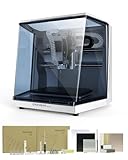

Quick comparison: tabletop CNC mills for 2026
These machines serve different definitions of “tabletop.” The Nomad 3 and Bantam Tools machine are genuinely compact desktop units. The Tormach 440 is better described as a benchtop or compact shop mill: it can sit on a heavy stand, but its mass and power demand planning. Published dimensions and capacities can vary slightly by configuration, enclosure, and accessories, so treat the figures below as buying benchmarks rather than installation drawings.
| Machine | Approx. work envelope | Approx. machine weight | Best materials | Typical noise and bench requirement |
|---|---|---|---|---|
| Carbide 3D Nomad 3 | 8 × 8 × 3 in | About 65 lb | Plastics, wood, wax, PCB materials, aluminum and brass in light cuts | Enclosed desktop machine; roughly 19 × 16 in of footprint, plus working clearance |
| Bantam Tools Desktop CNC Milling Machine | 7 × 9 × 3.3 in | About 150 lb | Aluminum, brass, plastics, wood, PCB materials | Enclosed; roughly 29 × 20 in of footprint, plus access and chip-management space |
| Pocket NC V2-50 | Approximately 4 × 4 × 4 in machining volume | About 80 lb | Small aluminum, brass, plastics, wax and advanced 5-axis work | Compact enclosed 5-axis machine; needs a very stable bench and additional clearance |
| Tormach 440 | 10 × 6.25 × 10 in travel | Roughly 600 lb, depending on configuration | Aluminum, brass, plastics and steel with conservative tooling and feeds | Much louder and more demanding; plan for a dedicated stand or reinforced floor area |
How the leading choices differ
Carbide 3D Nomad 3: the easiest small-workshop choice
The Nomad 3 is the most approachable option when your projects are small and your priority is a clean, relatively quiet installation. Its enclosure contains much of the dust and chips, and its footprint is close to that of a compact desktop printer. It is well suited to engraved plates, small molds, electronics fixtures, jewelry patterns, guitar hardware, model parts, and aluminum brackets.
Its limitation is rigidity. Aluminum is possible, but the machine rewards shallow passes, sharp tools, good workholding, and patience. It is not the right choice for removing large amounts of metal or making repeated steel parts. The 8-inch square work area sounds generous until a vise, fixture, and tool clearance are accounted for; useful production space is smaller.
Bantam Tools Desktop CNC Milling Machine: the stronger all-rounder
The Bantam Tools machine occupies substantially more bench space and weighs more than the Nomad 3, but that mass is useful. The stiffer structure, automatic tool-length probing, and workholding ecosystem make it a better fit for frequent aluminum milling and small precision parts. It also supports PCB milling and a broad range of plastics and wood-based materials.
It remains a desktop mill rather than a miniature industrial machining center. The work envelope is modest, and the spindle and frame are not intended for aggressive steel cutting. However, for a workshop making aluminum brackets, instrument parts, jigs, nameplates, or prototype components every week, it offers a more convincing balance of accessibility and metal-cutting ability.
Pocket NC V2-50: choose it for complexity, not volume
The Pocket NC V2-50 is unusual because it brings five-axis machining to a compact form. That capability is valuable for impellers, sculptural parts, angled features, and workpieces that would require multiple setups on a three-axis mill. Its small machining volume makes it a specialist rather than a general-purpose choice.
Five-axis capability also increases programming and workholding complexity. A beginner who mainly needs flat plates and pockets may produce parts faster on a simpler three-axis machine. Consider the Pocket NC when difficult geometry is the problem; do not buy it merely because five axes sounds more capable.
Tormach 440: the compact-production option
The Tormach 440 is the strongest choice here for users who routinely need rigidity, larger travel, better workholding, and a more conventional CNC-mill workflow. Its 10-inch X travel and 10-inch Z travel provide considerably more room than a typical desktop unit, and its mass helps control chatter.
The trade-off is everything around the cutting process: delivery, lifting, a rigid stand, coolant or chip-management decisions, electrical planning, and more noise. It can be a sensible first production mill for a serious workshop, but calling it a tabletop CNC mill can lead to an unsafe or impractical installation if the bench is not designed for several hundred pounds.
Decision matrix by workshop situation
| Your situation | Best fit | Why | What to accept |
|---|---|---|---|
| First CNC, limited experience, occasional projects | Nomad 3 | Enclosed, compact, and comparatively simple to operate | Light cuts and a small work envelope |
| Weekly aluminum parts on a sturdy bench | Bantam Tools Desktop CNC Milling Machine | More mass, useful probing, and a stronger metal-cutting focus | About 150 lb and a footprint near 29 × 20 in |
| Complex angled or sculpted parts | Pocket NC V2-50 | Five-axis motion reduces repeated setups | Small capacity and a steeper CAM learning curve |
| Frequent production, larger fixtures, or steel work | Tormach 440 | Greatest rigidity, travel, and conventional mill capability | Heavy installation, higher cost, noise, and chip control |
| Very limited bench space | Nomad 3 | Smallest practical footprint in this comparison | Leave room for the computer, tooling, dust collection, and access |
How much bench space do you really need?
Do not size the installation from the machine’s outline alone. As a practical calculation, a Bantam-style installation may require approximately 29 inches of machine width plus 6 inches for access on one side and 12 inches for chip trays, cables, or a small tool area behind it. That is about 47 inches of usable width before placing another machine beside it. A Nomad 3 may fit on a 24-inch-deep bench, but its enclosure door, computer, stock, and tools still need operating space.
Weight matters as much as area. A 150-pound mill concentrated on four feet can flex a lightweight utility table even when the tabletop appears large enough. Use a rigid bench, spread the load with a substantial top, and keep the machine level. For a Tormach 440, use a purpose-built stand or a floor-supported structure rather than an ordinary woodworking bench.
Metal-cutting reality: rigidity beats headline spindle speed
For aluminum, the useful question is not simply whether a listing says “cuts metal.” Ask how the machine handles deflection, vibration, chip evacuation, and workholding. A small rigid mill making a 0.02-inch-deep pass can outperform a larger but flexible router trying to take a deep cut.
- Use a sharp, short carbide end mill appropriate to the material.
- Keep tool stick-out as short as the setup allows.
- Clamp the work over the strongest part of the table or fixture.
- Use chip-clearing air or a suitable lubricant where the machine and enclosure permit it.
- Reduce radial and axial engagement when you hear chatter rather than simply increasing feed.
Steel is a dividing line. The Nomad 3 and Bantam Tools machine are best treated as light-metal machines; occasional experimental steel work is different from productive steel machining. The Tormach 440 is the appropriate direction when steel, repeatability, and larger tooling are central requirements, although feeds, tooling, and workholding still determine results.
Ownership costs and maintenance people often overlook
The purchase price is only part of the budget. General market pricing for compact desktop mills ranges from roughly the low thousands to several thousand dollars, while a configured Tormach-class machine can move into the higher five-figure territory after stand, tooling, workholding, and accessories. Reserve money for collets, end mills, a vise or fixture plate, measuring tools, stock, and replacement cutters.
The first consumables to wear are usually end mills, engraving cutters, spoilboards or sacrificial fixtures, and collets contaminated by chips. Aluminum chips packed into a collet can cause runout, which then breaks cutters and produces poor surface finish. After each session, vacuum or brush chips from the enclosure, wipe exposed ways or guide surfaces as specified by the manufacturer, inspect the tool holder, and verify that clamps have not loosened.
A common beginner mistake is treating zeroing as a one-time setup. Stock thickness, fixture height, tool length, and work offsets all affect the result. Before cutting valuable material, run an air cut, confirm the toolpath stays inside the work envelope, and check that the spindle can reach every feature without colliding with clamps.
Final recommendation
Buy the Nomad 3 when space, simplicity, and quieter enclosed operation matter most. Choose the Bantam Tools Desktop CNC Milling Machine when aluminum work is a regular part of your woodworking or maker workshop and you can support a heavier machine. Pick the Pocket NC V2-50 for specialized five-axis geometry. If you need production-like rigidity, larger travel, and serious metal capability, step beyond the true tabletop category to the Tormach 440 and plan the installation accordingly.