
Our Top Picks
 KATA 10 Inch Mini Hacksaw for Metal Cutting10 Inch (3 Blades)11.4 x 2.75 x 1.18 Inches0.3 PoundsCheck on Amazon




What's inside
As an Amazon Associate I earn from qualifying purchases. This post may contain affiliate links at no extra cost to you.
My whole shop is half of a one-car garage, and the car still parks in the other half most nights. That means every tool has to earn its footprint, and the table saw is the worst offender. It is the tool I use for almost every project and also the tool that eats the most floor. Finding a compact table saw for small spaces is less about picking the “best” saw and more about deciding which compromises you can live with for the next five years.
Here is the part the marketing photos skip: a small saw does not just mean a smaller table. It usually means a shorter fence, less mass to absorb vibration, a smaller motor that bogs in thick hardwood, and dust collection that ranges from mediocre to nonexistent. None of that is a dealbreaker. I have built cabinets, drawers, and a workbench on a saw I can pick up. But you should walk in knowing what you are trading away.
As an Amazon Associate we earn from qualifying purchases at no extra cost to you.




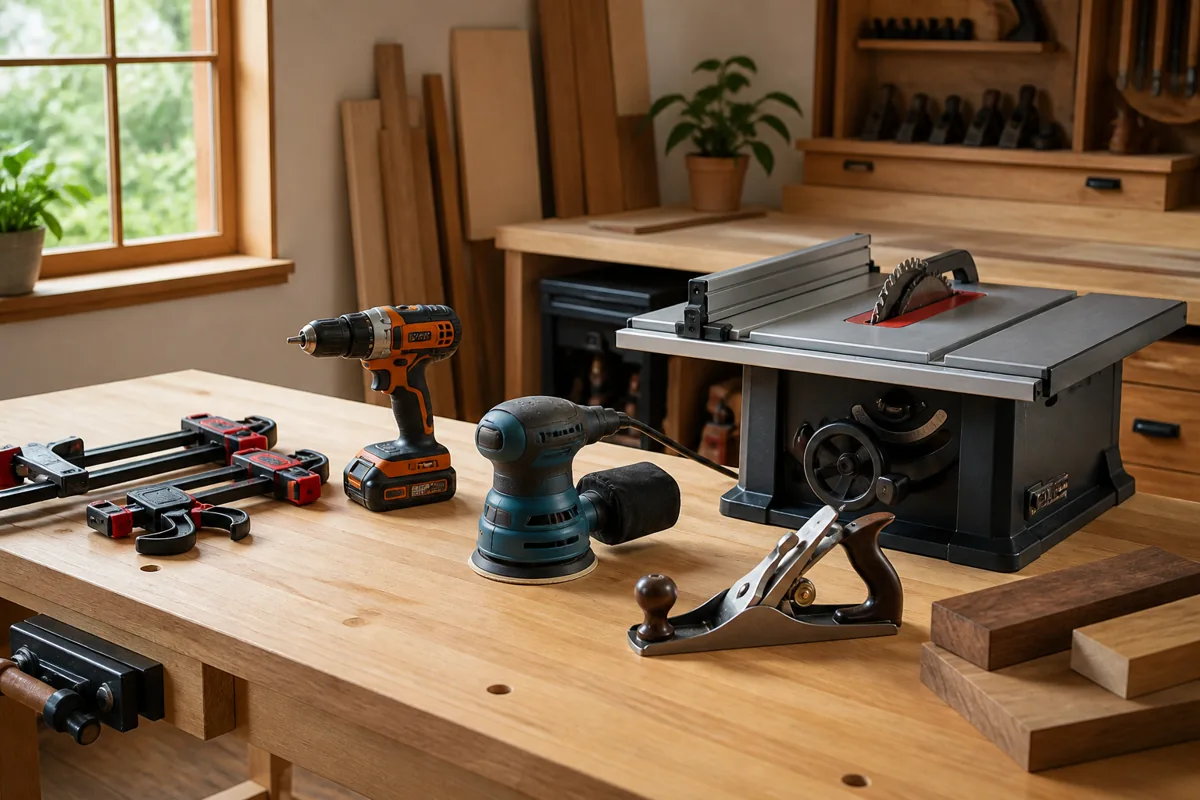
The three sizes of small saw, and who each one is for
Before you shop, get clear on which category you are actually in. The word “compact” gets stretched across three very different machines, and they behave differently in a cramped shop.
| Type | Typical footprint | What it does well | Where it hurts |
|---|---|---|---|
| Benchtop / jobsite saw | Sits on a bench or folding stand, stores against a wall | Cheapest entry, genuinely portable, decent rip capacity on newer models | Vibration, plastic-heavy build, limited dado support on some units |
| Compact contractor / hybrid | Rolling base, roughly a small dishwasher footprint | More mass, better fence, quieter cuts, real dust port | Needs a dedicated parking spot, heavier to move alone |
| Cordless jobsite saw | Same as benchtop, no cord | Cuts in a garage with one outlet, no extension cord across the floor | Battery cost, less power in thick stock, shorter run time |
If your saw has to come out of a closet and go back in, you are in the benchtop world and that is fine. If you can commit a two-by-two-foot square of floor permanently, a compact hybrid on a mobile base is a big step up in cut quality. I moved from the first category to the second and the biggest surprise was not power, it was how much less I had to fight the fence.
What actually matters on a compact table saw for small spaces
The fence, first and always. A saw with a mediocre motor and an excellent fence will produce better work than the reverse. Look for a fence that locks front and back, sits square to the table without shimming, and does not deflect when you lean on the outfeed end. If you can see the saw in a store, lock the fence and push sideways on it. Any movement you feel is movement your rip cuts will inherit.
Rip capacity to the right of the blade. This is the number that decides whether you can break down a sheet of plywood. Anything around 24 inches or better lets you rip a full sheet in half lengthwise-ish with a helper or a good outfeed setup. Under about 18 inches and you will be doing most sheet breakdown with a circular saw and a track or straightedge first. Honestly, in a small shop you should be doing that anyway. Wrestling a full sheet of three-quarter ply on a saw the size of a microwave is how people get hurt.
Blade height and bevel mechanics. Cheap saws often use a single crank that feels gritty and drifts under load. Check that the blade returns to a repeatable 90 degrees and that the bevel stop is adjustable, not molded plastic. You will set 90 degrees once, carefully, and then rely on it forever.
Dust control. Most benchtop saws blow fine dust out the bottom and into your lungs. A shrouded blade with a 2.5-inch port plus an overarm guard connection is worth real money in a garage where you also breathe. If the saw has no lower shroud, plan on building a plywood box under it and connecting a shop vac. I did exactly that and it cut my cleanup time roughly in half, which I will admit I only measured by how often I got yelled at for tracking dust into the house.
Compact jobsite table saw with rack-and-pinion fence
If you only have room for one saw and it has to move, this is the category to shop. Rack-and-pinion fences on modern jobsite saws are genuinely good, and the better ones give you enough rip capacity for real cabinet work. Filter for models with a soft-start motor, a riving knife, and a dust port you can actually attach a hose to, then buy the best fence you can afford.
The honest trade-offs of going small
I want to be straight about this because the review sites rarely are. A small saw makes some tasks harder and a few genuinely worse.
- ✔ Fits in a garage that still parks a car
- ✔ Cheap enough to leave room in the budget for good blades and a dado stack
- ✔ Light enough to carry to a job or a friend’s shop
- ✔ Cordless options let you cut where there is no convenient outlet
- ✔ Forces you into a track-saw-first workflow, which is safer for sheet goods anyway
- ✘ Short tables mean long boards need outfeed support you have to build
- ✘ Less mass equals more vibration and a slightly rougher cut face
- ✘ Thick hardwood rips will slow the motor, so you feed slower and take your time
- ✘ Aftermarket accessories like miter gauges and zero-clearance inserts are scarcer
- ✘ Some models do not accept a full dado stack, so check the arbor length before you buy
The vibration point is the one that surprised me most. On my first small saw, a clean rip in poplar looked fine and a rip in white oak came out with faint chatter marks I had to clean up with a hand plane. That is not the saw being defective. That is physics. Twenty-five pounds of plastic and aluminum cannot damp what two hundred pounds of cast iron damps.
Setting up a small saw so it punches above its size
Most of the performance gap between a compact saw and a big one closes with setup, not spending. Here is my order of operations after unboxing anything.
Align the blade to the miter slot. Use a dial indicator or a block clamped in the slot and a marked tooth. Rotate the blade, measure front and back. Get it as close to zero as the saw allows. Then align the fence parallel to the blade, or with a hair of relief at the back if the manual permits it.
Buy a good thin-kerf blade. A quality 40-tooth thin-kerf combination blade takes less power to push, which matters enormously on a small motor. This is the single cheapest upgrade with the biggest visible result. The blade that came in the box is a construction blade, not a woodworking blade.
Make a zero-clearance insert. Trace the stock insert on quarter-inch hardboard or ply, cut it, add leveling screws, and raise the blade through it. Tearout on the bottom face of plywood basically stops.
Build outfeed and a folding side table. A hinged plywood wing on a wall cleat, or a rolling stand you set at exactly table height, changes what the saw can do more than any spec on the box. My outfeed table is a piece of MDF on two sawhorses. It is ugly and it works.
Solve mobility once. Either a mobile base with real locking casters, or a French cleat so the saw hangs on the wall. Half-solutions mean the saw stays buried and you stop using it.
Rolling stand and mobile base for a small shop saw
The stand matters as much as the saw in a shared garage. Look for a base rated above your saw’s weight with locking casters that actually lift the wheels off the floor when engaged, not just brake them. A saw that rolls out in ten seconds gets used. One that needs two people and a cleared aisle does not.
Frequently asked questions
Can I really build furniture on a compact table saw? Yes, with a workflow adjustment. Break sheet goods down with a circular saw and a straightedge or track first, then use the table saw for final dimensioning of the smaller pieces. That is safer in a tight shop and produces straighter parts than trying to steer an eight-foot sheet across a small table.
Is a cordless jobsite saw worth it for a garage shop? If your garage has one outlet and a shop vac already fighting for it, cordless is genuinely appealing, and platforms like DeWalt XR, Milwaukee FUEL, and Makita LXT all have credible entries. If you already own batteries in one of those systems, the math gets much better. If you are starting from zero, a corded saw plus a decent extension cord gets you more capability per dollar.
Should I buy a used cast iron contractor saw instead? If you have the floor space and a way to move a heavy machine, a used contractor or hybrid saw is often the best value in woodworking, full stop. The catch is that many older ones lack a riving knife and modern guarding, and you need to be honest about whether it will end up as an expensive workbench that never gets tuned. In a shop where the car still parks, I would take the smaller modern saw with a riving knife.
What I would tell my past self
Buy for the fence and the dust port, not the horsepower number. Spend the leftover money on a good thin-kerf blade, a zero-clearance insert, and a mobile base. Accept that you will break down plywood with a circular saw and be glad you do. And measure your actual available floor space with tape on the ground before you order anything, because the spec sheet footprint never includes the room you need to stand and feed stock.
The saw that lives in your shop and gets used every weekend beats the perfect saw you cannot fit. That is the whole calculation.
Check prices on Amazon →