Our Top Picks
 Cen-Tec Systems 94709 Quick Click 16 Ft. Hose16 Ft. Hose18.35 x 15.79 x 7.64 inches100 KilogramsCheck on Amazon


What's inside
As an Amazon Associate I earn from qualifying purchases. This post may contain affiliate links at no extra cost to you.
For the longest time my “dust collection” was a shop vac and a broom, and my lungs and my car both paid for it. Fine dust is the hazard nobody warns beginners about loudly enough — it’s the invisible stuff that hangs in the air for hours. Here’s the setup that finally fixed my little garage shop without a ductwork budget.
Here’s the part nobody tells you: dust collection in a small garage shop is two jobs, not one. Job one is grabbing chips and dust at the tool before they get airborne. Job two is cleaning the fine particulate that escapes anyway, because some always does. A shop vac alone only does the first job, and only partly, which is why people buy a bigger vac and still find the garage smelling like sawdust the next morning. They didn’t buy the wrong vac — they solved half the problem.
As an Amazon Associate we earn from qualifying purchases at no extra cost to you.




Why the fine dust is the part that matters
The sawdust you sweep is the harmless fraction. It’s heavy, it falls, and it looks like progress. The fraction that matters is the part you never see land — the single-digit-micron range and smaller — because it stays suspended long after the saw stops and travels deep into your lungs instead of getting caught in your nose and throat. Sanding, routing, and cutting sheet goods like MDF and plywood are the heaviest producers, and those are exactly the jobs beginners do most.
That reframing changes what you buy. Judge a setup by how clean the floor looks and a broom wins. Judge it by what’s in the air at head height twenty minutes after you shut the sander off, and you need capture at the tool, filtration in the room, and something on your face to cover the gap. The four steps below are in the order I’d buy them again.
Step one: a cyclone separator on the vac
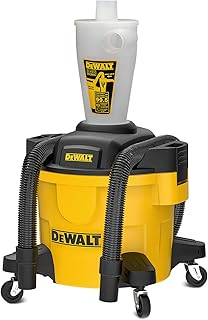
The biggest single upgrade for the least money. A cyclone separator sits between your tool and your shop vac and drops 95%+ of the debris into a bucket before it ever reaches the filter. Your vac stops clogging, suction stays strong, and you empty a bucket instead of wrestling a filthy filter.
Cyclone Dust Separator + Bucket
This changed my shop more than any single tool. The vac filter stays clean for months, suction never fades mid-cut, and cleanup is dumping a bucket. If you do one thing on this page, do this.
What separates a good separator from a bad one
- A bucket that won’t implode. Block the hose with an offcut and a thin-walled pail can collapse under vacuum. Look for a heavy-wall bucket, a reinforced or metal lid, or a purpose-built drum.
- A lid that genuinely seals. A gasket and real clamping pressure. Leaks cost you suction and let fine dust puff back out at floor level, which defeats the whole point.
- Ports that match your hose. Stepping down from a wide hose to a narrow inlet throttles airflow. Check the inlet and outlet sizes against the hose and adapters you already own before ordering.
- Cone size matched to the work. Small cones are fine for sanders and trim routers. If you’re feeding it planer shavings or a miter saw, a larger cone separates better and clogs less.
- Static control. Dry dust through plastic builds a charge. An anti-static hose or a grounding wire stops the nuisance shocks and keeps dust from clinging inside the cone.
- Stability. A cyclone on a bucket next to a vac is tall and tippy. A cart, a strap, or a shared base saves you from resetting it every session.
At the entry level you’re buying a bare cone and a lid, and you supply the bucket and hoses — the parts that fail are the lid seal and the bucket wall. Mid-range kits arrive with the bucket, a gasketed lid, decent fittings, and mounting hardware, which is where most garage shops should land. Spending up gets you a bigger cone, a clear or metal drum, casters, and a lid that survives years of being pried off. Nothing above the mid tier makes the dust cleaner; it just makes the thing more pleasant to live with.
Step two: a real shop vac with a fine filter
Pair the cyclone with a vac that takes a fine (HEPA-ish) cartridge filter. The cyclone handles the chips; the filter catches what’s left.
Ignore the peak horsepower number on the box — it’s a marketing figure, not a performance spec. What actually matters is sealed suction and airflow together, plus hose diameter, because a narrow, kinked, ten-foot ribbed hose will strangle a strong motor. A vac that pulls hard through a short, wide hose beats a bigger vac choked by fittings every time.
- A fine filter that’s actually available. Confirm a HEPA-rated or high-efficiency cartridge exists for your model, that it’s stocked, and that the price won’t make you postpone replacing it.
- Bag compatibility. A fleece collection bag behind the cyclone is cheap insurance for fine sanding dust and makes emptying a no-dust-cloud job.
- A tool-triggered outlet. Auto-start means the vac runs whenever the sander does, so you never skip capture because reaching the switch was annoying.
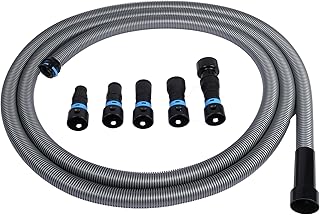
- Hose and adapter set. Anti-static hose, a length you can actually reach the far end of the bench with, and adapters that fit your tools’ ports rather than “close enough” with tape.
- Noise and footprint. Some vacs are shrill enough that you’ll want hearing protection for the vac alone. A tall, narrow tank on good casters beats a wide one in a one-car bay.
- ✔ Cheap, no ductwork needed
- ✔ Keeps fine dust out of the air
- ✔ Vac filter lasts far longer
- ✔ Empties in seconds
- ✘ Still need a mask for the finest dust
- ✘ Bucket takes up floor space
This combination suits anyone running handheld tools, a small table saw, a miter saw, or a benchtop sander in a shared garage. Who should skip it? If your machines are a jointer, a thickness planer, or a big drum sander, a vac is the wrong tool — those need high volume rather than high suction, and you’ll want a dedicated collector with a wide hose instead. The cyclone-and-vac setup still earns its place for everything else in that shop.
Step three: an air filter running while you work
The dust you can’t see is what settles in your lungs. A ceiling-hung or benchtop air filtration unit running during and after a session clears the fine particulate that a vac at the tool never catches. I flip mine on when I start and let it run an hour after I stop.
Size it by room volume, not by feel. The rule of thumb usually quoted is enough airflow to turn the whole room over several times an hour — six to eight passes is the common target — so multiply your floor area by ceiling height and shop for a unit rated to move that much air several times over. Undersizing is the most common mistake here, and running it on low all the time is better than running a monster on high for ten minutes.
Placement matters nearly as much as capacity. Hang or set it so the discharge pushes air along one wall and the intake sits toward the opposite end, which sets up a slow loop through the room instead of a dead spot in a corner. Look for a two-stage arrangement: a washable outer prefilter for the visible stuff and an inner pleated filter fine enough to matter. A remote or a built-in timer is what makes the after-session run actually happen. If money is the constraint, a box fan with a taped-on pleated furnace filter is a real stopgap — it’s louder, uglier, and less efficient, but it’s far better than nothing.
Step four: the mask you’ll actually wear
The best dust mask is the one that’s comfortable enough that you don’t take it off. Don’t cheap out here — it’s your lungs.
There are three tiers worth knowing. Disposable NIOSH-rated respirators are fine for short jobs, as long as they’re rated respirators and not nuisance dust masks with earloops. An elastomeric half mask with particulate cartridges is the sweet spot for anyone who sands for an hour at a stretch: it seals better, it lasts years, and you only replace filters. A powered air respirator or helmet is the answer if you have a beard, wear glasses that fog, or simply won’t tolerate a seal on your face for long sessions.
Fit beats rating. A P100 that leaks at the cheek does less than a well-fitted N95, so check the seal by covering the intake and inhaling — the mask should pull against your face. Store a half mask in a sealed bag so the cartridges aren’t loading with shop air between uses, and keep it on during cleanup, which is usually the dustiest part of the day. The mask is the last line of defense, not the first; it covers what the other three steps miss.
Mistakes that quietly undo all of it
- Sweeping and blowing off with compressed air. Both take settled dust and put it back in your breathing zone. Vac it, and let the air cleaner run.
- Leaky adapters. Duct tape and a wobbly step-down fitting turn good capture into mediocre capture. Get the right port adapter for each tool.
- Aiming the vac exhaust at the floor. It kicks up everything you just collected. Point it away from your work area.
- Leaving the door to the house open. Fine dust follows air currents straight into the living space. Close it, and don’t drag dusty clothes in either.
- Shutting everything off when the cut ends. The dust that matters is still airborne. Give the air cleaner its extra time.
- Letting a filter load up. Even behind a cyclone, filters eventually pack. Tap out the pleats regularly and replace on schedule instead of waiting for the suction to fade.
FAQ
Do I need a real dust collector instead of a shop vac?
Only if you run big machines. A vac is high suction and low volume, which is ideal for small ports on sanders, routers, and saws. A jointer, planer, or drum sander needs the opposite — lots of air through a wide duct — and no shop vac will keep up no matter how strong it feels in your hand.
Will the cyclone separator cost me suction?
You lose a small amount at the fitting, and you gain far more over the session because the filter isn’t loading up. A clean filter with a separator in line beats a caked filter without one within the first few minutes of sanding.
If my vac has a HEPA filter, do I still need the air cleaner?
Yes. Capture at the tool is never complete, especially with handheld sanders and routers where the shroud can’t surround the cut. Whatever the hose misses ends up in the room, and the only thing that removes it is filtering the room air.
Can’t I just open the garage door and run a fan?
It helps, and it’s free, but it depends on wind, weather, and the door being open in the first place. It also tends to push dust toward the house rather than out of it, and it does little for the air right in front of your face. Use it as a supplement, not the plan.
The honest bottom line
You don’t need a 3 HP cyclone and metal ducting to work safely in a garage. A separator, a decent vac, an air filter, and a good mask cost a fraction of that and cover the real hazard. Set it up before your next big sanding job — your future self will thank you.
Buy in that order if you’re spreading the cost out, with one exception: the respirator is cheap enough that there’s no reason to wait for it. Everything else is about making the safe habit easier than the lazy one, because the setup you’ll actually switch on is the only one that protects you.