What's inside
As an Amazon Associate I earn from qualifying purchases. This post may contain affiliate links at no extra cost to you.
Routing a dust-collection hose from the collector to a tool usually comes down to two choices: run it across the floor, or lift it overhead on a swinging boom. Floor routing costs less and is easier to install. An overhead boom costs more and takes more planning, but it can make a small shop safer and easier to use.
The right choice depends less on the hose itself than on traffic, tool placement, ceiling height, and how often you move equipment. A fixed table saw in a dedicated corner may need nothing more than a short floor run. A garage shop that changes layout every week benefits more from flexibility.
As an Amazon Associate we earn from qualifying purchases at no extra cost to you.


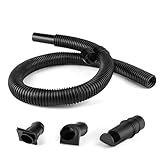
When floor routing makes sense
Floor routing is the practical default for many workshops. A 2-1/2-inch hose for a shop vacuum or a 4-inch hose for a dust collector can run along the wall, behind cabinets, or between stationary tools. If the hose stays out of walking paths, there is little reason to complicate the installation.
It is also the cheaper option. You may only need a length of 4-inch dust collection hose, a few clamps, and wall hooks or pipe straps. Keep the route as straight as possible. Every sharp bend adds resistance, and a crushed or kinked hose can reduce airflow enough to leave chips behind.
Use floor routing when the hose run is short, tools are mostly stationary, and the hose can stay beside a wall. It is often fine for a benchtop planer, router table, drum sander, or miter saw that lives in one position.
The main failure mode is a trip hazard. A hose across a doorway or in front of a workbench will eventually get stepped on, dragged over, or crushed by a mobile base. Even a low hose crossing can catch a foot when someone is carrying lumber. Protect unavoidable crossings with a proper cable or hose ramp rather than a scrap board.
What an overhead boom changes
An overhead boom lifts the hose above the floor and lets it swing toward the tool. A basic design uses a wall- or ceiling-mounted arm, a vertical drop, and a swivel or flexible section at the end. The boom can be made from steel pipe, electrical conduit, strut channel, or a purpose-built overhead dust collection boom.
The benefit is not simply a cleaner-looking shop. The hose no longer crosses the floor, so carts, mobile bases, and workpieces can move without snagging it. An overhead drop also keeps the connection visible, which makes it less likely that a tool will be used with the dust hose disconnected.
A boom is especially useful for a central workbench, assembly table, track saw station, or tools that move around the room. A 6- to 8-foot arm can cover a useful area, but do not assume a longer arm is automatically better. The hose gets heavier as it extends, and a long boom puts substantial leverage on its mounting point.
Mount the boom to framing, masonry, or a properly installed structural ceiling bracket. Drywall anchors alone are not adequate. A 4-inch hose full of chips can weigh more than expected, and the hose is often pulled sideways when a tool is moved. Add a mechanical stop or a short safety cable if the arm can swing into lights, doors, or shelving.
Overhead boom versus floor routing
| Factor | Floor routing | Overhead boom |
|---|---|---|
| Initial cost | Low; hose, clamps, and supports | Moderate to high; arm, mount, swivel, and drop |
| Installation | Simple and easy to change | Requires structural mounting and careful balancing |
| Trip hazard | Possible unless routed against a wall | Nearly eliminated in the working area |
| Tool mobility | Good only within hose length | Good within the boom’s swing radius |
| Airflow | Usually best with a short, straight run | Can suffer from long hose and tight bends |
| Best use | Fixed tools and wall-side layouts | Central stations and frequently moved tools |
Do not sacrifice airflow for convenience
Dust collection performance depends heavily on hose diameter and total length. A small shop vacuum can move air through a 2-1/2-inch hose, but it is not a substitute for a collector designed for a 4-inch duct. A 4-inch hose is commonly appropriate for planers, table saws, jointers, and other high-chip-volume tools when the collector can supply enough airflow.
Keep the hose run below about 15 to 20 feet where practical, and avoid unnecessary elbows. A boom with two tight 90-degree bends may perform worse than a straight floor route that is several feet longer. Use wide-radius bends, smooth interior fittings, and clamps that do not protrude into the airflow.
Do not reduce a 4-inch connection to 2-1/2 inches just because the smaller hose is easier to handle. That may be acceptable at a small tool port, but it becomes a restriction if used for the entire run. For a flexible connection at the tool, consider anti-static dust collection hose, particularly with a high-powered shop vacuum. It will not fix an undersized collector, but it can reduce static shocks and hose cling.
Practical boom details
Use a rigid upper section and keep the flexible hose mainly in the drop. A fully flexible arm tends to sag, twist, and pull on the tool port. Put a swivel near the mounting point or at the drop so the hose can rotate without coiling. A spring balancer is useful for a lightweight vacuum hose, but it is not a replacement for a solid structural mount.
Leave at least 7 feet of clearance over normal walking routes, and check the boom at its lowest point when the hose is pulled toward the tool. In a low-ceiling garage, an overhead boom may create a head-strike hazard even if the hose is technically above the work surface. Brightly mark low sections with tape or use a rigid arm that stays above eye level.
Provide strain relief at the tool connection. If the hose is pulled tight, the tool’s dust port or the boom fitting should not carry the load. A short tether, hose hanger, or secondary support can prevent a costly crack. Inspect the hose for flattening, worn spots, and loose clamps every few months.
Which setup should you buy?
Choose floor routing if the hose can run along a wall, the shop is used by one person, and you are trying to control costs. Spend the savings on a better separator, more effective tool hoods, or a collector filter. A cheap route that stays out of the way is better than an expensive boom that restricts airflow.
Choose an overhead boom when a hose regularly crosses a walkway, several tools share one collection point, or mobile equipment is central to your workflow. Start with one boom over the busiest station rather than trying to suspend every hose in the shop. That limits cost and gives you a chance to find problems with reach, balance, and airflow before expanding the system.