What's inside
As an Amazon Associate I earn from qualifying purchases. This post may contain affiliate links at no extra cost to you.
Sheet goods are awkward because they are large, heavy, and easily damaged. A full 4-by-8-foot plywood sheet needs a storage system that supports it without stealing the floor space needed for cutting and assembly. In a small shop, the best solution is usually vertical storage: sheets stand on edge in a narrow rack, close to the wall and preferably near the shop entrance.
Vertical storage is not simply a matter of leaning plywood against a wall. An unsupported stack can slide, bow, damage corners, or fall onto someone. The rack needs a stable base, a backstop, and enough separation to retrieve one sheet without unloading the entire stack.
As an Amazon Associate we earn from qualifying purchases at no extra cost to you.
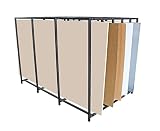
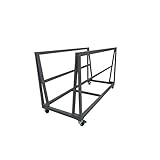

Choosing the Right Vertical Layout
There are three practical layouts. A simple wall-leaning rack holds sheets at a shallow angle. A floor bin holds them nearly vertical between dividers. A dedicated sheet-goods cart adds casters so the material can move around the shop.
| Storage type | Typical footprint | Best use | Main drawback |
|---|---|---|---|
| Wall-leaning rack | 12 to 18 inches deep | Small shops with a permanent storage wall | Sheets are harder to separate and may slide |
| Divided floor bin | 18 to 24 inches deep | Organizing plywood, MDF, and offcuts by type | Uses more floor space |
| Rolling sheet-goods cart | 20 to 30 inches deep | Shops that need to move stock to a saw or workbench | Costs more and must be parked securely |
For most small shops, a fixed rack is the best value if sheets enter through one door and are cut in one area. A cart earns its space when the shop layout changes frequently or when a single person needs to move several sheets without carrying them.
How Deep and Tall Should the Rack Be?
Design the rack around the largest sheet you will store, not the smallest one. Standard plywood is 48 inches wide and 96 inches long. A vertical rack should have a backstop at least 50 inches high and 10 to 20 inches of bottom depth. The extra width prevents a sheet from slipping past the support when it is pulled out at an angle.
The bottom support should be strong enough to carry the entire stack. A group of twenty 3/4-inch plywood sheets can weigh roughly 700 to 900 pounds, depending on the wood species and moisture. You may never store that much, but the rack should not rely on a single narrow strip of plywood.
Use a solid base made from 2-by-4 lumber, structural plywood, or steel angle. A 2-by-4 laid flat gives only 1-1/2 inches of bearing width, so add a plywood deck or several cross supports. Round or sand the front edge. Sharp corners crush plywood edges as sheets are dragged in.
For a ready-made solution, compare vertical sheet goods storage racks. A budget rack is fine for a few lightweight sheets, but check its rated load and whether it is intended to be anchored. Many inexpensive stands are designed for temporary staging, not a full inventory of MDF.
Dividers and Material Sorting
Dividers make a rack much more useful. Separate plywood, MDF, melamine, drywall, and reusable offcuts so you do not have to move a heavy stack to reach one sheet. Dividers spaced 12 to 16 inches apart work well for full sheets. Use narrower compartments for thin panels and wider ones for large offcuts.
Do not make the dividers so tall that they block your grip. A divider 8 to 12 inches high is usually enough to keep sheets in their lanes while leaving room to pull from the top edge. Line contact points with thin rubber, carpet, or scrap hardwood. Bare steel can mark melamine and dent soft plywood.
Store sheets with the best face protected from contact with the floor and neighboring material. MDF should remain dry and should not sit directly on concrete. Concrete can transmit moisture, and a swollen MDF edge may prevent the sheet from sliding out later. A rack in a damp garage needs more attention than one in a heated, dry shop.
Anchoring and Tip-Over Safety
Anchoring is the most important detail. A loaded vertical rack has a high center of gravity, and pulling one sheet forward can shift the rest. Fasten a fixed rack to wall studs with structural screws, not drywall anchors. If the wall is masonry, use anchors rated for the rack’s expected load.
Keep the rack tilted slightly toward the wall, typically 5 to 10 degrees. The bottom must remain fully supported, and the backstop should be continuous or have several strong contact points. Avoid a rack that depends on a narrow strap across the top; the strap may stop a tip-over but can make individual sheets difficult to remove.
Leave at least 36 inches of clear aisle space in front of the rack when possible. Do not put it beside a table saw outfeed path, electrical panel, or main doorway. A falling sheet can block an exit, and a sheet pulled across a walkway creates a trip hazard.
Building a Simple DIY Rack
A straightforward rack can be built from two vertical 2-by-4 posts, a plywood back panel, and a reinforced bottom shelf. Fasten the posts to studs, attach the back panel, and add a bottom rail projecting 12 to 18 inches from the wall. Install dividers on the bottom rail with screws from underneath.
Use exterior-rated or painted material if the shop is unheated or humid. Predrill near plywood edges to prevent splitting. Check that the floor is level; a small wedge under one end is better than a rack that rocks. After loading it, push the stack firmly toward the backstop and test the rack before adding more sheets.
If you prefer a movable setup, look at rolling plywood storage carts. Choose locking casters rated for the combined cart and sheet weight. Four small casters may roll poorly on sawdust or an uneven concrete floor; larger, locking polyurethane casters are more reliable.
Protecting Sheets and Shop Air
Store sheets flat only when they are fully supported. A few sawhorses will let plywood sag and develop a permanent curve. Vertical storage reduces that problem, but thin panels can still bow if they lean against a single point. Add a broad back panel or several horizontal rails.
Keep storage away from dust-collection exhaust, roof leaks, and heating appliances. Dust on a rack is not just a housekeeping issue: MDF dust can settle into sheet edges and contaminate glue joints. Vacuum the rack occasionally, and do not use compressed air to blow dust around the shop. A shop vacuum with a brush attachment is safer and keeps fine dust out of the air.
For a small collection, a properly anchored DIY rack is usually cheaper and stronger than a store-bought unit. Buy a commercial plywood storage divider system when you need adjustable compartments, quick assembly, or a rack that can be relocated. Whichever approach you choose, prioritize a strong base, wall anchoring, dry storage, and a clear aisle over decorative features.