What's inside
As an Amazon Associate I earn from qualifying purchases. This post may contain affiliate links at no extra cost to you.
Stationary tools are only stationary until you need to clean behind them, change a layout, or make room for a large project. A mobile base can solve that problem, but a poor one creates new problems: a saw that rolls during a cut, a planer that tips when pushed over a threshold, or a dust hose that pulls a machine out of alignment. The best base matches the tool’s weight, footprint, center of gravity, and the floor it will cross.
As an Amazon Associate we earn from qualifying purchases at no extra cost to you.


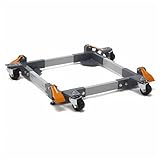

Choose the Right Base for the Tool
There are three common approaches: a factory mobile base, a universal adjustable base, and a shop-built platform with casters. Factory bases usually fit well and preserve the manufacturer’s intended working height, but they can be expensive and may only fit one tool. Universal bases are more flexible, especially for table saws, bandsaws, and drill presses. A homemade platform costs less and can be stronger than either option, but it takes careful measuring.
Before buying, weigh the tool and add the weight of accessories, a dust hose, and anything normally stored on it. A machine that weighs 300 pounds should not sit on a base rated for 300 pounds. A practical target is a rated capacity at least 25 percent higher than the loaded tool weight; 50 percent is better for machines that cross thresholds or get pushed over uneven concrete.
For a straightforward starting point, compare universal mobile bases for woodworking tools by capacity, minimum and maximum footprint, wheel size, and lifting mechanism—not just price.
Mobile Base Types Compared
| Base type | Best use | Strengths | Common failure |
|---|---|---|---|
| Factory-fit base | One specific machine | Good fit, simple installation, correct height | High cost or limited compatibility |
| Universal adjustable base | Several medium and large tools | Flexible footprint and good load capacity | Frame loosens or tool shifts if poorly assembled |
| Shop-built platform | Odd-shaped tools or tight budgets | Cheap, customizable, easy to repair | Weak casters, poor bracing, excessive added height |
| Lift-and-roll base | Tools that must stand solidly while operating | Wheels retract completely during use | More parts to adjust and maintain |
Casters, Load, and Floor Conditions
Wheel diameter matters more than many buyers expect. Two-inch casters may roll acceptably on smooth epoxy, but they catch on sawdust, expansion joints, and small thresholds. Three-inch wheels are a better minimum for most workshops; four-inch wheels are preferable for heavy tools or rough concrete. Larger wheels raise the tool slightly, so check the final working height before committing.
Swivel casters make a base easy to turn, but four swivels can make a tall tool wander sideways. A fixed-wheel and swivel-wheel arrangement tracks better, while four swivels offer the smallest turning circle. Locking casters are convenient, but their brakes often stop wheel rotation without preventing the caster from swiveling. That is not enough for a tall drill press or bandsaw.
For a solid operating position, use a base with retractable wheels or leveling feet. The feet should lift the casters clear of the floor, not merely press against it while the wheels remain loaded. If the machine rocks when you push on its upper frame, the base is not stable enough for cutting or drilling.
Check Fit and Working Height
Measure the tool’s actual feet, not just the outside cabinet dimensions. Look for protruding bolts, dust ports, motor housings, and doors that must still open. Adjustable rails should overlap enough to resist twisting; a rail held by one short bolt at each corner is a weak arrangement, especially under a top-heavy tool.
Added height is a serious issue. Raising a table saw changes the relationship between the saw table and outfeed support. Raising a drill press can make the quill harder to control. Raising a planer reduces the available height below a dust hood or ceiling. Before installation, measure the original working height and keep the new base as low as possible.
When a shop-built base makes sense, use a rigid plywood platform or a braced frame rather than a loose sheet with casters screwed near its edges. Through-bolt the casters with washers, and add corner blocking below the mounting points. A base that flexes can let a machine shift several millimeters under load.
Installation and Safety Details
Install the base on a level floor and keep the machine centered over the wheel footprint. Tighten fasteners evenly, then push the tool from several directions. Check again after the first few uses; vibration can loosen adjustable rails. Threadlocker can help on metal-to-metal fasteners, but it is not a substitute for proper locknuts or crushed tubing.
Keep the power cord and dust hose from becoming a towing strap. Leave enough slack for movement, but secure the hose high enough that it cannot catch a caster. A hose snag can pull a machine sideways or disconnect at the dust port. Add a wall-mounted cord reel or overhead drop when the tool is moved frequently.
Do not move a tool while its blade, cutter, or bit is spinning. Unplug it before repositioning, lower adjustable tables, close doors, and remove loose accessories. For tall machines, push near the center of the frame instead of the top. If the route includes a ramp or threshold, get help; a 250-pound tool on casters can accelerate quickly.
Where to Spend and Where to Save
Spend more on the base for a table saw, planer, jointer, or bandsaw—machines that create substantial cutting forces or have a high center of gravity. A proper heavy-duty mobile base for a table saw or planer is usually cheaper than repairing a tipped machine or damaged floor.
The cheaper option is fine for a low, compact tool such as a benchtop grinder, small sander, or compact dust extractor. A plywood platform with four quality locking casters can work well when the load is modest and the machine is not used while rolling. Avoid bargain casters with thin plates, loose bearings, or brakes that are difficult to engage.
For dust collectors, mobility is especially useful because the unit often needs to serve more than one tool. Choose dust collector mobile base casters that match the collector’s weight and leave the filter and intake accessible. Keep the collector low and stable; a tall collector on a narrow base is more likely to tip when the hose is pulled.
The right mobile base should make relocation predictable, not merely possible. Prioritize stability while operating, adequate wheel size, a conservative load rating, and a setup that does not compromise tool height or dust collection. Mobility is useful only when the machine returns to a repeatable, safe position every time.