What's inside
As an Amazon Associate I earn from qualifying purchases. This post may contain affiliate links at no extra cost to you.
Why Routing Dust Is Difficult to Capture
Routing produces two different dust problems. A handheld router throws chips from the bit at high speed, often before a hose can catch them. A router table contains the bit below the workpiece, but the cutter can still eject dust through the opening, fence, and underside of the table. Fine dust also stays airborne longer than the heavier chips you can see.
The best setup captures dust at the source rather than trying to clean the whole shop afterward. That means using the router’s dust port, fitting the table and fence with their own ports, and keeping the hose short and smooth. A powerful collector connected to a badly designed hose can perform worse than a smaller machine with a direct connection.
As an Amazon Associate we earn from qualifying purchases at no extra cost to you.



Choose the Right Collector
A shop vacuum is usually the practical choice for a handheld router. It creates relatively high static pressure, which helps when pulling through a narrow 1-1/4- or 2-1/2-inch hose and a small router port. Choose a unit with a sealed connection, a fine-dust filter, and an automatic tool-start outlet if you want the vacuum to switch on with the router.
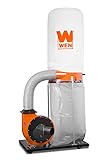
A dust collector with a 4-inch hose moves more air and is better for a router table, especially when the cabinet and fence are both connected. It is less convenient for a handheld router unless you use a reducer, because many collectors do not maintain useful suction through long sections of small hose.
Published CFM figures are not directly comparable. Some manufacturers list free-air CFM, while others measure airflow under restriction. Static pressure matters just as much. As a rough target, a router connection should have about 100 to 150 CFM at the tool, while a 4-inch table connection benefits from roughly 350 to 500 CFM at the pickup point. These are practical targets, not guarantees; a blocked filter or leaky separator can cut actual airflow sharply.
| Routing setup | Best collector | Typical hose | Main trade-off |
|---|---|---|---|
| Occasional handheld routing | Shop vacuum with fine-dust filter | 1-1/4 to 2-1/2 inches | Simple and inexpensive, but louder and limited on large tables |
| Frequent handheld routing | Shop vacuum with cyclone separator | 2-1/2 inches | Better filter life, with extra fittings and floor space |
| Router table in a small shop | Single-stage or compact dust collector | 4 inches | More airflow, but needs duct space and costs more |
| Router table plus other machines | Central collector with blast gates | 4 to 6 inches | Most capable, but installation and leakage matter more |
Build the Pickup Around the Router
For handheld work, fit the largest dust hood that does not interfere with the bit, base, or workpiece. A small port is common, so use a short reducer rather than running a long small hose across the floor. Every sharp bend costs airflow. Use a broad-radius elbow or let the hose curve naturally.
On a router table, use two collection points when possible: one below the bit and one on the fence. The lower port catches dust falling into the cabinet, while the fence port catches material thrown toward the operator. If you can connect only one, start with the fence port for face-frame and edge-routing work, or the lower port when the cabinet is well sealed and most work is routed from above.
A closed router-table cabinet generally improves suction, but it needs an intentional air inlet. Seal large gaps around doors and corners, then add a small filtered vent or controlled opening. If the cabinet is completely sealed, the collector may pull little air. If it is full of open gaps, suction leaks away from the cutter.
For a buying shortcut, compare fine-dust shop vacuums with automatic tool start for handheld routing, and consider a router-table dust collection fence if your existing table has no fence port. The cheaper option is fine for occasional edge profiles; a dedicated fence is worthwhile when you rout regularly or work with MDF.
Control Hose and Duct Losses
Keep the hose under 10 feet where possible. A 20-foot hose may be convenient, but it adds friction, bends, and places to clog. Avoid corrugated flex hose when a smooth-walled section will work. Flex hose is useful at the machine because it moves, but fixed runs should use smooth pipe or duct with gradual bends.
Use blast gates to close unused branches. An open branch can rob airflow from the router, particularly with a modest collector. Mount the gate where you can reach it without walking around the machine. Check reducers for internal lips that catch chips; a step-down should be smooth and gradual.
Do not reduce a 4-inch line to 1-1/4 inches far from the tool and expect the same performance. The restriction belongs as close to the router port as possible. If the collector has a filter-cleaning mechanism, use it before airflow drops. A dusty filter often looks like a collector failure when it is simply overloaded.
Separate Chips and Protect Filters
A cyclone separator ahead of a shop vacuum catches most chips before they reach the filter. This is especially useful when routing plywood, MDF, or large batches of edge profiles. A separator does not replace a fine filter: the remaining airborne dust still needs to be captured and safely exhausted.
For occasional routing in solid wood, a separator is optional. Emptying the vacuum more often is cheaper and may provide equal performance. For frequent work, the separator usually pays for itself in cleaner filters, steadier suction, and fewer interruptions. Choose a container that will not collapse under suction; thin plastic bins can deform and leak.
Use Respiratory and Shop Controls
Collection is not a substitute for personal protection. Wear a properly fitted N95 or better respirator during routing, especially with MDF, plywood, or unknown finishes. Keep the router running until the bit stops cutting, then leave the collector on for another 15 to 30 seconds to clear the hose and cabinet.
Never blow settled dust around the shop with compressed air. Use a HEPA-rated shop vacuum for floors and benches, or use a damp cleaning method compatible with the surface. Inspect hoses for splits, make sure the filter is seated, and test airflow at the pickup before starting a long routing session.
Keep cords and hoses behind the operator’s working path, use adequate lighting at the bit and fence, and stop immediately if the hose blocks the workpiece or pulls the router off line. Good dust collection should make routing cleaner without making the cut less controlled.