What's inside
As an Amazon Associate I earn from qualifying purchases. This post may contain affiliate links at no extra cost to you.
Choosing a Dust Collector for an Eight-Foot Ceiling
An eight-foot ceiling does not prevent you from building a good dust collection system, but it limits where the collector can go. A ceiling-mounted unit may technically fit, yet it can interfere with garage doors, lighting, lumber storage, and safe access to filters. In most compact workshops, a floor-standing collector or a shop vacuum with a cyclone separator is easier to install and maintain.
Start with the tools you actually use. A table saw, planer, jointer, and router table need more air movement than a random-orbit sander or miter saw. A collector rated for a large duct system will not automatically perform well through a small hose, and a powerful vacuum cannot compensate for a badly designed duct run.
As an Amazon Associate we earn from qualifying purchases at no extra cost to you.
The Main System Options
| System | Best for | Typical limitation | Space impact |
|---|---|---|---|
| Shop vacuum with cyclone separator | Sanders, routers, small saws, one tool at a time | Limited airflow and noisy operation | Small floor footprint |
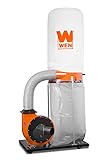
| Single-stage dust collector | One stationary machine at a time | Fine dust may pass through the filter; poor for long duct runs | Moderate floor footprint |
| Two-stage cyclone collector | Multiple stationary tools and high-volume chips | Higher cost and greater height | Larger floor footprint |
| Wall-mounted collector | Small shops needing to preserve floor space | Usually lower capacity and airflow | Very small floor footprint |
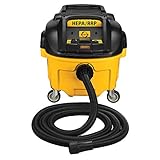
For a hobby shop with a benchtop planer, compact table saw, and sanders, a shop vacuum and cyclone separator is often the sensible starting point. The separator catches roughly 90 percent or more of the chips before they reach the vacuum, preserving suction and reducing filter cleaning. It is cheaper than a full dust collector and easier to roll out of the way.
Choose a full-size collector when you regularly use a planer or jointer, or when you want a permanent ducted system. These machines move more air but occupy valuable floor space. Check the actual height, including the filter or cartridge, before buying. Some units are too tall to fit beneath a typical eight-foot ceiling once you allow room to remove the filter and empty the bag.
Airflow, Hose Size, and Duct Design
Do not compare collectors using horsepower alone. Airflow at the tool matters more than the marketing number printed on the motor housing. A small tool hose generally needs high velocity to carry dust. A 1-1/4-inch or 1-1/2-inch hose works well for sanders and handheld tools, while a 2-1/2-inch hose is common for routers and compact saws.
Large stationary machines with four-inch ports typically need a collector capable of moving around 350 to 500 cubic feet per minute at the tool. That figure drops quickly with long hoses, tight bends, undersized reducers, clogged filters, and restrictive blast gates. A four-inch port on a tool does not mean the machine will perform well with a collector that only delivers strong suction through a two-inch hose.
Keep flexible hose short. Use smooth-wall four-inch duct or pipe for the main run, and install gradual bends rather than sharp elbows. Every unnecessary branch adds resistance. If the shop has only one collector, close every blast gate except the one serving the machine in use. An open unused branch can reduce collection enough to leave chips on the floor and dust in the air.
A Practical Layout Under Eight Feet
Place the collector in a corner or along a wall, but leave enough clearance to remove the bag or empty the drum. A two-stage cyclone is often too tall for convenient overhead installation in this kind of shop, so plan for a floor location near the machines that create the most chips. Mounting the unit on a low platform can make bag changes easier, but do not raise it so high that the filter or drum becomes difficult to handle.
For a floor-standing collector, leave roughly 24 inches of working clearance around service points when possible. Protect the collector from direct rain, damp concrete, and extreme temperature changes. If the shop shares space with a vehicle, use locking casters and park the collector where it cannot be struck.
Wall-mounted units save floor space, but the wall must carry the machine, hose reel, and vibration. Use structural framing rather than relying only on drywall anchors. Keep the filter below ceiling-mounted lights and away from stored boards. A collector that blocks a light fixture or requires a ladder for every filter cleaning is poorly placed, even if it technically fits.
Fine-Dust Filtration and Shop Safety
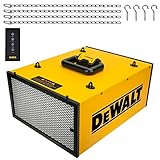
Chip collection and air filtration are different jobs. A dust collector captures debris at the tool; an overhead air cleaner removes suspended particles from the room. If you sand often, add a shop air filtration system on a wall or ceiling location that does not conflict with the eight-foot height limit.
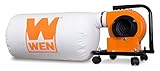
Look for a cartridge filter rated for fine wood dust, preferably around one micron or better. A cloth bag that allows visible dust to escape is not adequate for fine-particle control. Clean filters according to the manufacturer’s instructions; a loaded filter reduces airflow, increases motor strain, and encourages leaks around joints.
Grounding and static control deserve attention with permanent ductwork. Plastic ducting can accumulate static charge, particularly in dry conditions. Follow the collector and duct manufacturer’s grounding guidance rather than improvising electrical connections. Never use a dust collector for hot ashes, metal grinding dust, solvents, or other materials it is not designed to handle. Fine wood dust can also burn or explode when concentrated, so avoid sparks and keep the collection area clean.
Buying Priorities That Matter
Buy the cheapest system that matches your largest machine, not your smallest one. If your work is mostly sanding and occasional routing, a HEPA shop vacuum with a separator is a reasonable choice. If you make furniture with a planer and jointer, spend more on airflow, filter area, and a larger collection container.
Budget for hoses, reducers, blast gates, clamps, and replacement filters. A collector that sits unused because it takes ten minutes to connect is not a successful system. For a compact eight-foot shop, mobility, easy emptying, and a short hose run are often worth more than a larger motor with an awkward installation.