What's inside
As an Amazon Associate I earn from qualifying purchases. This post may contain affiliate links at no extra cost to you.
A workshop that also houses a vehicle has two jobs: it must support accurate, messy work, then become a safe parking space without a long cleanup ritual. The best storage is therefore not simply the largest cabinet you can afford. It is storage that keeps tools off the floor, contains dust, survives vehicle movement, and leaves a reliable clearance path around the car.
As an Amazon Associate we earn from qualifying purchases at no extra cost to you.


Start With the Parking Layout
Park the vehicle in its normal position and mark the corners with painter’s tape. Leave at least 30 inches of walking space along one side, and more if that side contains a workbench or frequently used storage. A car door needs roughly 24 to 30 inches to open usefully; a truck door or hatch may need more. Do not design cabinets around an empty garage and hope the vehicle will fit later.
Use the wall behind the vehicle for shallow storage, but avoid projecting cabinets into door-swing areas. A cabinet 12 to 18 inches deep is usually enough for hand tools, fasteners, and small power tools. Full-depth 24-inch cabinets hold more, but they consume valuable aisle space and make it easier to strike the vehicle with a tool or cabinet door.
Choose Storage That Matches the Work
For most shared garages, a combination works better than one expensive storage system. A lockable wall cabinet keeps valuable tools and chemicals away from children. A rolling tool chest holds the tools used at the bench. Open shelves handle bulky items such as sanders, clamps, and finishing supplies. Pegboard or a slatwall makes frequently used hand tools visible, but it should not be the only storage: exposed tools collect dust and are easy to knock down.
| Storage type | Best use | Main advantage | Common failure |
|---|---|---|---|
| Rolling tool chest | Hand tools and small parts | Moves with the job | Drawers become overloaded and hard to roll |
| Wall cabinet | Valuable, chemical, or rarely used tools | Uses vertical space and locks | Doors block the vehicle aisle |
| Open shelving | Bulky tools and bins | Cheap and easy to reconfigure | Dust settles on everything |
| Slatwall or pegboard | Frequently used hand tools | Fast visual access | Tools fall when bumped or vibrated |
| Ceiling rack | Seasonal or lightweight storage | Preserves floor area | Unsafe if overloaded or poorly anchored |
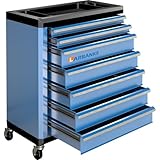
A basic rolling tool chest is often the best first purchase. Buy one with full-extension drawers, decent casters, and a load rating appropriate for steel tools. Lock the casters while working and park the chest against a wall afterward. Cheap chests are fine for homeowner use, but thin drawers can bend when packed with sockets and ratchets.
Use Walls and Ceiling Carefully
Anchor tall cabinets and shelving to wall studs. Do not rely on drywall anchors for a loaded cabinet, especially above a vehicle. Store heavy items between waist and shoulder height or lower. Put lightweight seasonal items in overhead bins, and label the weight limit on the rack. A ceiling rack that drops onto a car is an expensive failure, even if the rack itself was inexpensive.
Choose lidded plastic bins for abrasives, electrical parts, and finishes. Clear bins save time, but opaque bins protect light-sensitive materials. Keep oily rags in a listed metal safety can with a self-closing lid; do not leave them in an open plastic tote. Gasoline, solvents, and aerosol cans should remain away from ignition sources and should not be stored where a vehicle can hit them.
Build a Bench That Can Get Out of the Way
A fixed bench is convenient only when the vehicle does not need its footprint. A 24-inch-deep bench on locking casters is a practical compromise. Use large wheels, at least 3 inches in diameter, because small casters catch on cracks and sawdust. Add leveling feet or retractable casters if you need accurate hand-tool work; a bench that shifts while sawing is frustrating and unsafe.
For a narrow garage, consider a wall-mounted folding bench or a bench built from two rolling modules. A 6-foot bench is useful, but a 4-foot bench with good lighting and a proper vise often accomplishes more than a long surface buried under supplies. Leave the floor below it clear so the vehicle tires cannot contact stored lumber or power cords.
Control Dust Before It Spreads
Storage cannot compensate for poor dust control. Connect portable tools directly to a shop vacuum using the largest practical hose, commonly 1-1/4 or 2-1/2 inches. A separator or cyclone prefilter keeps the vacuum filter from clogging and preserves suction. For table saws, planers, and other high-producing machines, a dust collector with a cartridge filter is more effective than a small vacuum.
A cyclone dust separator is one of the cheaper upgrades that genuinely helps. Empty it before it becomes full; a packed separator or clogged filter reduces airflow and leaves fine dust on cabinets, vehicles, and lungs. Sweep with a vacuum rather than compressed air, which simply redistributes fine dust into door seals and stored tools.
Light the Work Area, Not Just the Ceiling
Install bright LED shop lights in rows parallel to the vehicle and bench. Aim for roughly 50 foot-candles at the work surface, or about 500 lumens per square meter. One central fixture often puts your body between the light and the work. Add an adjustable task light at the bench, preferably with a high color-rendering rating so wiring colors and finish defects are easier to see.
Protect fixtures from accidental impact and keep cords off the floor. Retractable cord reels mounted above the bench are useful, but unplug portable tools before moving the vehicle. A cord stretched across a tire path is a trip hazard and can be crushed without obvious damage.
Safety Rules for a Shared Space
Use wheel chocks when the vehicle is parked on any slope, and never run an engine in the garage with the door closed. Keep a clear route to the garage door and electrical panel; do not let storage reduce the exit aisle below about 30 inches. Mount a suitable fire extinguisher near the exit, not behind the bench where a fire may begin.
Before parking, remove clamps, screws, offcuts, and metal chips from the floor. Check that cabinet doors and drawers are fully closed. Store long boards vertically only when they are restrained against falling, and keep them away from the vehicle’s path. The most useful storage improvement is often a simple end-of-day parking checklist: tools returned, dust collected, cords hung, liquids closed, and floor clear.
If you need more flexible wall storage, compare garage slatwall storage systems. They cost more than pegboard but move hooks and shelves without drilling new holes. For a low-budget setup, painted plywood cleats, labeled bins, and a used rolling chest can work just as well. Spend the extra money on secure anchoring, good lighting, and dust extraction before paying for polished cabinet finishes.