
Our Top Picks


What's inside
As an Amazon Associate I earn from qualifying purchases. This post may contain affiliate links at no extra cost to you.
I am not going to pretend this shop was planned well. It was assembled through a series of enthusiastic purchases, some of which were wrong. Here are the ones worth warning people about.
Here is the part nobody tells you: most wasted money in a small shop does not go on bad tools. It goes on decent tools bought in the wrong order, or on the cheap version of something you end up buying twice. Sequencing is the one upgrade that costs nothing, so next to each mistake I have put the criteria I would use now, and who the choice actually suits.
As an Amazon Associate we earn from qualifying purchases at no extra cost to you.


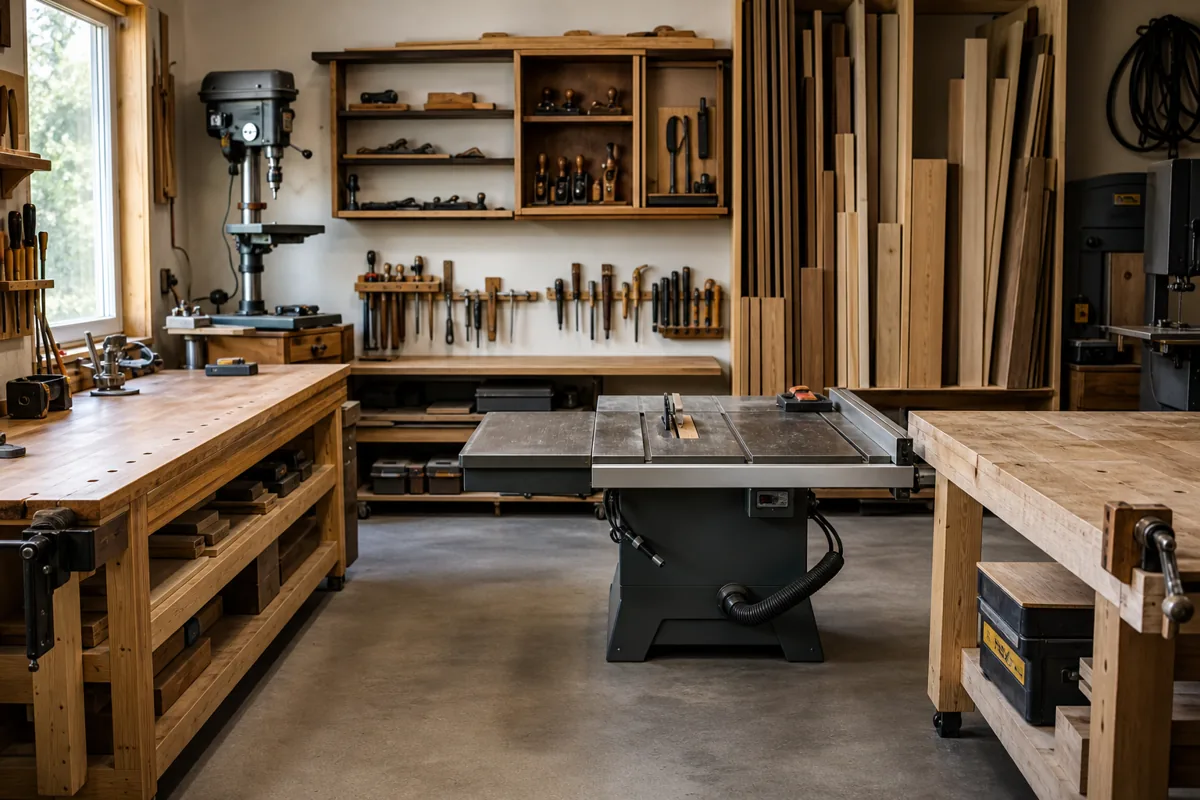
1. I bought a table saw before I had space for it
A contractor saw takes up a footprint far larger than the machine itself, because you need infeed and outfeed room. For two years mine sat against a wall, unusable for anything longer than three feet, and I broke down sheet goods on the driveway with a circular saw anyway.
The measurement that matters is not the cast iron, it is the clear run in front of and behind the blade. Pushing a full sheet through wants something in the region of eight feet each side, plus room to the left for the offcut. In one garage bay that sometimes holds a car, that geometry does not exist unless the saw lives on a mobile base and you reposition it for every cut.
What I should have done: bought a track saw first, and the table saw when I had the floor space to use it properly.
- Rail length and joining. A rail in the 55 inch class crosscuts a sheet easily; ripping one lengthwise needs two rails joined, so check the connectors exist and the joint stays true.
- Depth stop and plunge. You set depth constantly, so a stop that returns to the same place and a plunge with no side play matter more than motor watts.
- Dust port fit. The port should accept a shop vac cuff without tape and adapters, because a track saw with a hose on it captures most of what it makes.
- Splinter strip and rail grip. Replaceable strips are cheap; a rail that creeps under the saw ruins otherwise good cuts.
At the budget end the compromise usually hides in the rail rather than the motor, so pay for a decent rail even if the saw is modest. Skip a track saw if your work is mostly solid lumber and repeated narrow rips, where a table saw is faster and more accurate.
Track saws
Straight, clean cuts in sheet goods with no floor space required. For a small shop, this beats a table saw as a first big purchase.
2. I ignored dust for two years
I thought dust was a tidiness issue. It is a health issue, and the fine particles are the dangerous part — the sawdust you sweep up is not what damages lungs. I now run extraction at the tool and an air filter for an hour after every session, and I wish I had started on day one.
The mistake is treating dust control as one purchase. It is three jobs, and no single machine does all of them:
- Capture at the source. Connect the tools that make the finest dust first: sanders, routers and the miter saw, not the ones that make the biggest mess.
- Protect the filter. A cyclone separator ahead of a shop vac drops chips into a bucket, so suction stays high instead of fading after ten minutes.
- Clean what escapes. Air filters are rated in airflow, so match one to your room volume, aim for several complete turnovers an hour, and leave it running after you stop.
Two cheap habits close the gap while you save up: a well-fitting respirator for sanding, and never using a broom on fine dust, because sweeping puts back into the air exactly what you want gone.
Cyclone separators and air filtration
A cyclone ahead of a shop vac plus a ceiling air filter. Not expensive, and the thing I most regret delaying.
3. I worked under one bulb for far too long
Bad lighting causes bad cuts, missed glue squeeze-out and finishing flaws you only see in daylight. Four LED shop lights cost less than a decent blade and improved my work immediately.
The trap is that a garage rarely lacks brightness, it lacks even coverage. One powerful fixture in the middle of the ceiling gives you a bright ceiling and a shadow under your own shoulders. I aim for roughly 70 to 100 lumens per square foot of floor, which in a single bay means four to six 4-foot fixtures spread wide, plus a task light at the bench and the miter saw.
Two specifications separate good fixtures from cheap ones at any price: color rendering, where 90 or above shows grain and scratches honestly, and driver quality, since bargain units buzz, flicker and dim unevenly as they age. Neutral to cool white, 4000K to 5000K, is the comfortable range. Paint the walls white before buying a fifth light.
LED shop lighting
Linkable fixtures, more than you think you need. Nothing on this list improved my work per dollar as much.
4. I bought a big cheap tool instead of a small good one
A large budget bandsaw with a flexing frame and poor guides taught me nothing except frustration. A smaller, better machine would have cut better and been usable. Capacity you cannot use accurately is not capacity.
Advertised capacity is the cheapest number for a manufacturer to print and the most expensive one for you to discover. A saw that claims deep resaw but cannot hold tension on a wide blade will wander no matter how careful you are. The same trap appears as quill play in a drill press, a miter saw fence out of square, and detents that will not repeat.
So I look at rigidity, guide and fence quality, whether adjustments hold once set, and whether wear parts are available, all before capacity. The exception is real: if you resaw wide stock most weeks, capacity is the whole point, and it is worth waiting to buy once.
5. I did not buy enough clamps for years
Every woodworker says this and every new woodworker ignores it. Insufficient clamping is the main cause of failed glue joints, and “I will do this glue-up in two stages” is how a project becomes crooked.
Plan on pressure every six to ten inches along a joint, which means four clamps for a small panel and more than you own for a carcase.
- Buy pairs, in matched lengths. Clamps work in opposition above and below a panel, so four medium ones beat one long one. Around 24 and 36 inches covers most furniture.
- Mix types deliberately. Parallel clamps keep panels flat and earn their price on casework, F-style clamps handle small work, and pipe clamps buy the most capacity per dollar if you accept the weight.
The mistakes that cost me: cranking hard to close a gap the joint should have closed itself, which starves the glue line, and owning no cauls, which are free offcuts and fix more flatness problems than another clamp would.
Bar and parallel clamps
Every experienced woodworker gives the same advice. Buy more than seems reasonable; you will still want more.
6. I skipped learning to sharpen
I bought better chisels instead of learning to sharpen the ones I had. The new ones were dull within a month and I was back where I started, poorer. Sharpening is a two-hour skill that improves every hand tool you will ever own.
What a first sharpening setup needs
Pick one system and stay with it long enough to get fast: sandpaper on plate glass, diamond plates, oil stones or water stones. All four give a working edge, and switching between them is what wastes money. You want a coarse surface for repairs, a medium one for routine work, a fine one for the final edge, and a strop to stretch the interval. Water stones also need a flattening plate, which people forget to budget for. A honing guide is not cheating; it is how you get repeatable angles before your hands know them.
The hidden work is flattening the backs of new chisels and plane irons once, properly. Do that and maintenance is a minute on the fine stone, caught early, instead of a trip back to the coarse plate.
What I would tell myself in year one
- ✔ Lighting and dust control before machines
- ✔ Track saw before table saw in a small space
- ✔ Clamps, constantly, forever
- ✔ Learn sharpening in the first month
- ✔ Build the workbench yourself — it teaches everything
- ✔ Buy the tool when the project needs it, not before
The order matters more than the brand. Health and visibility first, because they change every hour you spend out there. Then a bench, because every other tool works against it. Then cutting and clamping, and only then machines, each one when a project is waiting and the floor space exists to use it.
FAQ
What is the best first big purchase? In a small shop, a track saw or a good combo kit. Not a table saw. Both keep working when the shop is full and neither claims floor space you do not have.
How much space do I really need? A 10×10 working area is workable with mobile machines and good planning. The real requirement is one clear path long enough for your longest cut, and everything on wheels.
What is the most overrated tool? For a beginner, a jointer. Buy surfaced lumber for the first year or two instead, and learn flattening with a hand plane while you decide whether you need one.
Does buying used avoid these mistakes? Often yes for heavy cast iron machines, where rigidity is the value and wear parts are cheap. Be more careful with cordless tools, where battery history is invisible, and anything whose electronics cannot be replaced.
See small-shop gear →