
What's inside
As an Amazon Associate I earn from qualifying purchases. This post may contain affiliate links at no extra cost to you.
The best table saw push stick for most woodworkers is a long, angled push stick with an ergonomic handle and a notched heel that can control narrow stock under 2 inches wide while keeping your hand at least 6 inches above the blade.
For wider rips and general crosscutting, a flat shoe-style pusher with a high-friction sole offers more downward pressure, while a classic straight stick is best reserved for simple, low-risk cuts where blade clearance is tight. Your ideal choice comes down to three factors: how narrow you regularly cut, how much downward control you need, and how your saw’s guard and fence limit space.
As an Amazon Associate we earn from qualifying purchases at no extra cost to you.


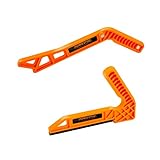
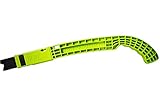
Push Stick Shapes Compared: Control vs. Clearance
All push sticks do the same basic job, but their shape determines how much contact they have with the workpiece and how far they keep your hand from the blade. These are the four designs you will find in 2026:
1. Classic Straight Stick with Notch
The traditional straight stick, often made from plywood or hard plastic, with a 90-degree notch at the rear. It pushes forward from the end grain and relies on the notch to catch the tail end of the board. Contact area is minimal, typically 0.5 to 0.75 square inches, and it offers almost no downward pressure. Its advantage is a very thin profile, so it easily fits between blade and fence for rips as narrow as 1/2 inch without hitting the guard.
2. Angled / Bird’s Mouth Stick
Features a handle angled at 30 to 45 degrees above the sole and a deeper V-notch or bird’s mouth. This design raises your hand higher and lets you apply both forward and downward force at the heel of the board. Common examples include the Milescraft PushStick and similar molded plastic models. Better control than a straight stick, but still limited contact patch.
3. Shoe / Block Pusher
A wide, flat-bottomed block with a handle on top, such as the POWERTEC 71009 Double Duty Push Block or the Bench Dog Push-Loc. The entire sole sits on top of the workpiece, providing 8 to 16 square inches of contact with a rubber or foam friction layer. Excellent for keeping thin stock flat against the table to prevent chatter and lift, but the wide body cannot pass between blade and fence on cuts narrower than about 1.5 inches.
4. Three-Directional Pusher with Adjustable Heel
Represented by the MicroJig GRR-RIPPER system and similar straddling pushers. It uses a center leg that runs against the fence, adjustable side legs, and a non-slip Green Grit surface to apply forward, downward, and lateral pressure simultaneously. It effectively traps the stock and prevents drift and kickback. It requires more setup and clearance but is the most secure option for ripping strips under 1 inch consistently.
Spec and Feature Comparison Table
Concrete dimensions matter when checking fence clearance and hand position. Use this table to compare typical market models by type, not just by marketing claims:
| Type / Example | Overall Length | Profile Width | Weight | Material | Contact Patch | Handle Angle |
|---|---|---|---|---|---|---|
| Classic Straight Stick (shop-made plywood) | 11 – 12 in (280-305 mm) | 0.5 in (12 mm) | 1.5 – 2.5 oz (42-70 g) | Baltic birch / MDF | ~0.6 sq in | 0 degrees (inline) |
| Angled Bird’s Mouth (e.g., Milescraft 3404) | 11.5 in (292 mm) | 0.75 in (19 mm) | 3.2 oz (91 g) | Glass-filled polypropylene | ~1.2 sq in | 35 degrees |
| Shoe Block Pusher (e.g., POWERTEC 71009) | 9.5 in (241 mm) | 3.25 in (83 mm) | 7.8 oz (221 g) | ABS plastic + rubber sole | ~12.5 sq in | 90 degrees (top handle) |
| Rockler Push Block (narrow version) | 8.5 in (216 mm) | 2.0 in (51 mm) | 5.1 oz (145 g) | Plastic + foam pad | ~9.0 sq in | 90 degrees |
| Three-Directional Pusher (e.g., MicroJig GRR-RIPPER GR-100) | 9.8 in (249 mm) | 3.6 in adjustable (91 mm) | 11.3 oz (320 g) | Polycarbonate + Green Grit | ~14.0 sq in (3 legs) | Ergonomic top handle |
Key takeaway: If your typical narrow rip is less than 1.25 inches between blade and fence, only the first two types will physically fit. Measure your fence-to-blade gap for your narrowest common cut before buying a wide shoe.
Decision Matrix: Which Design for Your Situation?
Match your workflow to the design that solves your most frequent problem:
| Your Situation | Best Choice | Why |
|---|---|---|
| You rip hardwoods into strips under 1 inch for edge banding or lamination weekly | Three-Directional Pusher | Only design that controls lateral drift and holds the offcut and keeper side simultaneously; prevents the strip from tipping into the blade gap |
| You make occasional narrow rips (1-2 inches) and need maximum hand clearance on a jobsite saw with a guard | Angled Bird’s Mouth Stick (keep 2) | Thin enough to clear guard, angled handle keeps knuckles 6-7 inches above table, cheap to replace after nicking |
| You mostly crosscut and rip panels wider than 3 inches and worry about the board lifting or chattering | Shoe Block Pusher | Large friction sole applies even downward pressure across the board, far better than a notched heel |
| You have a small shop, limited budget, and want one versatile option | One angled stick + one narrow shoe block | Covers 90% of cuts for under $30 total market range; use stick for narrow rips, block for everything else |
| You are a beginner or teach others | Bright-colored plastic angled stick | High visibility, no splintering, and the handle geometry naturally trains correct hand position |
Blade Clearance and Why Contact Area Matters
The trade-off is simple: more contact area equals more control, but a larger pusher needs more space. For a 10-inch table saw, the distance from the blade to the fence is your limiting factor. A standard shoe block at 3.25 inches wide cannot be used for a 1-inch rip without riding over the blade. An angled stick at 0.75 inches wide can.
For narrow stock, downward pressure is less important than preventing rotation. A board that is 3/4 inch thick and 1 inch wide can pivot if you push only at its very end. A notched heel helps, but a three-directional pusher solves this by contacting the top and side of the board over 4 to 5 inches of length, which prevents that pivot. If you must use a stick for narrow rips, keep the notch depth shallow (3/8 inch) so it does not grab too aggressively and lift the tail.
Also consider handle height. A straight inline handle puts your hand about 1.5 inches above the workpiece. An angled handle raises it 4 to 5 inches, which gives critical clearance if kickback occurs. On saws with an overhead guard or riving knife, test that the handle does not collide with the guard at the end of the cut.
Material and Grip Trade-offs
Wood (plywood, hardwood): Cheap, easy to make custom widths, and disposable if you cut into it. However, wood glazes over time, loses friction, and can split along grain if the notch catches. Replace shop-made sticks when the notch rounds over or the tip splinters.
Standard ABS / Polypropylene Plastic: Durable, lightweight, and often molded with a textured grip. Lower friction on the sole than rubber, so you must rely on the notch. It will melt slightly if it contacts the blade rather than shattering, which is safer. Most models in this category cost within the $8 to $18 range.
Rubber / Foam-Soled Block: Highest grip for downward pressure, even on dusty surfaces. The foam compresses to conform to slight board variations. Downside is the sole wears and must be cleaned. Sawdust embedded in rubber reduces friction dramatically.
Polycarbonate with Friction Coating: Used on premium three-directional pushers. Very rigid, clear support legs let you see the cut, and the Green Grit-style coating maintains grip longer than plain rubber. The coating is a consumable and will eventually need replacement.
Grip ergonomics matter for fatigue. Look for a handle that lets you keep your wrist neutral, with a closed loop or flared end to prevent slipping forward. A handle that is too small forces a pinch grip, which reduces pushing force and increases hand strain on long ripping sessions.
Durability and Ownership Realities
No push stick lasts forever if you use your saw regularly. Knowing what wears first saves money and keeps you safe.
- What gets damaged first: The heel/notch. Every time you misjudge clearance, the blade kisses the plastic or wood. On sticks, the notch gradually widens and loses its square shoulder, which means it will slip off the board end. On shoe blocks, the rear edge of the rubber sole gets chewed. Inspect the heel before each session; if it no longer catches a square edge firmly, replace or recut it.
- Consumables: Rubber soles, foam pads, and friction coatings are wear items. Expect to clean or replace a foam pad every 6 to 12 months with weekly use. Replacement pads typically cost $5 to $12. For MicroJig-style pushers, adjustable legs and Green Grit strips are sold as spare parts.
- Cleaning: Wipe plastic pushers with a dry brush, not solvents that make them slippery. For rubber-soled blocks, use a stiff nylon brush and mild soapy water to remove pitch and sawdust, then dry completely. Do not use compressed air to clean foam, it drives dust deeper.
- Common mistakes: Using a wide block for a narrow rip and riding the fence with the block itself, which can trap the offcut and cause kickback; pushing from the center of a long board instead of the trailing end, which lets the front lift; and continuing to use a push stick that has been cut deeply by the blade, which weakens the tip and can snap under pressure.
- Storage: Hang push sticks near the saw, not on the floor or behind the fence where you have to reach over the blade to grab them. Many woodworkers mount a small hook on the fence rail or saw stand so the pusher is within arm’s reach before starting the cut.
General market price ranges in 2026 are stable: classic and angled plastic sticks $8 to $20, single shoe blocks $12 to $25, double packs $18 to $30, and three-directional systems $50 to $80. Making a few shop-made plywood sticks as backups is still the most economical way to ensure you always have a thin stick for very narrow cuts, even if you own a premium pusher for general work.
FAQ
Should I use two push sticks at once?
For narrow rips, yes. Use one to push the keeper piece through and a second to keep the offcut from drifting back into the blade. For wide panels, a single shoe block with firm downward pressure is sufficient. Never use your free hand to steady the offcut.
Can a push stick prevent kickback entirely?
No. A push stick reduces exposure and improves control, but kickback prevention also requires a riving knife, proper fence alignment, and not standing directly behind the blade. Think of the push stick as one part of a system.
How narrow is too narrow to rip safely on a table saw?
Many manufacturers advise against ripping solid stock narrower than 1/2 inch between blade and fence with a standard fence, because the piece can tip or jam. For strips under 1/2 inch, consider a thin-strip jig that cuts on the offcut side of the blade instead of between blade and fence.