
What's inside
As an Amazon Associate I earn from qualifying purchases. This post may contain affiliate links at no extra cost to you.
Best Milwaukee Portable Band Saws: Compare Sizes and Cutting Capacity
The best Milwaukee portable band saw depends on the largest material you regularly cut: choose a compact model for conduit, threaded rod, and overhead work; choose a deep-cut model for larger pipe, strut, and bundled stock. For most tradespeople who need one saw for varied jobsite cuts, a standard deep-cut saw is the most versatile, while a compact saw is easier to carry and control in tight spaces.
Milwaukee portable band saw comparison
Milwaukee’s portable band saw lineup includes compact, standard-capacity, and deep-cut options. Capacities and weights vary by exact model and whether the tool is corded or cordless. The figures below are representative published specifications; check the model number and regional listing before buying, since bare-tool weight, battery, and kit configurations can differ.
As an Amazon Associate we earn from qualifying purchases at no extra cost to you.


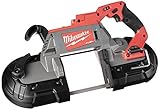
| Type | Representative Milwaukee model | Maximum cutting capacity | Approx. tool weight | Best fit |
|---|---|---|---|---|
| Compact cordless | M12 FUEL Sub-Compact Band Saw (2529-20) | 2⅝ in. | About 6.5 lb bare | Conduit, copper pipe, threaded rod, and overhead cuts |
| Standard cordless | M18 FUEL Compact Band Saw (2829-20) | 3¼ in. | About 8.5 lb bare | Everyday electrical and plumbing work with moderate stock sizes |
| Deep-cut cordless | M18 FUEL Deep Cut Band Saw (2729-20) | 5 in. × 5 in. | About 14.5 lb bare | Larger pipe, strut, and cuts requiring greater throat depth |
| Deep-cut corded | Milwaukee Deep Cut Band Saw (6232-21) | 5 in. × 5 in. | About 14 lb | Shop or stationary work where continuous power is available |
Weights are approximate and refer to the tool without a battery where applicable. A battery adds weight, so a cordless deep-cut saw in working configuration can feel substantially heavier than its bare-tool figure. Cutting capacity describes the largest material that fits through the saw’s opening; it does not guarantee a fast cut through every material.
Choose by the cuts you actually make
For frequent overhead work and small stock: M12 compact
The M12 FUEL Sub-Compact is the easiest choice to carry for repeated cuts in confined spaces. Its 2⅝-inch capacity covers common conduit and smaller pipe, while its lower weight helps reduce fatigue when working above shoulder height. It is not the right tool for a 3-inch pipe or wide bundled material: the workpiece simply will not fit.
For occasional cuts in small metal stock, this compact saw can be a practical primary tool. If your work regularly includes larger strut, pipe, or lumber, it is better as a second saw than as your only one.
For a balance of reach and portability: M18 compact
The M18 FUEL Compact Band Saw raises capacity to 3¼ inches without jumping to the size and weight of a deep-cut frame. It suits contractors who often cut material larger than the M12’s limit but still value maneuverability. The trade-off is that it cannot handle stock near the deep-cut model’s 5-inch capacity.
This is a sensible middle ground when most cuts are manageable one-handed or in crowded work areas, but occasional larger cuts can be made with another tool or by changing the job’s setup.
For larger pipe and stock: deep-cut models
The M18 FUEL Deep Cut and corded 6232-21 provide a 5-by-5-inch capacity. That extra opening can eliminate the need to reposition some larger workpieces or switch to a different cutting method. It is particularly useful for substantial pipe, channel, strut, and repeated cuts in larger sections.
The cost of that reach is bulk and weight. For a few small cuts on a ladder or in a cramped cabinet, a deep-cut saw can be cumbersome. The corded version avoids battery-runtime limits in a shop, but the cord can restrict movement on a jobsite. The cordless model is more mobile, though demanding cuts consume battery faster than light work.
Quick decision matrix
| Your situation | Best starting point | Why |
|---|---|---|
| Mostly small conduit and overhead cuts | M12 compact | Lower carry weight and enough capacity for smaller stock |
| Regular mixed trade work; stock usually under 3¼ in. | M18 compact | More room than the M12 without a full deep-cut frame |
| Frequent pipe, strut, or stock approaching 5 in. | M18 deep-cut | Greater capacity and cordless jobsite mobility |
| Repeated cuts at a bench with outlet access | 6232-21 corded deep-cut | Deep-cut capacity without managing battery charge |
| Uncertain future work or one saw for varied stock | M18 deep-cut, if weight is acceptable | Capacity is harder to add later than portability is to plan around |
Blade changes and material choice
Portable band saws use replaceable loop blades, and blade compatibility depends on the saw’s required blade length, width, and thickness. Confirm all three measurements for the exact model before ordering; a blade that looks close may not track or tension correctly. Milwaukee saws commonly have tool-free blade-change features, but the procedure differs by model. Follow the manual, disconnect the cord or remove the battery, and keep fingers clear of the blade path while releasing tension and fitting the replacement.
For metal, choose blade teeth per inch (TPI) to suit the material’s thickness. As a practical rule, keep at least a few teeth engaged in the work at once: a fine-tooth blade generally suits thin-wall tubing and sheet-like sections, while a coarser tooth pattern can clear chips more effectively in thicker stock. If the teeth are too coarse for thin material, they can catch and strip; too fine for thick stock, they may cut slowly and load up. Use a blade rated for the material and consult its manufacturer’s guidance for the specific thickness.
These saws can cut many metals, including steel and aluminum, with the correct blade and controlled feed. Wood is also possible with a suitable blade, but a portable metal-cutting saw is not a substitute for a woodworking bandsaw when you need curves, resawing, or precise table-guided work. Avoid forcing the frame through a cut: let the blade do the work and secure the stock so it cannot twist or pinch the blade.
Ownership realities that affect the choice
- Blades are consumables. Dull or damaged teeth increase cutting time and can leave rougher edges. Keep a spare compatible blade if the saw is essential to daily work.
- Chip buildup needs attention. Metal chips collect around the blade path and wheels. With the tool disconnected, clear debris according to the manual; packed chips can interfere with tracking and wear parts sooner.
- Do not use capacity as a speed rating. A saw may fit a large workpiece but still cut slowly if the blade is wrong, the material is hard, or the blade is dull.
- Account for working weight. Compare a cordless model with the battery you will actually use, not just its bare-tool weight. A lighter compact tool can be the more productive choice for repeated overhead work.
- Secure the material. Clamp stock where practical, support long pieces, and keep the blade aligned. Twisting the saw to steer a cut can damage the blade and produce a poor finish.
Bottom line
Pick the M12 compact when low weight and tight access matter more than maximum capacity. Choose the M18 compact when you need a useful step up in opening size without a deep-cut tool’s bulk. For frequent cuts in larger material, the 5-by-5-inch deep-cut models are the strongest fit; choose cordless for mobility and corded for a fixed work area with steady power. Before purchasing, measure the largest stock you cut, confirm the exact model’s blade dimensions, and consider the battery or cord setup you will use on the job.