
What's inside
- Jointer Planer Combo vs. Separate Machines: When the Combo Wins
- Capacity Comparison: Board Width, Cutting Depth, and Table Length
- Changeover Process: How Long It Really Takes
- Dust Collection: The Deciding Detail Many Buyers Overlook
- Floor Space and Power: What Fits Your Shop
- Setup, Calibration, and Ownership Realities
- Which Jointer Planer Combo Should You Choose in 2026?
- FAQ
- Related Guides
As an Amazon Associate I earn from qualifying purchases. This post may contain affiliate links at no extra cost to you.
A jointer planer combo saves 30 to 40 square feet of floor space while giving you 8 to 16 inches of jointing and planing width in one machine, and it is the right choice if you work in a one or two-car garage shop or need to process wide boards without owning two separate stationary tools.
As an Amazon Associate we earn from qualifying purchases at no extra cost to you.
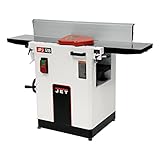

Jointer Planer Combo vs. Separate Machines: When the Combo Wins
A jointer planer combo uses one cutterhead, one motor, and one dust hood for both operations. You joint on top, then swing or remove the tables and feed boards through the planer underneath. Separate machines require two cutterheads, two motors, and about 65 to 80 square feet combined with infeed and outfeed clearance. A combo needs roughly 35 to 50 square feet total.
The combo is not always better for production. Changeover takes time, and you cannot joint and plane simultaneously. For these shop situations, the trade-off is clear:
- Choose a combo if your shop is under 400 square feet, you move tools to work, or you joint and plane in batches rather than continuously.
- Choose separate machines if you run a small production shop, frequently switch between operations on the same project, or need jointer widths over 16 inches that combos rarely offer.
- Choose a benchtop combo only if you work with boards under 6 feet long and value portability over capacity. Full-size floor-standing combos handle longer stock with far less snipe and vibration.
Capacity Comparison: Board Width, Cutting Depth, and Table Length
Width is the defining spec. An 8-inch combo limits you to 8-inch face jointing, which means wider boards must be ripped or flattened with alternative methods. A 12-inch combo covers more than 90% of typical hardwood lumber, while 16-inch European combos handle wide slabs without a separate wide jointer.
Table length matters as much as width for flattening. A jointer table under 45 inches makes it difficult to joint 5 to 6-foot boards straight without auxiliary support.
| Model (Type) | Jointing / Planing Width | Cutterhead | Jointer Table Length | Planing Height Capacity | Motor | Weight | Footprint (W x D) |
|---|---|---|---|---|---|---|---|
| Rikon 25-210H (Benchtop 10-inch) | 10 in | Helical, 30 inserts | 40 in | 5 in | 15A, 120V (1.5 HP) | 235 lbs | 41 x 22 in |
| Jet JJP-12HH (Floor 12-inch) | 12 in | Helical, 56 inserts | 55 in | 8 in | 3 HP, 230V | 575 lbs | 57 x 28 in |
| Grizzly G0634XP (Floor 12-inch) | 12 in | Helical, 56 inserts | 54 in | 9-3/4 in | 5 HP, 230V | 665 lbs | 59 x 30 in |
| Hammer A3-31 (Floor 12-inch) | 12 in (310mm) | Silent-Power helical, 48 inserts | 55 in (1400mm) | 9 in (225mm) | 4 HP, 230V 1-phase or 3-phase | 750 lbs | 59 x 32 in |
| Hammer A3-41 (Floor 16-inch) | 16 in (410mm) | Silent-Power helical, 64 inserts | 63 in (1600mm) | 9 in (225mm) | 4 HP, 230V | 980 lbs | 67 x 36 in |
Takeaway: For most home shops, a 12-inch helical combo like the Jet JJP-12HH, Grizzly G0634XP, or Hammer A3-31 hits the balance of capacity and footprint. The 10-inch Rikon saves money and space but requires shorter boards and more careful technique. The 16-inch Hammer A3-41 is for shops that regularly process wide figured stock and can accommodate the weight and 230V requirement.
Changeover Process: How Long It Really Takes
Changeover is the main ownership difference you will not see on a spec sheet. Manufacturers quote 30 to 90 seconds, but that assumes an empty machine and practiced motion. In real use, add time to clear the jointer table, lower the planer table, and reset the dust hood.
Three common changeover systems
1. Swing-away tables (Jet, Grizzly, Hammer): Release two or three cam levers, swing the jointer tables up and to the side, and flip the dust hood from jointer to planer position. No fence removal needed on Hammer and newer Jet models. Typical changeover is 45 to 75 seconds.
2. Removable fence + lift tables (older 8-inch combos): Remove the aluminum fence completely, lift tables on hinges, reposition dust port. Takes 90 to 120 seconds and requires storing the fence.
3. Benchtop flip-top (Rikon and similar): No swing. You simply use the top for jointing and feed stock through the side/port for planing after moving the dust hood lever. Changeover is fastest at 15 to 30 seconds, but dust collection switching is more fiddly.
If you batch work, changeover cost is minimal. Joint all boards first, then convert once and plane everything to thickness. If you constantly alternate, the time adds up. A shop that changes over four times per project, three projects per week, loses about 15 to 20 minutes weekly to changeover alone on a swing-away machine.
Dust Collection: The Deciding Detail Many Buyers Overlook
All combos use a single 4-inch dust port and an internal hood that rotates between the cutterhead and the planer bed. Chips must be redirected 90 degrees, which creates more back pressure than separate machines with dedicated hoods.
- Required airflow is 450 to 600 CFM at the port for 12-inch helical heads. A 1 HP dust collector with 4-inch hose will clog on heavy planing cuts; a 1.5 to 2 HP collector or 650+ CFM system is recommended.
- Helical heads produce smaller, more uniform chips than straight knives, which actually improves collection and reduces hood jams by about 30% compared to two or three-knife cutterheads.
- Check hood design before buying. Swing-away hoods that lock with a single lever seal better than friction-fit hoods. Poor seals leak fine dust at the hinge and coat the elevating screws with resin.
- Planer chip ejection on combos is downward into the hood, not overhead. If your collector is underpowered, chips pack around the elevation screws and cause uneven planing height. Clean the planer cavity weekly if you plane resinous woods like pine.
Floor Space and Power: What Fits Your Shop
Use this decision matrix to map your situation to the right class of jointer planer combo.
| Shop Situation | Recommended Width Class | Why | Power and Space Needed |
|---|---|---|---|
| One-car garage, mobile tools, 120V only | 8 to 10-inch benchtop | Lightest weight, rolls under bench, runs on household circuit | 120V/15A, 12 sq ft storage, 35 sq ft working |
| Two-car garage, fixed station, 230V available | 12-inch floor-standing helical | Covers most hardwood widths, long tables reduce snipe, best value per inch | 230V/20A, 16 to 18 sq ft footprint, 50 sq ft with infeed/outfeed |
| Basement shop with low ceiling and stairs | 10 to 12-inch lightweight floor model | Heavier 16-inch machines are difficult to move down stairs without disassembly | Check disassembled weight; Jet JJP-12HH splits into two 300 lb sections |
| Dedicated 400+ sq ft shop, wide slabs, frequent use | 16-inch European combo | Eliminates need for separate 16-inch jointer, handles live-edge slabs | 230V/30A or 3-phase, 20+ sq ft footprint, 60 sq ft working |
Worked example: Space saved
A typical 8-inch jointer needs 56 x 24 inches plus 36 inches infeed and outfeed. A separate 13-inch benchtop planer needs 30 x 24 inches on a stand plus the same clearance. Combined, they block about 72 square feet when in use. A Jet JJP-12HH occupies 57 x 28 inches and uses the same infeed/outfeed lane for both functions, totaling about 42 square feet. Net saving is roughly 30 square feet, equivalent to a full assembly table or lumber rack in a small shop.
Setup, Calibration, and Ownership Realities
Combo machines save money but demand more precise setup than separate tools because one cutterhead serves two functions. These points determine long-term satisfaction:
Initial setup steps that matter
- Level the jointer tables coplanar before checking planer bed parallel. Use a 4-foot straightedge across both tables. Tables out by more than 0.003 inch will joint a taper that the planer cannot remove.
- Wax the cast iron tables and planer bed with paste wax, not silicone spray, to prevent rust and reduce feed resistance. Reapply every 20 to 30 hours of use.
- Check fence squareness at 90 degrees and 45 degrees with a digital angle gauge. Aluminum fences on combos flex more than cast iron fences on standalone jointers. Lock the fence at both ends, not just the front, to reduce deflection on wide boards.
What wears first and what it costs
- Helical inserts last 4 to 10 times longer than straight knives and can be rotated three times before replacement. Replacement sets run in the general range of $120 to $250 for 12-inch heads depending on insert size. Straight knives need sharpening or replacement every 40 to 80 hours in hardwoods.
- Elevation screws and bronze nuts on the planer table collect dust first. Brush them out and apply dry lubricant monthly. Grit buildup causes the handwheel to bind and creates thickness variation side to side.
- Drive belts stretch in the first 50 hours. Retension once after break-in, then annually.
- Dust hood hinges and cam levers loosen with vibration. Check and snug them quarterly to maintain seal and table lock.
Common mistakes that damage accuracy
- Planing boards that are not flat on one face first. The planer will press a bow flat and you will get a flat but still bowed board after it springs back. Always face joint first.
- Forgetting to switch the dust hood. Planing with the hood in jointer position sends 80% of chips onto the floor and into the motor cabinet.
- Taking planer cuts deeper than 1/16 inch on wide hardwood with a 1.5 HP benchtop motor. This trips breakers and stalls rollers. Floor-standing 3 to 5 HP machines handle 1/8 inch on 12-inch wide stock without bogging.
Which Jointer Planer Combo Should You Choose in 2026?
For the smallest budget and tightest space where 10 inches is enough and boards are short, the Rikon 25-210H class of benchtop helical combos is practical and runs on 120V. For the broadest appeal, a 12-inch floor-standing helical combo such as the Jet JJP-12HH or Hammer A3-31 offers the best compromise of width, table length, dust handling, and resale value without moving to 16 inches. If you routinely flatten slabs over 12 inches wide or want to skip a drum sander for wide panels, step up to the Hammer A3-41 class despite the higher weight, cost, and power requirement.
Measure your longest typical board, verify you have 230V and at least 50 square feet of open floor with infeed clearance, and confirm your dust collector delivers 600 CFM at 4 inches before you decide. A well-calibrated 12-inch combo will outperform an out-of-level pair of separates in the same footprint.
FAQ
Do jointer planer combos produce more snipe than separate planers?
Snipe depends on bed design and roller pressure, not whether the machine is a combo. Floor-standing combos with 55-inch jointer tables and cast iron planer beds control snipe as well as standalone 13 to 15-inch planers when the tables are level and you support the board on entry and exit. Benchtop combos show slightly more snipe, typically 0.005 to 0.010 inch, because of shorter beds and lighter weight.
Can I joint a board wider than the jointer width on a combo?
No. Face jointing is limited to the cutterhead width. For wider boards you must use a planer sled, router sled, or rip and glue up. This is true for both combo and separate jointers.
Is a helical cutterhead worth it on a combo?
Yes for most buyers in 2026. Helical inserts cut more quietly, reduce tearout in figured grain by shearing at an angle, and extend time between knife changes. The premium over straight knives is usually recovered within the first year of moderate use due to avoided sharpening costs.