
What's inside
- Why the DeWalt DCS7485 is the practical choice
- DeWalt cordless table saw specifications that affect buying decisions
- Cutting capacity and material handling
- Battery performance: plan by workload, not by an advertised runtime
- Stand setup and stability
- Which DeWalt cordless table saw fits your situation?
- Setup procedure for accurate cuts
- Ownership realities and common wear points
- Verdict
- Related Guides
As an Amazon Associate I earn from qualifying purchases. This post may contain affiliate links at no extra cost to you.
The best DeWalt cordless table saw for portable woodworking is the 8-1/4-inch 20V MAX DeWalt DCS7485, especially when you need a compact saw for trim, cabinet parts, shelving, flooring, and job-site work rather than high-volume sheet-goods production.
As an Amazon Associate we earn from qualifying purchases at no extra cost to you.

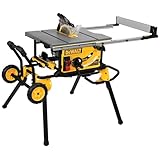


Why the DeWalt DCS7485 is the practical choice
The DCS7485 combines a brushless motor, rack-and-pinion fence adjustment, a metal roll cage, onboard storage, and a compact footprint. It accepts DeWalt 20V MAX batteries and can be purchased as a bare tool or with a folding stand, depending on the kit. Its main advantage is not maximum capacity; it is the ability to carry a useful table saw to a site without bringing a power cord or a full-size rolling cabinet saw.
Its 8-1/4-inch blade is smaller than the 10-inch blade on many corded job-site saws, but the saw still handles common 3/4-inch plywood, dimensional lumber, hardwood boards, and trim stock comfortably. A 10-inch saw remains the better choice for frequent deep crosscuts, thick hardwood, or large production runs.
DeWalt cordless table saw specifications that affect buying decisions
| Specification | DeWalt DCS7485 | What it means in practice |
|---|---|---|
| Blade diameter | 8-1/4 inches | Compact and efficient, but less depth than a typical 10-inch saw |
| Maximum cut depth at 90 degrees | 2-9/16 inches | Enough for standard 2x lumber and most sheet goods |
| Maximum cut depth at 45 degrees | 1-3/4 inches | Suitable for bevel cuts in common boards and panels |
| Maximum rip to the right of the blade | 24 inches | Can rip a 4×8 sheet in half lengthwise with adequate outfeed support |
| Arbor size | 5/8 inch | Uses widely available 8-1/4-inch blades with the matching arbor |
| Power source | One DeWalt 20V MAX battery | No cord, but battery choice affects useful cutting time |
| Tool weight | Approximately 45 pounds, bare tool | Portable for one person, but not effortless to carry repeatedly |
| Dust port | 2-1/2 inches | Compatible with common shop-vac hoses and adapters |
Published dimensions and package weight can vary by kit, stand, and market. Check the label for the exact configuration before ordering, particularly if transport weight matters.
Cutting capacity and material handling
Sheet goods
The 24-inch right-side rip capacity is the key number for panel work. It allows a 48-inch-wide plywood sheet to be divided into two 24-inch strips, but a full sheet should not be pushed through unsupported. Use a cutting table, roller support, or a second person to prevent the panel from tipping and levering against the fence.
For repeatable cabinet parts, break full sheets down with a track saw or circular saw first, then use the DeWalt for accurate final-width cuts. This reduces the force required at the table saw and makes it easier to keep the panel against the fence.
Dimensional lumber and hardwood
The 2-9/16-inch depth at 90 degrees covers ordinary 2×4 and 2×6 material. It does not provide the same margin as a 10-inch saw when cutting thick rough stock, glued-up slabs, or multiple layers. Use a sharp combination or general-purpose blade for mixed materials, and switch to a fine-tooth plywood or crosscut blade when edge quality matters more than speed.
Dense hardwood consumes more battery power and puts more demand on the blade. Feed at a steady rate without forcing the stock. A burning smell, darkened cut edge, or slowing motor usually indicates a dull or inappropriate blade, an overly aggressive feed rate, or material that is not adequately supported.
Battery performance: plan by workload, not by an advertised runtime
A cordless table saw’s runtime varies too much for one universal “hours per charge” figure. Battery temperature, blade sharpness, stock thickness, feed pressure, and the number of stop-start cuts all change consumption. For light trim work, a 5Ah 20V MAX battery is a sensible minimum. For repeated plywood or hardwood cuts, a 8Ah or 12Ah battery gives a more useful working reserve and reduces battery changes.
As a planning example, suppose a project requires 80 short cuts and each cut takes about 8 seconds of motor operation. That is only about 11 minutes of actual cutting time, but setup, repositioning, and occasional long rips make the job much more demanding than the motor-time calculation suggests. For a half-day of intermittent work, carry one charged spare battery rather than assuming the battery installed in the saw will last all day.
- Occasional trim and shelving: one 5Ah battery may be adequate.
- Cabinet parts or repeated plywood work: choose a 8Ah battery or carry a spare 5Ah pack.
- Continuous production cutting: a corded 10-inch job-site saw is usually more economical and less interrupted.
Do not store batteries fully discharged in a hot vehicle. Let a heavily loaded pack cool before charging, and keep a second pack available if the saw will be used away from mains power.
Stand setup and stability
The folding stand version is worthwhile for job-site use because it raises the work surface and makes the saw easier to transport. The stand should be opened on level ground, all locking points should be fully engaged, and the feet should be checked before cutting. A stand that is slightly twisted or incompletely locked can cause the fence setting to change as the saw flexes.
For a small workshop, a rigid custom station can be better than the folding stand. Build the surrounding surface to match the saw table height, leave access to the fence rails and battery, and include removable panels around the dust port. Do not permanently enclose the motor or block ventilation.
Which DeWalt cordless table saw fits your situation?
| Your situation | Best choice | Reason |
|---|---|---|
| Small workshop with limited floor space | DCS7485 bare tool with a compact folding or mobile stand | Stores more easily than a full-size saw and needs no permanent installation |
| Frequent remodel or construction-site use | DCS7485 kit with stand and a high-capacity 20V MAX battery | Fast deployment and no dependence on a nearby outlet |
| Mostly plywood and cabinet components | DCS7485 with a suitable fine-tooth blade and outfeed support | Its 24-inch rip capacity covers many cabinet-part dimensions |
| Large hardwood boards or long production runs | A corded 10-inch job-site or cabinet-style saw | Greater depth, longer continuous operation, and lower interruption |
| Already invested in DeWalt 20V MAX batteries | DCS7485 bare tool | Avoids paying for another charger and battery |
| No compatible batteries and infrequent use | Compare the complete cordless kit against a corded saw | The battery ecosystem can make the total purchase cost higher |
Setup procedure for accurate cuts
- Install the correct blade. Confirm the blade is an 8-1/4-inch model with the proper 5/8-inch arbor and that the teeth face the direction shown by the saw.
- Check the riving knife and guard. They should move freely and align with the blade. Never remove safety equipment to solve a feeding problem.
- Place the saw on a stable surface. Support long stock before the cut begins, not after it has already passed the table.
- Set the fence using the rack-and-pinion adjustment. Measure from the blade to the fence at both the front and rear, then make a test cut with scrap material.
- Set blade height just above the material. Exposing roughly 1/8 to 1/4 inch of tooth above the workpiece usually limits unnecessary exposure while allowing a clean cut.
- Connect dust extraction where practical. A shop vacuum will not collect every chip, but it reduces airborne dust and keeps the saw mechanism cleaner.
Ownership realities and common wear points
The blade is normally the first consumable. A dull blade increases battery drain, makes the cut wander, and encourages unsafe pushing. Replace or sharpen it when burning and tear-out continue after the fence and feed technique have been checked.
Dust can accumulate around the height and bevel mechanisms, fence rails, and battery contacts. Unplug the battery before cleaning, then use a brush or low-pressure air rather than packing debris deeper into the mechanism. Inspect the throat plate, guard, riving knife, and fence before each substantial project. Do not lubricate surfaces that are intended to remain dry unless the manual specifically recommends it; oily rails can attract abrasive dust.
The most common accuracy mistake is trusting the scale without making a test cut. Fence scales can be affected by installation, transport, or a small shift in the rail. Mark a known reference cut, verify the result with a reliable rule or caliper, and recalibrate when necessary.
Verdict
The DeWalt DCS7485 is the strongest choice when portability, battery operation, and a manageable footprint matter more than maximum depth or uninterrupted production. Its 24-inch rip capacity is useful for cabinet and remodeling work, while the 2-9/16-inch cut depth handles ordinary construction lumber. Choose a larger corded saw if your work regularly involves thick hardwood, full-time sheet breakdown, or many hours of continuous cutting. For small workshops and mobile crews already using DeWalt 20V MAX batteries, the DCS7485 offers the best balance of capacity and transportability in the DeWalt cordless table saw range.