
What's inside
- SawStop Compact vs Pro: the short decision
- Where the Compact makes more sense
- Why choose the SawStop Jobsite Saw Pro?
- One-turn blade elevation: useful, but not magic
- Dust collection: Pro advantage, same basic limit
- Decision matrix: which one fits your work?
- Ownership realities and maintenance
- Final verdict
- Related Guides
As an Amazon Associate I earn from qualifying purchases. This post may contain affiliate links at no extra cost to you.
For most garage shops, the SawStop Compact Table Saw is the better value; for repeated jobsite work and larger sheet goods, the SawStop Jobsite Saw Pro earns its extra weight with a sturdier stand, deeper cutting capacity, and more controlled dust collection. The Compact is easier to carry and store, while the Pro is the more capable sawstop jobsite saw for contractors who set up and break down frequently but still demand table-saw accuracy.
As an Amazon Associate we earn from qualifying purchases at no extra cost to you.
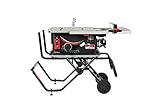


SawStop Compact vs Pro: the short decision
| Specification | SawStop Compact Table Saw (CTS) | SawStop Jobsite Saw Pro (JSS-120A60) |
|---|---|---|
| Blade diameter | 8-1/4 inches | 10 inches |
| Motor | 15-amp, 120-volt | 15-amp, 120-volt |
| Maximum cut depth at 90 degrees | 2-1/8 inches | 3-1/8 inches |
| Maximum rip capacity | 25-1/2 inches | 25-1/2 inches |
| Approximate saw weight | 68 pounds | 80 pounds |
| Elevation adjustment | One-turn elevation | One-turn elevation |
| Dust outlet | 2-1/2-inch port | 2-1/2-inch port with enclosed dust-collection design |
Specifications can vary slightly by package, stand, and regional configuration, so confirm the exact model number before ordering. The important point is that the Pro does not provide more maximum rip width than the Compact. Its advantages are the 10-inch blade, deeper cut, heavier construction, and jobsite stand system.
Where the Compact makes more sense
The Compact is the logical choice for a garage shop, apartment workshop, or remodeling setup where the saw must be moved around obstacles and stored after every project. At roughly 68 pounds, it is still substantial, but one person can lift it into a vehicle or onto a bench without turning every setup into a two-person job.
Its 25-1/2-inch rip capacity handles typical cabinet sides, shelving, trim stock, and many plywood breakdown tasks. The smaller 8-1/4-inch blade also keeps the saw’s overall package relatively compact. For common 3/4-inch sheet goods, its cutting depth is more than sufficient.
The trade-off appears when cutting thick hardwood, stacked material, or dimensional lumber. A 2-1/8-inch maximum depth leaves less room than the Pro, especially when making a 45-degree bevel cut. The Compact is also more sensitive to being placed on an uneven work surface because its lighter body has less mass to resist movement.
Why choose the SawStop Jobsite Saw Pro?
The sawstop jobsite saw pro is aimed at users who transport a table saw regularly but use it hard once it arrives. Its 10-inch blade reaches about 3-1/8 inches at 90 degrees, which covers standard 2-by stock in one pass with useful clearance. That extra capacity matters for framing, stair work, thick hardwood, and bevel cuts.
The Pro’s heavier body is not simply a disadvantage. More mass helps the saw stay planted while ripping long boards, and its jobsite stand gives a more consistent working height than an improvised garage bench. The stand also improves setup speed when the work area changes daily.
There is a practical cost: approximately 80 pounds for the saw before considering the stand and accessories. If the tool regularly has to travel up stairs, through finished homes, or into a truck bed alone, the Pro can become tiring. For a contractor who rolls it from a vehicle to a nearby cutting station, the added weight is easier to justify.
One-turn blade elevation: useful, but not magic
Both versions use one-turn blade elevation, so raising or lowering the blade takes much less rotation than on a conventional table saw. This is valuable when switching between thin plywood and thick lumber, or when setting the blade just above the workpiece for safer, cleaner cuts.
The best setting is usually only slightly higher than the material—approximately the height of the gullets above the top surface, rather than exposing the entire blade. One-turn adjustment makes that small correction quick, but it does not replace checking blade height, bevel angle, and lock before starting a cut.
After transport, inspect the elevation and bevel controls for dust or debris. A common mistake is assuming that a fast adjustment system means the blade cannot shift during loading. Verify the setting whenever the saw has been carried, folded, or stored on its side.
Dust collection: Pro advantage, same basic limit
Both saws use a 2-1/2-inch dust port, so either can connect to a shop vacuum or suitable dust extractor. The Compact’s open jobsite layout makes external extraction helpful, particularly when cutting plywood or MDF. Without a vacuum, fine dust can collect around the throat plate, motor housing, and fence rails.
The Pro’s enclosed blade area and dust-management design generally give it the edge when connected to extraction. It is still not a cabinet saw: a small amount of dust will escape during bevel cuts, narrow rips, and cuts involving warped stock. A high-airflow extractor with a clean filter matters more than simply owning a larger hose.
For a garage shop, route the hose so it cannot pull against the fence or catch on the stand. Empty the vacuum before a long sheet-goods session; a restricted or full collector can make an apparently well-sealed saw perform poorly.
Decision matrix: which one fits your work?
| Your situation | Better choice | Reason |
|---|---|---|
| Mostly 3/4-inch plywood, shelving, and trim | Compact | Matching rip width with lower weight and smaller storage footprint |
| Daily transport between jobsites | Pro | Heavier platform and more capable stand for repeated setup |
| Frequent cutting of 2-by lumber or thick hardwood | Pro | 10-inch blade and approximately 3-1/8-inch cut depth |
| Limited garage space or frequent bench storage | Compact | About 12 pounds lighter and easier to lift onto storage |
| One-person remodeling work with stairs | Compact | Reduced carrying fatigue is more useful than extra cut depth |
| Long rips where stability matters more than portability | Pro | More mass and a dedicated jobsite support system |
Ownership realities and maintenance
The parts most likely to need attention are not the safety electronics. Dust accumulates on the elevation mechanism, fence contact surfaces, and stand hinges. Keep the table clean and use a dry lubricant where the manufacturer permits; oily products can attract abrasive dust. Check the fence alignment after transport and confirm that it locks parallel to the blade before ripping.
Blade quality also affects the ownership experience. A dull or resin-coated blade increases feed pressure, worsens tear-out, and makes dust collection less effective. Keep a general-purpose combination blade for construction material and a finer-tooth blade for cabinet plywood or hardwood. Replace blades when cleaning no longer restores performance.
The safety brake system is a major reason to choose a SawStop, but it does not eliminate ordinary table-saw hazards. Use the guard and riving knife when the cut allows, keep hands away from the blade path, and support long or awkward stock. If the brake activates, stop and follow the model’s replacement and inspection procedure rather than bypassing the system.
Final verdict
Choose the Compact if your saw lives in a garage, moves between a bench and a storage shelf, and primarily cuts plywood, boards, and trim under 2 inches thick. Choose the Jobsite Saw Pro if you transport the saw often, cut thick stock, or value a heavier and more stable setup over easy lifting.
Because both offer a 25-1/2-inch rip capacity and one-turn elevation, the decision is less about maximum sheet width than about carrying weight, cut depth, stand stability, and dust containment. For most occasional woodworkers, the Compact saves space and effort. For daily site transport and demanding cuts, the Pro is the more complete sawstop table saw jobsite package.