
What's inside
As an Amazon Associate I earn from qualifying purchases. This post may contain affiliate links at no extra cost to you.
The best wooden hand planer for most fine joinery is a beech-bodied, bevel-down smoother with a 45–50 mm blade, a flat sole, and a mouth that can be closed finely enough to prevent tear-out; choose a longer jointer-style body when edge straightening matters more than final surface polish.
Wooden planes are lighter and quieter than metal-bodied planes, but they demand more attention to sole wear, humidity, blade setup, and mouth geometry. The right choice depends less on the country of manufacture than on the relationship between the plane’s body wood, blade steel, sole flatness, and the timber you intend to prepare.
As an Amazon Associate we earn from qualifying purchases at no extra cost to you.


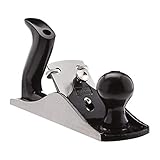
Best wooden hand planers by situation
| Situation | Best choice | Useful specification | Why it fits |
|---|---|---|---|
| First wooden plane | E.C.E. Primus-style No. 4 smoother | About 240–250 mm long; 45–50 mm blade; roughly 1.2–1.6 kg | Manageable size, replaceable iron, and enough sole length for general furniture work |
| Fine joinery and dense hardwood | HNT Gordon smoothing plane | Typically about 230–260 mm long; 50 mm blade; hard laminated or carbon-steel iron | Fine mouth and robust blade support suit short, controlled cuts in figured timber |
| Long edges and panel work | Ulmia or E.C.E. wooden jack/jointer plane | Approximately 350–600 mm long; 48–60 mm blade | The longer sole bridges hollows and produces straighter edges |
| Lowest-cost traditional option | Well-made wooden smoother from a specialist maker | 220–260 mm body; 45–50 mm iron; replaceable wedge | Good value if the sole and mouth are inspected before purchase |
| Very softwood or end-grain work | Low-angle wooden block-plane design | 150–220 mm long; 35–45 mm blade; 12–20° bed angle | A lower cutting angle reduces resistance, though it needs a fine mouth for clean end grain |
Dimensions vary between makers, so treat the figures as buying targets rather than universal specifications. A wooden hand planer weighing around 1.3 kg is usually easier to control for long smoothing sessions than a heavy jointer, while a 500 mm body is much better for correcting an edge than a 240 mm smoother.
Head-to-head: what the body wood changes
European beech
Beech is the conventional all-rounder. It is hard, close-grained, relatively stable when properly seasoned, and easy to shape accurately. E.C.E. and Ulmia-style planes commonly use beech or comparable European hardwoods. Beech bodies provide a good balance of wear resistance and moderate weight, making them suitable for softwood, maple, oak, cherry, and most cabinetmaking tasks.
The limitation is moisture movement. A beech sole can become slightly convex, concave, or twisted after a large change in workshop humidity. That does not automatically make the plane unusable, but it means the sole should be checked before precision work.
Hornbeam and other dense European hardwoods
Hornbeam is harder and more abrasion-resistant than beech, so it is attractive for a plane that will see frequent use or rougher stock preparation. It can feel more stable under repeated wear, although the added density increases weight. Hornbeam-bodied planes are particularly useful when working abrasive woods, reclaimed timber, or hardwoods with mineral contamination near the surface.
Australian hardwoods
HNT Gordon planes are known for traditionally styled wooden bodies made from Australian hardwoods, with models intended for smoothing, joinery, and specialty work. The important buying question is not simply the species name: inspect whether the sole is straight, whether the wedge holds securely, and whether the maker has fitted the iron so it bears evenly.
A dense hardwood body can survive years of use, but it is not immune to seasonal movement. Store any wooden plane supported on its side or on small runners rather than leaving the sole pressed against a damp bench.
Wooden bodies to approach cautiously
Very light woods can make a plane comfortable for extended work, but they dent more easily and may wear quickly at the mouth. Decorative exotic woods are not automatically better. A stable beech plane with a well-fitted iron will outperform a beautiful but poorly seasoned body.
Blade steel matters more than the logo
Traditional wooden planes use a thick, single iron held by a wedge, while some modern designs use a cap iron or a separate chipbreaker. A single iron is simple and quick to sharpen. A cap iron can improve shaving control in difficult grain, but only when its edge is fitted closely and adjusted correctly.
- Plain carbon steel: easy to sharpen and capable of a keen edge, but it can rust quickly if stored damp.
- High-carbon tool steel: a practical choice for daily use because it combines edge life with straightforward sharpening.
- High-speed steel: resists edge loss on abrasive material, but it takes longer to sharpen and is less forgiving with traditional hand tools.
- Laminated or hard-alloy irons: often provide a hard cutting layer backed by a tougher body, but replacement irons may be less readily available.
For pine, spruce, fir, and ordinary hardwood, a well-tempered carbon-steel iron is sufficient. For hard maple, beech, white oak, and figured wood, prioritize an iron at least 3–4 mm thick and a mouth that can close to approximately 0.5–1 mm for finishing cuts. Thick irons resist chatter, but they also make the plane heavier and more demanding to sharpen.
Sole flatness and mouth adjustment: the deciding details
A wooden hand planer does not need a perfectly polished sole, but the working area must be reliably flat. For a smoother, check the toe, area immediately in front of the mouth, and heel on a known-flat surface. A gap of about 0.1 mm under a straightedge may be acceptable away from the mouth; a hollow directly in front of the mouth is more troublesome because it allows the sole to rock during a cut.
The mouth controls how much unsupported wood reaches the cutting edge. A wide opening is useful for thick shavings and initial flattening, but it allows grain to lift ahead of the blade. A narrow opening supports the fibers and reduces tear-out in figured maple, reversing-grain oak, and interlocked cherry.
Traditional wooden planes usually adjust the mouth by moving the iron bedding or modifying the front edge of the sole. This is precise but not always convenient. A plane advertised as having an adjustable mouth may use a sliding front section, a movable toe, or interchangeable mouth inserts. Confirm how the adjustment works before buying: some systems are quick to change, while others are intended to be set once and left alone.
Which plane handles which wood?
| Wood and task | Preferred plane | Setup | Common mistake |
|---|---|---|---|
| Softwood face smoothing | Medium-length smoother | Moderate cut, 45° bed, mouth around 1 mm | Taking an excessively fine cut that compresses rather than cuts the fibers |
| Hard maple and beech | Heavy smoother with thick iron | Very sharp edge, fine mouth, shallow cut | Using a wide mouth and forcing the plane through changing grain |
| Figured or interlocked grain | Fine-mouth smoother or low-angle plane | Skew the plane 20–30° and reduce shaving thickness | Increasing force instead of reducing the cut |
| Long board edges | Jointer plane, 450–600 mm body | Slightly cambered iron for stock removal | Expecting a short smoother to correct a bowed edge |
| End grain | Low-angle block-plane design | Very sharp iron and fine mouth | Blunting the edge by taking a heavy cut across the full width |
Setup and maintenance that protect the investment
- Check the body first. Sight along the sole and confirm that the wedge is not cracked. Small cosmetic marks are less important than a twisted sole or loose iron.
- Flatten only what is necessary. Use abrasive paper on a flat board or a jointer bed. Remove the minimum material needed to create a continuous bearing surface, especially around the mouth.
- Sharpen to the intended job. A 25–30° primary bevel with a small 30–35° secondary bevel is a useful general range. Hone until the edge produces a continuous wire-free polish.
- Set the iron evenly. Tap the iron laterally, if the design allows it, until the shaving is equally wide on both sides. Adjust depth with light taps rather than striking the wedge aggressively.
- Wax and store correctly. A thin coat of paste wax on the sole reduces friction and slows moisture exchange. Do not saturate the wood with oil, which can soften some surfaces and attract dust.
- Recheck seasonally. In a dry winter or humid summer, verify sole flatness and wedge tension before precision joinery.
The parts that wear first are usually the cutting edge, the sole immediately around the mouth, and the wedge contact surfaces. Replacement irons are a normal ownership cost. If a plane is used twice a week and an iron needs sharpening or replacement every 6–12 months, an extra iron costing roughly $30–$90 adds about $0.30–$0.85 per use over 100 sessions. That is often cheaper than replacing a poorly fitting plane, so confirm that replacement blades are available before purchasing.
Final buying recommendation
Choose a beech or dense hardwood smoother around 240 mm long if you want one wooden hand planer for general furniture work. Select an HNT Gordon-style hardwood smoother when fine mouth control and a traditionally fitted body are priorities. Choose an E.C.E. or Ulmia-style longer plane for jointing edges and flattening panels, and choose a low-angle wooden block-plane design for end grain and small parts.
Before paying, ask for the actual blade width, body length, iron thickness, sole-flatness tolerance, mouth-adjustment method, and replacement-iron availability. Those details reveal far more about a wooden plane’s usefulness than its finish or the species printed on the product label.