
What's inside
As an Amazon Associate I earn from qualifying purchases. This post may contain affiliate links at no extra cost to you.
The best budget thickness planer for most home workshops is a 12½-inch benchtop model with a three-knife cutterhead: it handles common furniture stock, replacement knives are widely available, and the machine is easier to fit and move than a floor-standing planer. Choose a compact 10-inch machine for occasional narrow boards, or step up to a helical-head model if quieter cutting and longer intervals between knife changes matter more than the lowest purchase price.
Prices and specifications below are approximate U.S. market ranges and can vary by configuration and retailer. Confirm the manual for the exact model before buying: listed maximum width and depth do not mean a planer can remove that much material in one pass.
As an Amazon Associate we earn from qualifying purchases at no extra cost to you.
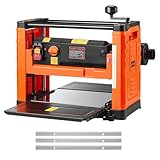


Budget planer comparison: what the numbers mean in a home shop
| Planer | Capacity | Cutterhead and feed | Approx. weight | Typical price range | Best fit |
|---|---|---|---|---|---|
| DEWALT DW734 | 12½-inch width; 6-inch maximum depth | Three knives; two feed speeds | About 80 lb | $450–$600 | Regular use and users who value a slower finishing feed option |
| DEWALT DW735 | 13-inch width; 6-inch maximum depth | Three knives; two feed speeds | About 92 lb | $600–$800 | Frequent work, wider stock, and a more substantial benchtop setup |
| WEN PL1326 | 13-inch width; 6-inch maximum depth | Helical-style cutterhead with 26 inserts; one feed speed | About 80 lb | $400–$550 | Budget-minded users seeking an insert-head finish and simpler knife changes |
| WEN PL1252 | 12½-inch width; 6-inch maximum depth | Three knives; two feed speeds | About 55 lb | $300–$400 | Occasional work and shops where storage or lifting matters |
Capacity figures are maximum openings, not recommended pass sizes. Cutting width, species, grain, board flatness, and knife condition all affect how much material a machine can remove cleanly. These models are benchtop planers, not jointers: a board needs one flat face before thicknessing, or the planer will usually reproduce its bend or twist.
Pick by workload and shop constraints
- Small shop, occasional projects: The WEN PL1252 is a lighter, lower-cost choice if you mostly dimension boards up to 12½ inches wide. Its three-knife head is familiar and economical to maintain. Plan on storing it securely and setting up support stands when long stock is involved.
- Regular furniture work, limited budget: The DEWALT DW734 offers two feed speeds, so you can use a slower pass when surface finish matters. Its weight is an advantage for stability but a drawback if the machine must be moved after every use.
- Frequent use or wider boards: The DW735 adds a half-inch of capacity over 12½-inch machines and is built for a more permanent benchtop station. It is heavy, loud, and typically costs more; its two-speed feed helps balance output and finish.
- Noise-sensitive shop, frequent knife changes a concern: Consider the WEN PL1326’s replaceable-insert cutterhead. Small inserts can be rotated or replaced individually, and the cut tends to be less abrupt than a straight-knife head. It is still a loud, high-speed machine, and inserts are a continuing cost.
“Quieter” is relative. Any thickness planer can produce hazardous noise levels, particularly in a small room. Wear hearing protection, use dust collection, and avoid running the machine in a shared living space without considering the noise and dust that escape the collection system.
Width, depth, and snipe: the practical limits
A 12½- or 13-inch planer covers most boards used in home furniture projects. Wider panels can sometimes be thicknessed in overlapping passes, but keeping the face level and the overlap consistent is difficult. For wide tabletops, a drum sander, router sled, or wide-belt service may be a better solution than trying to push a panel through a benchtop planer.
Maximum depth capacity describes the tallest piece that fits through the opening; it does not describe the amount removed in one cut. Start with a shallow cut—often around 1/32 inch for wide, hard, or figured stock—and increase only if the machine feeds smoothly and the finish stays acceptable. Take lighter cuts on figured grain to reduce tear-out.
Snipe is a deeper cut near a board’s leading or trailing end. It occurs when the board’s weight or handling changes as it engages or leaves the rollers, and it can happen on any benchtop planer. To reduce it:
- Put the planer on a rigid, level stand and align the infeed and outfeed support with the table.
- Keep the board level as it enters and exits; do not lift or push down on its end while the rollers grip it.
- Use the manufacturer’s bed-extension or snipe-adjustment procedure, if provided, and verify the setting with scrap.
- When possible, plane longer stock and cut the damaged ends off afterward. For valuable short pieces, test the setup on similar scrap first.
Support helps, but it does not guarantee snipe-free results. Feed boards end-to-end with a small gap when the manual allows it; never force a board or put hands near the cutterhead.
Cutter performance and ownership costs
Three-knife straight cutters are a good value when low-cost replacement knives and a clean, even cut are priorities. Their trade-offs are noise, a more noticeable cutting impact, and the need to change or index a full set when the edge wears or gets nicked. A single damaged or dull knife can leave repeating lines across the board.
Helical-style heads use multiple small carbide inserts. A nick may affect only one insert, which can often be rotated to a fresh edge. They can leave a smoother surface on difficult grain and reduce the sharpness of the cutting noise, but they do not eliminate tear-out, dust, or loud operation. Replacement inserts add to ownership cost, and a cutterhead retrofit is not automatically compatible with every budget planer.
For either style, expect dust collection to be essential. Planers eject chips quickly; a shop vacuum may struggle with continuous use, while a suitable dust collector and clear hose reduce clogging. Check the chip chute during setup, especially when cutting resinous wood or taking heavy passes.
A simple cost-per-use check
Suppose a planer costs $500 and you use it for 25 projects over five years. The machine cost works out to $20 per project before knives, inserts, dust collection, and electricity. At five projects, it is $100 per project. This does not make the less expensive model automatically better: a machine that is awkward to set up or too narrow for your stock may get used less. Estimate your actual project frequency and include the cost of consumables before comparing a straight-knife model with an insert-head option.
What wears first—and how to make a budget planer last
Knives or inserts are the main wear items. Abrasive grit, hidden fasteners, and dirty reclaimed lumber can dull edges or chip carbide quickly, so inspect stock with a metal detector where appropriate and remove dirt before planing. Feed clean, dry wood; wet or resin-heavy stock can leave buildup on rollers and the cutterhead.
After use, disconnect power before cleaning. Clear chips from the table and chute, inspect the rollers and knives or inserts, and follow the manual’s instructions for lubrication and adjustment. Waxing the table with an appropriate non-silicone product can help boards feed smoothly; avoid products that could interfere with later finishing. Do not change cutter settings or remove guards while the machine is plugged in.
Before buying, check replacement-knife or insert availability, the cost of a full set, dust-port size, and whether the machine fits your stand and storage plan. A 90-pound planer that stays bolted to a stable station may suit a frequent user; a lighter machine is easier to stow, but still needs solid support when operating.
Bottom line
For the broadest balance of capacity and value, start with a 12½-inch, three-knife planer such as the DEWALT DW734. Choose the WEN PL1252 if price and portability matter most and your workload is occasional. The DW735 is the stronger match for frequent use and wider stock, while the WEN PL1326 is worth considering when insert-style cutting and easier localized edge replacement appeal to you. Whichever you choose, a flat reference face, light passes, stable support, and dust collection will have as much effect on the result as the planer’s headline capacity.