
What's inside
As an Amazon Associate I earn from qualifying purchases. This post may contain affiliate links at no extra cost to you.
The best drill press for beginners is the WEN 4214T for most home workshops, while the WEN 4212T suits tighter budgets and the JET JDP-15B is the better choice for frequent, larger woodworking projects.
A drill press is easier to learn than a handheld drill when you need repeatable holes, clean entry and exit points, or accurate dowel and hardware placement. For a first machine, capacity matters, but so do speed changes, table adjustment, setup effort, and the ability to keep the spindle square to the work.
As an Amazon Associate we earn from qualifying purchases at no extra cost to you.

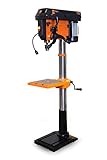


Quick comparison: beginner-friendly drill presses
| Model | Type and capacity | Speed range | Table adjustment | Approx. weight | Best fit |
|---|---|---|---|---|---|
| WEN 4212T | Benchtop, 10-inch swing; about 2-1/2-inch spindle travel | 5 variable speeds, roughly 600–3,100 RPM | Height and tilt adjustment; geared rack | About 55 lb | Low-cost first drill press and small projects |
| WEN 4214T | Benchtop, 12-inch swing; about 3-1/8-inch spindle travel | Variable speed, roughly 580–3,200 RPM | Rack-and-pinion height adjustment; tilting table | About 75 lb | Best all-around beginner choice |
| Shop Fox W1848 | Benchtop, 13-inch swing; about 3-1/8-inch spindle travel | Variable speed, approximately 250–3,050 RPM | Rack-and-pinion height adjustment; tilting table | About 90 lb | Woodworkers who need slower speeds and more capacity |
| JET JDP-15B | Floor model, 15-inch swing; about 3-1/8-inch spindle travel | 12 speeds, approximately 210–3,500 RPM | Large geared table with height and tilt adjustment | About 150 lb | Frequent use, large workpieces, and long-term ownership |
Specifications can vary slightly by revision and market, so confirm the manufacturer’s current specification sheet before ordering. The useful comparison is not just the largest swing: it is how easily the machine accommodates the bits, materials, and projects you actually expect to make.
Our beginner picks by workshop situation
Best overall: WEN 4214T
The WEN 4214T offers a practical middle ground. Its 12-inch swing gives you room to drill near the center of a moderately wide panel, while its variable-speed control avoids the chore of moving a belt every time you switch from a small brad-point bit to a larger Forstner bit.
For typical woodworking, the roughly 3-inch-plus spindle travel is enough for through-holes in common boards, stopped holes for joinery, and hardware installation. The rack-and-pinion table is also friendlier for beginners than a table that must be lifted manually and held in place while its clamp is tightened.
Choose it when you have a sturdy bench, expect to use the machine regularly, and want room to grow without immediately buying a floor-standing machine. Its general market price is usually in the mid-range for benchtop drill presses rather than the entry-level tier.
Best budget choice: WEN 4212T
The WEN 4212T is a sensible starting point for occasional drilling, small furniture parts, shelves, boxes, and basic shop fixtures. Its 10-inch swing is adequate for many boards and narrow assemblies, and its variable-speed design is more convenient than a basic fixed-speed press.
The trade-off is working room. A 10-inch swing means the distance from the spindle center to the column is about 5 inches, before allowing for the actual table and workpiece shape. That is plenty for a 3-inch-wide cabinet rail, but not enough for drilling near the center of a wide tabletop.
It is also lighter than larger machines. That makes it easier to move, but it increases the importance of bolting it to a solid bench. A press that shifts during drilling can produce a hole that is technically vertical relative to the machine but incorrectly positioned on the workpiece.
Best for slower speeds and larger bits: Shop Fox W1848
The Shop Fox W1848 is attractive when your projects include large Forstner bits, wide construction lumber, or repeated drilling through thick stock. Its lower minimum speed gives you more control with larger-diameter cutters, which generally should not be run at the same speed as a 1/8-inch twist bit.
The larger table and heavier construction can reduce vibration, especially when the machine is properly anchored. This model takes more floor or bench space and costs more than a basic beginner press, so it is best for a woodworker who already knows that a small machine would soon feel restrictive.
Best for a permanent workshop: JET JDP-15B
The JET JDP-15B is a floor-standing choice for users who drill often, work with larger panels, or want a more substantial machine that does not need to be moved after every project. Its 15-inch swing, broad work area, and 12-speed range provide more flexibility than most entry-level benchtop presses.
Its disadvantages are the same features that make it capable: it is heavy, takes considerable space, and generally costs several times as much as a basic benchtop model. It also requires more planning during delivery and assembly. For a beginner making occasional holes in small parts, that extra capacity will not automatically improve results.
How to choose between them
| Your situation | Recommended direction | Why |
|---|---|---|
| Lowest reasonable cost and small projects | WEN 4212T | Compact capacity and variable speed without paying for a floor model |
| First serious press for furniture and joinery | WEN 4214T | Useful 12-inch swing, adequate travel, and simple table adjustment |
| Frequent large-hole drilling | Shop Fox W1848 | Lower speeds, more mass, and additional working room |
| Permanent shop and heavy weekly use | JET JDP-15B | Floor-standing stability and a wider speed selection |
| Very limited bench space | Compact benchtop press | A 10-inch class machine is easier to store, but check swing before buying |
What the specifications mean for woodworking
Swing and spindle travel
Swing is twice the distance from the spindle center to the column. A 12-inch drill press can theoretically reach 6 inches from the edge of a workpiece to the hole center. In practice, subtract space for the table edge, clamps, and the shape of the workpiece.
Spindle travel is the distance the chuck and bit move downward. Around 2-1/2 to 3-1/8 inches is enough for most cabinet, furniture, and small-shop tasks. A deep hole still needs a bit with a suitable flute length; spindle travel alone does not determine how deep a cutter can safely drill.
Variable speed versus stepped pulleys
Variable speed is beginner-friendly because it allows quick changes for different bit diameters. However, a belt-and-pulley machine can provide excellent results and may have fewer electronic parts to maintain. The important point is to change speed before starting the motor, not while the spindle is running.
As a rough starting point, small twist bits often tolerate several thousand RPM in softwood, while large Forstner bits commonly need a few hundred to around 1,000 RPM depending on diameter, material, and cutter guidance. When uncertain, begin slower and increase only if the bit cuts cleanly without burning.
Setup steps that protect accuracy
- Secure the machine. Bolt a benchtop press to a rigid surface. Use a stable, level floor and anchor a floor model according to its instructions.
- Clean the taper and chuck. Remove shipping oil, dust, and chips before installing the chuck or arbor. Contamination can create runout.
- Check table squareness. Place a known-straight bit or rod in the chuck and compare it with a small engineer’s square. Adjust the table before drilling joinery holes.
- Use a sacrificial board. Clamp scrap beneath the workpiece to reduce tear-out as the bit exits. This also protects the drill-press table.
- Clamp the work. Never hold a loose board by hand when a bit can catch it. A clamp or drill-press vise prevents the workpiece from spinning.
- Set depth with a test piece. For stopped holes, drill scrap first and measure the actual depth rather than relying only on the depth stop scale.
A useful accuracy check is to drill a hole halfway through a scrap block, turn the block over using a reference edge, and drill from the opposite side. If the two holes do not meet cleanly, check table alignment, quill play, bit condition, and whether the block was held square.
Ownership costs and common maintenance issues
Plan on a general market price of roughly $150–$350 for an entry-level benchtop press, about $300–$700 for a heavier benchtop model, and $700–$1,500 or more for a substantial floor-standing machine. The machine is only part of the budget: add quality brad-point bits, Forstner bits, a clamp or vise, eye protection, and a sacrificial board.
The first items that commonly cause trouble are dull or overheated bits, loose belts, dirty quill components, and a chuck that has collected dust. Brush chips from the table and column after each session, keep the quill and rack lightly maintained according to the manual, and inspect the belt for glazing or cracks. Do not lubricate parts unless the manufacturer specifies the lubricant; excess oil can attract abrasive dust.
For most beginners, spending more on a rigid stand, accurate layout tools, and good bits produces a larger improvement than buying the largest available press. If your work is mainly boxes, shelves, cabinet parts, and small furniture, the WEN 4214T is the most balanced starting point. Choose the WEN 4212T when space and budget dominate, and move to the Shop Fox W1848 or JET JDP-15B when larger workpieces and frequent drilling justify the additional size and cost.