
What's inside
As an Amazon Associate I earn from qualifying purchases. This post may contain affiliate links at no extra cost to you.
The best benchtop scroll saw for most woodworkers is the 20-inch DeWalt DW788, while the 22-inch Jet JWSS-22B is the better choice for frequent work, the 21-inch Excalibur EX-21 for maximum cutting control, and the WEN 3921 for a tight budget.
Those recommendations depend less on advertised speed than on six practical questions: how much material fits in front of the blade, how thick you normally cut, how much vibration reaches the bench, whether the table supports your work, how quickly you can change blades, and whether the saw stays fixed during a cut.
As an Amazon Associate we earn from qualifying purchases at no extra cost to you.
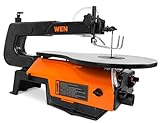


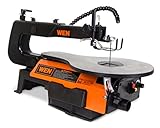
Best benchtop scroll saws compared
| Model | Throat capacity | Published maximum cutting thickness | Speed range | Table size | Approx. weight | Best for |
|---|---|---|---|---|---|---|
| DeWalt DW788 | 20 in | 2 in | 400–1,750 SPM | 16 x 23 3/4 in | 56 lb | Quiet, controlled general-purpose work |
| Jet JWSS-22B | 22 in | 2 in | 400–1,550 SPM | 16 x 23 in | 70 lb | Frequent use and large patterns |
| Excalibur EX-21 | 21 in | 2 in | 400–1,550 SPM | 16 x 32 in | 70 lb | Large workpieces and easy blade access |
| WEN 3921 | 16 in | 2 in | 550–1,600 SPM | 16 x 10 in | 28 lb | Occasional projects and low cost |
| Delta 40-694 | 20 in | 2 1/8 in | 400–1,750 SPM | 16 x 24 in | 60 lb | Heavy benchtop work and large stock |
Specifications can vary slightly by production revision and market, so confirm the current manual before buying. The table is most useful for comparing scale: a 22-inch throat gives more room for rotating a large panel, but it does not automatically make intricate cuts more accurate.
Head-to-head: which saw fits your situation?
| Your situation | Best match | Why | Main compromise |
|---|---|---|---|
| First scroll saw, occasional use, limited budget | WEN 3921 | Low purchase cost, variable speed, 16-inch throat, and tool-free upper blade access | Lighter body can move unless firmly bolted down |
| Regular fretwork and general shop projects | DeWalt DW788 | 20-inch capacity, smooth linkage, broad table, and good control at low speed | Costs more than entry-level saws; front blade access is not the fastest design |
| Large patterns or long sessions | Jet JWSS-22B | 22-inch throat, sturdy base, useful dust collection, and quick-access blade clamps | Heavier and more expensive |
| Maximum visibility and frequent blade changes | Excalibur EX-21 | Tilting head and accessible blade-clamp arrangement simplify inside cuts | Large footprint and premium pricing |
| Heavy stock and a permanent bench location | Delta 40-694 | Rigid construction, 20-inch reach, and a slightly greater published thickness capacity | Less convenient to move or store |
DeWalt DW788: the balanced choice
The DW788 remains an especially safe recommendation when accuracy and comfort matter more than the lowest price. Its parallel-arm mechanism is designed to reduce blade deflection and produce a smooth stroke, and its 20-inch throat handles most fretwork, ornaments, signs, and small furniture details.
Its broad cast-iron table gives a stable platform for rotating a pattern. The limitation is blade-change access: changing a blade inside a closed workpiece is not as immediately convenient as on saws with front-facing clamps. It is also too heavy to treat as a casually portable tool. Bolt it to a bench or a rigid stand rather than relying on its weight alone.
Jet JWSS-22B: best for frequent use
The JWSS-22B is the stronger choice when a scroll saw will be used every week. Its 22-inch throat provides extra clearance for large panels, while the substantial frame helps suppress movement. Front-access blade clamps make internal cuts less frustrating, particularly when a project requires many pierced openings.
The extra capacity is useful only if your patterns need it. For small inlay pieces, a larger throat will not compensate for a dull blade, excessive feed pressure, or a flexible bench. The Jet also deserves a permanent mounting position because its weight and footprint make repeated lifting inconvenient.
Excalibur EX-21: best for access and oversized work
The EX-21’s tilting-head design is its defining advantage. Instead of tilting the table and potentially changing how the work rests on the surface, the head can be positioned to improve visibility or accommodate an awkward workpiece. That can make inside cuts and pattern alignment easier.
The long table and 21-inch throat suit larger decorative panels. Its premium design makes the most sense for a serious hobbyist, sign maker, or small shop that changes blades often. It occupies more bench depth than the raw throat number suggests, so measure the motor and rear-arm clearance as well as the table.
WEN 3921: a sensible low-cost entry point
The WEN 3921 delivers useful capacity for occasional work and accepts pinned and pinless blades. Its lighter 28-pound body makes storage easier, but that is also its main vibration disadvantage. A saw this light can creep across a smooth bench or transmit more movement through thin stock.
Use bolts, large washers, and a rigid bench surface. If permanent holes are not acceptable, a temporary mounting board clamped to the bench is better than rubber feet alone. The WEN is a practical way to discover whether scroll sawing suits you, but frequent production work may justify stepping up to a heavier frame.
Why mounting matters more than a small speed difference
A scroll saw cuts with a reciprocating blade, so every stroke creates a force that the frame and bench must absorb. A secure mount improves line control, reduces visible vibration, and prevents the workpiece from bouncing against the table.
For a typical 20-inch saw, use four mounting points if the base provides them. Drill through a bench at least 1 1/2 inches thick, or mount the saw to a plywood or MDF board at least 3/4 inch thick and clamp that board to the bench. Use bolts rather than short wood screws where possible. Add flat washers under the bolt heads and nuts to spread the load, but do not compress rubber isolation feet so tightly that they become ineffective.
Before final tightening, check that the table remains level and that the blade is square to it. A secure saw on a flexible folding table can still vibrate; mounting solves movement, not an unstable support structure.
Blade-change access and cutting accuracy
For pierced fretwork, blade changes are part of the normal workflow. A convenient saw should let you release the upper and lower clamps without contorting your hands around the arm. Front-access clamps are particularly valuable when the blade must pass through a drilled hole in the middle of a workpiece.
Pinless blades are preferred for fine patterns because their narrow ends fit through small drilled holes. They also require careful clamping: too little tension allows wandering, while too much tension can damage the blade or clamp. Pinned blades are faster for simple through-cuts but limit the minimum starting-hole size.
Choose blade speed according to the material and pattern. Slow settings generally give better control in tight turns and reduce burning in some woods. Fast settings can improve progress through soft stock, but forcing the workpiece is a common cause of broken blades and rough edges. Let the teeth cut; do not push faster than the blade can clear dust.
Ownership costs and maintenance
Blades are the main consumable. A useful planning estimate is $10–$20 for a multi-blade pack, depending on type and quantity. If one blade lasts two hours of actual cutting, a 40-blade pack containing 20 hours of usable life costs about $0.50–$1 per cutting hour, before counting wood and electricity. Hard abrasive woods, plywood glue, and excessive feed pressure shorten that life.
- Vacuum dust from the table, arm linkage, and vents regularly; packed dust can affect movement and cooling.
- Inspect blade clamps for resin buildup and tighten them consistently.
- Lubricate only the points specified by the manual. Excess oil attracts fine dust.
- Replace a blade when it requires unusual pressure, burns the cut, or wanders despite correct tension.
- Check mounting bolts periodically because vibration can loosen hardware over time.
- Use a zero-clearance insert or clean table support for very small pieces, while keeping fingers away from the blade path.
On budget machines, the first frustrations are often loose clamps, table movement, and vibration rather than motor failure. On heavily used machines, blade-clamp wear, linkage bearings, and dust-exposed switches deserve attention. Keeping the saw clean and avoiding forced cuts does more for service life than running it at maximum speed.
Bottom line
Choose the WEN 3921 when price and storage are decisive, but mount it securely. Choose the DeWalt DW788 for the best all-round balance of capacity, smooth operation, and comfortable control. Choose the Jet JWSS-22B for larger work and regular use, or the Excalibur EX-21 when blade access and head positioning are worth paying for. The Delta 40-694 is a strong permanent-bench option for woodworkers who value a substantial frame and do not need portability.