
What's inside
- Makita Band Saw Lineup at a Glance
- Cutting Capacity: What Those Numbers Mean in Practice
- Battery Compatibility and Runtime Explained
- Weight, Balance, and Where Each Model Fits Best
- Decision Matrix: Match Your Situation to the Model
- Durability and Ownership Realities
- Beyond the Spec Sheet: What a Listing Won’t Tell You
- FAQ
- Related Guides
As an Amazon Associate I earn from qualifying purchases. This post may contain affiliate links at no extra cost to you.
The right Makita band saw for you comes down to cut capacity and battery platform: choose the 18V LXT Compact XBP03Z for one-handed work up to 3-1/4 inches, the 18V LXT Deep Cut XBP02Z or corded 2107F for 4-3/4 to 5-inch material, and the 40V XGT PB002G if you are already invested in Makita’s XGT system and want the longest runtime.
As an Amazon Associate we earn from qualifying purchases at no extra cost to you.
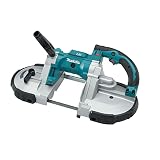


Makita Band Saw Lineup at a Glance
Makita keeps its portable band saw range intentionally small. As of 2026, there are four core models relevant to most workshop and jobsite buyers in North America. All use a 1/2-inch wide blade and variable-speed dials, but they differ significantly in capacity, weight, and power source.
| Model | Power Source | Cut Capacity (W x H) | Blade Size (L x W x Thickness) | Blade Speed (FPM) | Weight (Bare Tool) |
|---|---|---|---|---|---|
| XBP03Z Compact | 18V LXT | 3-1/4″ x 3-1/4″ (83 x 83 mm) | 28-3/4″ x 1/2″ x 0.020″ | 0 – 630, variable dial + trigger | 7.7 lbs (3.5 kg) |
| XBP02Z Deep Cut | 18V LXT | 5″ x 5″ (127 x 127 mm) rectangular, 5″ round | 44-7/8″ x 1/2″ x 0.020″ | 0 – 630, variable dial + trigger | 14.2 lbs (6.4 kg) |
| PB002G / PB002GZ | 40V XGT | 5″ x 5″ (127 x 127 mm) rectangular, 5″ round | 44-7/8″ x 1/2″ x 0.020″ | 0 – 630, variable dial + trigger | 14.8 lbs (6.7 kg) |
| 2107F Corded | 120V AC | 4-3/4″ x 4-3/4″ (120 x 120 mm) | 44-7/8″ x 1/2″ x 0.020″ | 235 – 505, variable dial | 13.1 lbs (5.9 kg) |
The XBP03Z is the outlier. Its shorter blade and smaller frame make it dramatically more compact than the other three, which all share the same 44-7/8-inch blade length and similar deep-cut frames. That shared blade length is useful for ownership costs, as blades for the three larger saws are interchangeable.
Cutting Capacity: What Those Numbers Mean in Practice
Cut capacity is listed as width x height with the material held in the vise or against the adjustable stop. Round capacity is the maximum diameter of pipe or solid bar you can pass through.
3-1/4-Inch Class (XBP03Z)
Designed for electrical, plumbing, and light fabrication. It will cleanly cut 2-inch EMT and rigid conduit, 2-1/2-inch copper, 2×2-inch angle iron, 2-inch unistrut, and threaded rod up to 3/4 inch in a single pass. It will not clear a 4-inch pipe or a 4×4 wood post. If your work is consistently under 3 inches, the smaller throat makes alignment faster and reduces blade wander.
4-3/4 to 5-Inch Class (2107F, XBP02Z, PB002G)
This is the standard for commercial work. A true 5-inch capacity clears 4-inch Schedule 40 steel pipe (4.5-inch OD), 4-inch square tubing, 5-inch C-channel laid flat, and double-stacked 2-inch conduit. The corded 2107F is listed at 4-3/4 inches rather than 5 inches, but in practice the difference is 1/4 inch of usable height at the guide rollers; both will cut the same common materials without repositioning.
All four models cut wood, plastics, and non-ferrous metals with the correct TPI blade. Makita ships them with 14 TPI bi-metal blades for general metal cutting. For wood and PVC, a 6-10 TPI hook-tooth blade reduces clogging, while 18-24 TPI is better for thin-wall conduit under 1/16 inch to keep at least 3 teeth in the cut.
Battery Compatibility and Runtime Explained
Makita’s two cordless platforms are not cross-compatible. This is the most common buying mistake.
- 18V LXT models (XBP03Z, XBP02Z): Use any 18V LXT battery (2.0Ah to 6.0Ah). They also work with the X2 (36V) adapter if you use two 18V packs, but the saws themselves are single-battery tools. Best value pairing is a 5.0Ah or 6.0Ah battery for weight-to-runtime balance.
- 40V XGT model (PB002G): Uses only 40V max XGT batteries (2.0Ah, 2.5Ah, 4.0Ah, 5.0Ah, 8.0Ah). You cannot use LXT batteries on it, and you cannot use XGT batteries on LXT tools. Chargers are also separate unless you own the dual-platform DC40RB + ADP10 adapter setup.
- Corded 2107F: No battery concern, unlimited runtime, but tethered to 120V. It has the most consistent speed under heavy load.
How Much Runtime to Expect: A Worked Calculation
Makita does not publish cuts-per-charge because material matters so much, but you can estimate from battery energy. An 18V 5.0Ah pack holds about 90 watt-hours (18V x 5.0Ah). An XGT 40V 4.0Ah pack holds about 144 watt-hours (36V nominal x 4.0Ah).
Taking real-world averages for a sharp 14 TPI blade in mild steel:
- Cutting 1-1/2-inch EMT (thin wall) takes roughly 6-8 watt-hours per cut on the XBP02Z.
- Cutting 2-inch Schedule 40 steel pipe takes roughly 18-22 watt-hours per cut.
That means:
- On an 18V 5.0Ah battery: ~11-15 cuts in 1-1/2-inch EMT, or ~4-5 cuts in 2-inch heavy-wall pipe before the battery is empty.
- On a 40V XGT 4.0Ah battery: ~18-24 cuts in 1-1/2-inch EMT, or ~7-8 cuts in 2-inch heavy-wall pipe.
- Switching to an 18V 6.0Ah (108 Wh) adds about 20% more cuts; an XGT 5.0Ah (180 Wh) adds about 25% over the 4.0Ah.
If you make 20-30 cuts per day in light conduit, a single 5.0Ah LXT pack on the compact XBP03Z will often last a full day. If you cut 3-inch and larger steel or unistrut all day, plan on two to three large packs per saw, or choose the corded 2107F for shop use.
Weight, Balance, and Where Each Model Fits Best
Weight tells only half the story. The compact XBP03Z at 7.7 pounds can be operated one-handed overhead for cutting all-thread or strut, with the other hand stabilizing the material. Its center of gravity sits directly over the handle.
The deep-cut models (14-15 pounds bare, 15.5-17 pounds with a large battery) require two hands. They are steadier on a workbench or with the material clamped, and the adjustable material stop and D-shaped handle reduce fatigue when making repeated vertical cuts. The corded 2107F is slightly lighter than the cordless deep-cuts without a battery, but the cord itself adds drag when moving around a jobsite.
Decision Matrix: Match Your Situation to the Model
| Your Situation | Best Fit | Why |
|---|---|---|
| Electrician / plumber, mostly conduit, strut, threaded rod under 3 inches; work overhead or on a ladder | XBP03Z Compact (18V LXT) | One-handed control, lightest to carry, least need for large capacity |
| Already own 18V LXT tools and batteries, need to cut up to 5-inch pipe or structural steel occasionally | XBP02Z Deep Cut (18V LXT) | Full capacity without buying into a new battery system, same blade as corded |
| Already invested in 40V XGT, want maximum cuts per charge and fastest charging | PB002G (40V XGT) | Larger energy pack, stays within one charger ecosystem, same capacity as XBP02Z |
| Fixed workshop, fabrication table, daily heavy use, no need for portability | 2107F Corded | No battery swaps, consistent torque, lowest long-term cost if you have power |
| Tight shop space, occasional metal + wood cutting, budget conscious | XBP03Z or 2107F depending on power preference | Compact saves storage space; corded saves battery investment |
If you own no Makita batteries yet, decide on the platform first, not the saw. 18V LXT has the broadest tool range and lower-cost batteries, with general market ranges typically lower than XGT. 40V XGT is newer, more powerful, and the direction Makita is expanding, but entry cost is higher. Buying a deep-cut saw on the wrong platform just to get one tool will cost more in batteries and chargers than the price difference between the saws themselves.
Durability and Ownership Realities
Portable band saws are low-maintenance, but these parts determine ownership cost:
- Blades wear first. Bi-metal blades dull faster when you cut with too few teeth in the material or force the saw. Keep at least 3 teeth engaged at all times. Let the weight of the saw feed the cut; pushing hard creates heat, strips teeth, and cracks blade welds. Expect 50-100 cuts in steel per blade in clean conditions, fewer if you cut hardened steel or stainless.
- Tires and guides. The rubber tires on the drive and idler wheels collect metal chips. Wipe them after each use. If chips embed, the blade will track off and squeal. The adjustable blade guide bearings should be set so they just clear the blade without pinching. Too tight wears bearings; too loose allows twist.
- Blade tension and break-in. New blades need a break-in: run the first 2-3 cuts at 50% feed pressure. This hones the tooth edge and can double blade life. Check tension after the first hour; new blades stretch slightly.
- Cleaning. Blow out or brush the chip tray and around the motor vents after each session. Metal dust near the battery terminals causes poor contact. Never use compressed air directly into the motor housing at close range; use a soft brush.
- Common mistakes: Cutting without securing the workpiece (causes blade grabbing), using a wood blade on steel (teeth strip instantly), and storing the saw with the blade tensioned for months (flattens tires). Release tension if you will not use it for weeks.
All four models have tool-less blade change levers and LED work lights. The cordless models add a soft-start and electric brake that stops the blade within a second of trigger release, which is a meaningful safety improvement when working off a ladder.
Beyond the Spec Sheet: What a Listing Won’t Tell You
Effective cut capacity shrinks if your material is not square to the blade. When cutting angle iron or channel with the leg vertical, the throat depth becomes the limiting factor, not the width. The deep-cut saws have about 5 inches of throat depth; the compact has about 3-1/4 inches. If you regularly cut 4-inch angle standing up, you need the deep-cut frame.
Noise and sparking are also different. A band saw is far quieter and produces cold chips rather than abrasive sparks like a cutoff saw, so it can be used in occupied buildings without fire watch in many cases. That is why the compact XBP03Z has largely replaced reciprocating saws for electricians cutting conduit in finished spaces.
FAQ
Can I use the same blades on all Makita band saws?
No. The three full-size models (XBP02Z, PB002G, 2107F) all use 44-7/8-inch blades. The compact XBP03Z uses a shorter 28-3/4-inch blade and is not interchangeable with the others. Within the same length, you can swap TPI and material types freely.
Are Makita 18V and 40V batteries interchangeable?
No. LXT and XGT are separate physical and electrical systems. An XGT battery will not fit an LXT tool and vice versa. If you need both systems, you need both chargers, or Makita’s dual-platform charger.
Do I need a special stand?
None of these saws require a stand, but Makita and third-party makers offer vertical table attachments that turn the deep-cut saws into a small vertical band saw for plate work. The compact XBP03Z is too small to benefit from a table and is best used handheld.