What's inside
As an Amazon Associate I earn from qualifying purchases. This post may contain affiliate links at no extra cost to you.
What makes a good assembly table?
An assembly table needs to hold parts flat and steady while you fit, clamp, drill, or glue them. In a small workshop, it also has to earn its floor space. A large, heavy bench can be excellent for cabinet work and a nuisance every other day; a folding table is easy to store but may rack under pressure from a clamp.
Before shopping, measure the space with the table in both its working and stored positions. Leave room to walk around the work, open drawers, and handle long stock. For many small shops, a top around 24 by 48 inches is a useful starting point—not a rule. If you regularly assemble doors or cabinets, a larger surface helps, provided you can still reach across it comfortably.
As an Amazon Associate we earn from qualifying purchases at no extra cost to you.


Compare table types
| Type | Best for | Main trade-off | What to check |
|---|---|---|---|
| Folding worktable | Occasional assembly and tight storage | Light and easy to move, but may flex or slide | Leg locks, load rating, and whether the top stays flat under clamping |
| Workbench with a solid top | Frequent glue-ups and general bench work | Stable, but takes permanent floor space | Top flatness, frame rigidity, and available clamping edges |
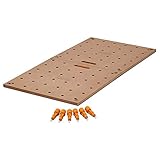
| Workholding table with a hole pattern | Repeatable clamping and modular fixtures | Convenient, but accessories add cost and holes can collect glue | Hole spacing, hole diameter, top thickness, and accessory availability |
| Mobile assembly cart | Shops where the work area must change | Flexible, but wheels can compromise stability | Locking casters, frame sway, and clearance for clamps |
Published load capacity is worth checking, but it does not tell you everything. A table may support a heavy static load and still wobble when you push a plane across it or tighten a clamp at the edge. If possible, test it with a hand on a corner and apply sideways pressure before buying.
Choose the right size and height
Top height depends on the work. A table near elbow height is convenient for fitting hardware and assembling smaller projects. A lower surface gives more leverage for planing or pressing joints together. If the table will serve both roles, choose a height that suits the work you do most often, or put a sacrificial assembly top on a lower bench when needed.
Think about reach as well as area. On a deep table, the far edge can be awkward to clamp or clean. For broad panels, a couple of outfeed supports or a second folding surface may be more practical than permanently buying a table too large for the room.
For a table that moves, look at the wheels, not just the advertised portability. Four locking casters are useful, but locks do not prevent every kind of sway. A mobile table should still have a stiff base, and the wheels should lock before you apply clamp pressure. If precision matters, set the table against a wall or use leveling feet if the design allows them.
Top material and clamping
A flat, replaceable top is often more valuable than a polished finish. MDF is inexpensive and smooth, but it dents, absorbs spills at damaged edges, and can sag if unsupported over a long span. Plywood is tougher at the edges but may have voids or a less even surface. A torsion-box top can be light and stiff, though building one takes time and it still needs protection from glue and moisture.
Protect the surface with paper, a thin hardboard skin, or removable assembly mats. Replace the cover when it gets covered in dried glue or fastener marks. Do not assume a laminate top is automatically clamp-friendly: some clamps need an edge lip or enough clearance beneath the surface.
Bench dogs and a regular hole pattern make repeat setups quicker, but only if you will use compatible stops and clamps. Check the hole diameter and spacing before ordering accessories; standards vary. For occasional glue-ups, ordinary F-style clamps and a flat sacrificial board may be all you need. A workbench with bench-dog holes is easier to fixture, while a plain top is usually cheaper and simpler to keep clean.
Buy or build?
A ready-made folding woodworking workbench makes sense if you need a surface quickly, use it intermittently, or cannot spare permanent floor space. Inspect the hinge and leg locks, and check whether the top has usable clamping points. The cheaper option is fine for light assembly, sanding, and layout if it does not wobble under your normal hand pressure.
Build a simple bench if you need a custom footprint or a particular height. A sturdy frame with cross-bracing and a replaceable top can outperform a flimsy budget table, but only if the top is reasonably flat and the joints resist racking. A low-cost portable workbench with clamps can be handy for small parts, though its built-in clamping surface is usually too small for large panel glue-ups.
Common problems to avoid
The most common failure is buying for storage convenience alone, then discovering the table moves during glue-up. A second is choosing a top that is too small for the widest project you assemble. Map out a typical workpiece and clamp positions before committing. Also check the underside: drawers, aprons, and folding legs can block clamps that would otherwise fit.
Keep glue off joints and hardware, and avoid storing a table where damp conditions can warp an MDF top. If you use a mobile table, clear dust and chips from the casters; debris can stop a wheel from locking properly. Finally, make sure the table has enough clearance around it for safe movement and that cords, clamps, and stored tools do not become trip hazards.
For most small shops, the practical choice is a stable, moderately sized table with a replaceable top and enough edge access for clamps. Pay extra for modular workholding only when you will use it regularly; otherwise, a sound plain table and a few well-placed clamps do the job.