
Our Top Picks
What's inside
As an Amazon Associate I earn from qualifying purchases. This post may contain affiliate links at no extra cost to you.
- Top Pick: Gyokucho 372 Dozuki Dovetail Saw
- Runner-up: SUIZAN Dozuki Dovetail Saw 6 Inch
- Also consider: SUIZAN Dozuki Dovetail Saw 9.5 Inch (D-001)
The best dovetail saw for a beginner is a Japanese dozuki pull saw with fine teeth and a replaceable blade, because the pull stroke keeps the thin plate in tension, starts with very little effort, and tracks a marked line without the pushing force that makes a Western backsaw jump for new users. If you want one answer: buy the Gyokucho 372 for full-size furniture work, a SUIZAN dozuki for a shorter or longer blade at a budget tier, and the Gyokucho 770-3500 for the lightest way to learn the stroke.
Every pick below is a dozuki, the Japanese backsaw pattern built for exactly this joint. A rigid spine stiffens a plate as thin as 0.012 inch, so the kerf stays narrow and joint faces need little cleanup. The teeth are impulse hardened and cannot be resharpened with a file, which is why the blades are replaceable: when one dulls, a fresh blade swaps in and the saw cuts like new. That keeps the first months of practice focused on layout and sawing straight instead of tool maintenance.
As an Amazon Associate, we earn from qualifying purchases.
Table of Contents
- Quick Answer
- Gyokucho 372 Dozuki Dovetail Saw
- SUIZAN Dozuki Dovetail Saw 9.5 Inch
- SUIZAN Dozuki Dovetail Saw 6 Inch
- Gyokucho 770-3500 Razor Dozuki Saw
- Gyokucho Folding Dozuki Razor Saw
- How to Choose
- Who Should Skip
- FAQ
- Final Verdict
Quick Answer
For a first dovetail saw, choose a dozuki pull saw with fine teeth, a plate around 0.012 inch thick, and a replaceable blade. The Gyokucho 372 is the best all-round first pick for furniture-scale dovetails. The SUIZAN 9.5 inch suits longer strokes, the SUIZAN 6 inch suits small boxes, the Gyokucho 770-3500 is the lightest budget starter, and the folding Gyokucho suits small shops.
Gyokucho 372 Dozuki Dovetail Saw

The Gyokucho 372 is the dozuki most often recommended as a first serious joinery saw, and its published specifications explain why. The 9.5 inch blade is long enough for a smooth, full stroke through drawer sides and carcass parts, while the plate is only about 0.012 inch thick, so its kerf is far narrower than a typical Western dovetail saw. A metal spine keeps that thin plate straight, and the depth of cut tapers from about 1-3/4 inches at the heel to 2-1/4 inches at the toe, covering most furniture stock a beginner will joint.
The teeth are cut in a rip pattern, the correct filing for tails and pins because those cuts run along the grain. Published tooth counts cluster around 19 to 21 teeth per inch, fine enough to leave a smooth wall yet coarse enough to start without skating on end grain. The handle is wood wrapped in rattan cane, and the blade detaches for storage or replacement.
Specs:
- Blade length: 9.5 inches (240 mm)
- Plate thickness: about 0.012 inch (0.3 mm)
- Teeth: rip pattern, about 19 to 21 TPI as published
- Depth of cut: about 1-3/4 inches at the heel, 2-1/4 inches at the toe
- Overall length: about 23-7/8 inches
- Weight: about 8.25 ounces
- Handle: wood with rattan cane wrapping
- Blade: replaceable, metal spine along the back
- Tier: mid-range
SUIZAN Dozuki Dovetail Saw 9.5 Inch
The SUIZAN 9.5 inch dozuki (model D-001) matches the Gyokucho 372 on blade length but files its teeth for crosscutting at 25 teeth per inch. That makes it a natural choice for the cross-grain half of dovetail work: trimming tenon shoulders, cutting joint baselines, and squaring small parts. Many beginners use it for tails and pins as well, accepting a slightly fuzzier rip cut in exchange for a very smooth, easy start.
The blade is Japanese steel held straight by a steel back, and at 6.7 ounces the saw is light enough that its weight does almost none of the work, which teaches a relaxed grip early. The blade is replaceable, so a kinked or dulled blade is a minor expense rather than a ruined saw. For a beginner building a first toolbox, this is a mid-priced way to get a full-size dozuki.
Specs:
- Blade length: 9.5 inches (240 mm)
- Teeth: 25 TPI, crosscut pattern
- Blade material: Japanese steel with steel back
- Handle: wood
- Weight: 6.7 ounces
- Blade: replaceable
- Model: D-001
- Tier: mid-range
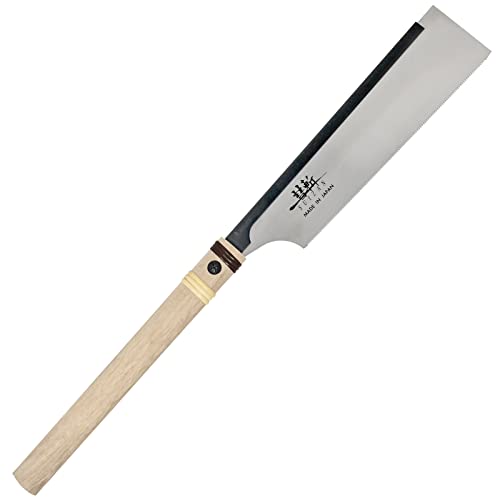
SUIZAN Dozuki Dovetail Saw 6 Inch

The SUIZAN 6 inch dozuki shrinks the same formula down for small work. A 150 mm blade with 25 TPI crosscut teeth and a 0.012 inch plate leaves a kerf of about 0.02 inch, suiting the thin stock in small boxes, drawer slips, and model-scale joinery where a full-size saw feels clumsy. The short blade also shortens the stroke, giving more control per pull when learning to follow a line.
A steel back keeps the thin blade from flexing, the handle is wrapped in rattan for grip, and the blade swaps out when the teeth eventually dull. At roughly five and a half ounces it is the lightest rigid saw here. Beginners learning on small practice boxes rather than full drawers will find this size easier to manage, and its budget tier makes a bent first blade a cheap lesson.
Specs:
- Blade length: 6 inches (150 mm)
- Teeth: 25 TPI, crosscut pattern
- Plate thickness: 0.012 inch
- Kerf: about 0.02 inch
- Back: steel spine
- Handle: wood wrapped in rattan
- Weight: about 5.5 ounces
- Blade: replaceable
- Tier: budget
Gyokucho 770-3500 Razor Dozuki Saw
The Gyokucho 770-3500, sold under the Razorsaw brand and built around Gyokucho blade number 290, is a compact 180 mm dozuki aimed at fine, shallow work. Gyokucho specifies a 0.3 mm plate with a 1.5 mm tooth pitch, which works out to roughly 17 teeth per inch, and rates the saw for stock up to about 35 mm thick. That combination of a slightly coarser tooth and a short blade makes it forgiving in pine and poplar practice boards, the woods most beginners learn on.
Unlike the wooden-handled saws above, this model uses a molded plastic handle, which some new users find easier to hold consistently. The blade is replaceable with the maker’s S-290 blade. It sits at the budget end of the Gyokucho range, so it works well as a low-risk first saw or as a smaller second saw beside a 240 mm model.
Specs:
- Blade length: 180 mm (about 7.1 inches)
- Plate thickness: 0.3 mm (about 0.012 inch)
- Tooth pitch: 1.5 mm, about 17 TPI
- Maximum stock thickness: about 35 mm, per the maker
- Handle: molded plastic grip
- Blade: replaceable, maker blade S-290
- Part number: No. 290
- Tier: budget
Gyokucho Folding Dozuki Razor Saw
The Gyokucho folding dozuki (model 110) folds its blade into the handle, which solves a real beginner problem: exposed fine teeth get damaged in a crowded toolbox, and damaged teeth make a good saw cut badly. Folded, it stores safely in a drawer, tool roll, or apron pocket, and travels without a separate blade guard.
The format suits woodworkers with small benches, shared spaces, or a habit of working away from a dedicated shop. Like the other Gyokucho saws here it uses a thin, spine-backed plate and a replaceable blade, so cutting behavior is the familiar dozuki pattern rather than a compromise made for folding. Check the current listing for blade length and tooth count before ordering.
Specs:
- Style: folding dozuki, blade folds into the handle
- Manufacturer: Gyokucho (Razorsaw)
- Model: 110
- Blade: replaceable, spine-backed thin plate
- Best for: small shops, toolboxes, and working away from the bench
- Tier: budget
How to Choose
Start with tooth filing. Tails and pins are rip cuts along the grain, so a rip-filed saw such as the Gyokucho 372 follows the line cleanly, while a crosscut-filed dozuki like the SUIZAN models starts more easily and excels at shoulders and baselines. Either pattern can cut a complete joint; beginners often find crosscut filing more forgiving at the start and rip filing cleaner at the bottom.
Next, match tooth count and blade length to your stock. Fine teeth around 25 TPI leave the smoothest walls in thin drawer sides and small boxes, while counts nearer 17 to 21 TPI clear waste faster in thicker carcass parts. A 9.5 inch blade supports a long, steady stroke; a 6 or 7 inch blade gives more control on small work. Finally, confirm the blade is replaceable, since impulse-hardened teeth cannot be resharpened, and check the published depth of cut against the thickest stock you plan to joint, because the spine sets that limit.
Who Should Skip
Skip these saws if your dovetails are cut by router or table saw and you only need a saw for rough breakdown work; a dozuki is a joinery specialist, not a general-purpose hand saw. Skip them if you regularly joint stock thicker than about two inches, because the spine caps the depth of cut on every model here. Also skip the pattern if you want a resharpenable Western backsaw you can maintain with a saw file for decades; that tool family has a thicker plate, a wider kerf, and a push stroke, and rewards a different set of skills.
FAQ
Should a first dovetail saw be rip filed or crosscut filed?
Rip filing is the textbook choice because dovetail cuts run along the grain, and a rip-filed saw such as the Gyokucho 372 leaves the cleanest wall. In practice, many beginners start joints successfully with a crosscut-filed dozuki, which starts more easily and handles shoulders well. Choose rip if you buy one saw, and add a crosscut model later.
How many teeth per inch should a beginner choose?
A count between about 17 and 25 TPI covers nearly all beginner work. Finer teeth near 25 TPI cut slowly and smoothly in thin stock, which helps when learning to follow a line. Coarser teeth near 17 to 21 TPI cut faster in thick stock and start more easily on end grain.
Can a dozuki cut tenons as well as dovetails?
Yes, within its depth of cut. The same thin plate and fine teeth that suit dovetails also trim tenon cheeks and shoulders accurately, and the longer 9.5 inch models handle small tenons comfortably. The spine limits how deep the saw can reach, so large tenons on thick frame parts may exceed its capacity.
What happens when a dozuki blade gets dull?
The teeth are impulse hardened and cannot be resharpened with a file, so a dull or damaged blade is replaced rather than sharpened. Each saw here uses a maker-specific replacement blade that swaps in minutes. Keeping a spare on hand means a kinked tooth during practice never stops a project for long.
Final Verdict
For most beginners, the Gyokucho 372 is the right first dovetail saw: rip-filed teeth, a full-size 240 mm blade, and a narrow kerf in a mid-range package. Choose the SUIZAN 9.5 inch if you prefer crosscut filing and a lighter saw, the SUIZAN 6 inch for small boxes and thin stock, the Gyokucho 770-3500 as the lightest budget starter, or the folding Gyokucho if safe storage matters most. Any of the five removes sharpening and heavy effort from the learning curve, leaving you free to practice layout and sawing to a line.


Related guides
More from Amazon
Programs that pair well with the guide above. Offers and eligibility are set by Amazon and may change.
A free business account with business pricing and bulk-buying tools for work, shop or home office.
Create a business accountFree shipping on eligible items, Prime Video and more. Eligible new members can start with a free trial.
Start a Prime free trialAudiobooks and podcasts to listen to on the go. Eligible new members can start with a free trial.
Try Audible freeAd-free music streaming. Eligible new subscribers can start with a free trial.
Try Music Unlimited freeAs an Amazon Associate we earn from qualifying purchases.


