As an Amazon Associate I earn from qualifying purchases. This post may contain affiliate links at no extra cost to you.
Buying sandpaper for an EZ-8 is not a general sandpaper decision. The EZ-8 is a floor drum sander, and its expandable drum takes one specific abrasive format: an 8 inch by 19 inch belt. Rolls and wraps made for benchtop drum sanders, however good they are on those machines, do not fit this one. So the real decision is narrower and more useful: which grit strategy do you need for the floor in front of you, and which pack format delivers it without waste.
OUR TOP PICK
Dechours 8" x 19" Sanding Belts, Assorted Grits, 10 Pack
This guide is for people refinishing hardwood floors with a rented or owned EZ-8, and for contractors who keep belts on hand for the expandable-drum model. One caution belongs up front: American Sanders also sold the EZ-8 with a clamp drum, which takes a sheet held under a bar rather than the 8 by 19 sleeve. Check which drum your machine has before ordering anything in this guide. The picks below are all 8 by 19 inch belts chosen from their Amazon listing details.
Quick Picks
As an Amazon Associate we earn from qualifying purchases.
Product
Best for
Key spec from title
Dechours 8″ x 19″ Sanding Belts, Assorted Grits, 10 Pack
A full grit sequence for one floor in one pack
8 x 19 inch, 2 each of 40, 60, 80, 100, 120 grit
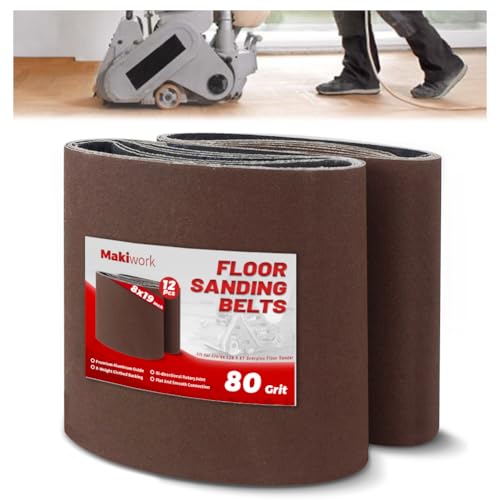
makiwork 8 inch x 19 inch 80 Grit Sanding Belts, 12 Pack
Mid-sequence and polishing passes in one grit
8 x 19 inch, 80 grit, 12-pack
Demissle 8 x 19 Inch Sanding Belts, 10 Pack
Heavy removal of old finish and coating
8 x 19 inch, coarse grit, 10-pack
How to Choose
Confirm the drum type before you confirm the belt
The EZ-8 name covers two different abrasive systems, and ordering against the wrong one wastes a delivery and a workday. The expandable drum uses the 8 inch by 19 inch belt, also called a sleeve, which slides over the drum and is held by the drum’s expansion. The clamp drum uses a flat sheet locked under a clamp bar. American Sanders lists the 8 by 19 belt for the expandable models, including the 07058A. Look at the drum itself or the model plate, and match the abrasive to what you see. If your machine has a clamp bar, none of the belts in this guide is the right purchase.
Plan the grit sequence around the floor, not the pack
Drum sanding works as a sequence: a coarse pass removes finish and levels the surface, middle grits remove the scratches the coarse pass left, and a fine pass prepares the wood for coating. A floor with thick old finish, paint or deep wear may need to start at a coarse grit like the Demissle pack, while a floor in fair condition can start at 40 or 60 grit. Skipping grits leaves scratches that only show after the finish goes on, which is the most expensive sanding mistake to fix. Count your sequence first, then choose between an assorted pack that covers several steps and single-grit packs that cover one step in depth.
Match pack size to floor area and belt wear
Belts are consumables, and a belt that has loaded with finish or torn at the seam stops cutting evenly long before the floor is done. A single room can work through several belts at the coarse stage, where removal is heaviest, and fewer at the fine stages. That is why the assorted pack’s two belts per grit suits a small job in fair condition, while larger or rougher floors need single-grit depth at the coarse end. Think in terms of belts per stage across the whole floor, and keep at least one spare belt for the grit you are running, because a torn belt with no replacement stops the rental clock working for you.
Check the seam and backing construction
A drum belt runs at speed under load, and its seam is the weak point. Listings for these belts call out reinforced taped seams, resin bonds and cloth backing, and those details decide whether a belt tracks smoothly or thumps once per revolution. A bidirectional joint, like the one the makiwork listing describes, is designed to remove the bump at the seam for a smoother finish. Cloth backing tolerates the heat and flexing of drum work better than paper on this format. Read the seam and backing lines on the listing, not just the grit number, when you compare two packs of the same size.
The 3 Best Options
Dechours 8″ x 19″ Sanding Belts, Assorted Grits, 10 Pack
Top Pick
Dechours 8″ x 19″ Sanding Belts, Assorted Grits, 10 Pack
Best for: A complete refinishing sequence on one floor from a single pack.
This is the one-pack answer for a floor that needs a normal full sequence. The pack holds ten belts at 8 by 19 inches, two each of 40, 60, 80, 100 and 120 grit, so removal, leveling, scratch refinement and pre-finish passes are all covered without a second order. The listing describes aluminum oxide grain on a heavy-duty cloth backing with a resin bond and a reinforced taped seam, and the hardwood version of this pack is also listed with a cleaning stick for clearing pitch and dust buildup between passes. For a rented EZ-8 and one or two rooms, this format is the simplest way to arrive with every grit on hand.
makiwork 8 inch x 19 inch 80 Grit Sanding Belts, 12 Pack
Runner-Up
makiwork 8 inch x 19 inch 80 Grit Sanding Belts, 12 Pack
Best for: Mid-sequence leveling and polishing passes across a larger floor area.
This pack serves the middle of the sequence in depth. Eighty grit is the working grit where a floor stops looking rough and starts looking level, and it is also the grit listed for floor polishing passes, so having twelve belts of it suits bigger floors and repeat users who already own their coarse and fine stages. The listing describes premium aluminum oxide on X-weight cloth backing, with a bidirectional rotation joint intended to remove bumps at the seam for a smoother finish. It also lists the belts for hardwood flooring and for grinding and polishing metal products, but on an EZ-8 the job that matters is the mid-sequence floor pass.
Demissle 8 x 19 Inch Sanding Belts, 10 Pack
Demissle 8 x 19 Inch Sanding Belts, 10 Pack
Best for: First-pass removal on floors with thick, worn or damaged finish.
This is the heavy removal end of the EZ-8 range. The pack holds ten 8 by 19 inch belts in a coarse grit of open-coat aluminum oxide, listed for removing old finish, glue and coating during floor refinishing, and for fitting most commercial and residential sanding machines of this format. The listing describes wear resistance with anti-static, moisture and heat resistance, which suits long first passes where the belt is doing the hardest work of the whole job. One caution: summaries of this listing show the coarse grit as 24 in one place and 36 in another, so confirm the exact grit on the product page before ordering.
Which One Fits Your Situation
You are renting an EZ-8 for one floor this weekend
Buy the Dechours assorted pack. It puts the full 40 to 120 grit sequence in one box, which is what a single rental job needs, and it removes the risk of discovering mid-job that a stage is missing. Confirm your rental machine has the expandable drum when you collect it, and inspect the floor for protruding nails or staples before the first pass, because hardware tears belts faster than any grit choice.
The floor has thick old finish, paint or glue residue
Start with the Demissle coarse pack for the removal pass, then follow with the Dechours sequence from 60 grit onward. Coarse belts exist for exactly this material load, and trying to strip a heavy finish with a 40 grit assortment belt loads and dulls it quickly. Verify the Demissle grit on the listing first, since it is reported two ways, and keep the coarse stage moving steadily to avoid digging into the wood.
You own an EZ-8 and sand floors regularly
Stock single-grit depth where your wear actually happens. The makiwork 12-pack at 80 grit covers the longest working stage of most sequences, and pairing it with a coarse pack and a fine pack of your own choosing beats repeatedly buying assortments whose middle grits you never open. Regular users should also track which seam construction runs smoothest on their drum and reorder that construction.
Your EZ-8 has a clamp drum
Do not order any belt in this guide. A clamp drum takes a flat sheet held under the clamp bar, not the 8 by 19 sleeve these packs contain. Check your machine’s manual for the sheet size it specifies, and buy clamp-drum sheets in the grits your sequence needs. If you are renting, ask the rental shop to swap the machine or supply the matching abrasive before you leave.
Common Mistakes
Ordering 8 by 19 belts for a clamp-drum EZ-8 that takes sheets instead.
Confusing EZ-8 floor belts with wraps and rolls made for benchtop drum sanders.
Skipping a grit in the sequence and finding the scratches only after coating.
Starting a heavy strip job with a fine or assorted belt and loading it within minutes.
Running a belt with a damaged seam instead of changing it before it tears at speed.
Frequently Asked Questions
What size sandpaper does the EZ-8 drum sander use?
The expandable-drum EZ-8 uses an 8 inch by 19 inch belt, which American Sanders lists as the sandpaper size for those models. The clamp-drum version is different and takes a sheet under a clamp bar. Check the drum fitted to your machine, because the two abrasive formats are not interchangeable and the wrong one will not mount at all.
Is the EZ-8 a Laguna sander?
No. The EZ-8 is an American Sanders floor sander, also associated with the Clarke name. Laguna is a different maker, known for SuperMax benchtop drum sanders, which take wraps rather than 8 by 19 belts. If your machine is a Laguna or SuperMax drum sander, the belts in this guide will not fit it, and you need wraps in that machine’s width instead.
How many belts do I need to refinish one room?
It depends on the floor’s condition and area, but plan for more than one belt at the coarse stage, where finish removal wears abrasive fastest, and at least one belt per later stage. The Dechours assortment’s two belts per grit covers a modest room in fair condition. Larger rooms, or floors with heavy finish, need extra single-grit packs at the starting grit.
Can I jump from a coarse belt straight to a fine belt?
That shortcut leaves the coarse scratches in the wood, because a fine belt removes too little material to erase them in a reasonable number of passes. Work through the sequence in steps, as the Dechours pack lays out from 40 to 120 grit, so each grit only has to remove the marks of the one before it. The extra passes are faster than re-sanding a coated floor.
J
JD's Woodworks Editorial Team
We compare specs, warranty terms, long-term owner feedback and street pricing before anything earns a spot. Rankings are never paid.
Affiliate disclosure. As an Amazon Associate we earn from qualifying purchases at no extra cost to you. Prices accurate as of the date shown.
Four hobby TIG welders compared for home shops: AC/DC picks for aluminum, a compact DC model for steel, listed specs, included gear and honest tradeoffs.
The best Creality Falcon engravers compared: Falcon A1 10W, CR-Laser Falcon 10W, Falcon2 Pro 22W and Falcon2 Pro S 40W, by power, work area and enclosure.
The best CNC machines for manufacturing compared: large-bed routers and closed-loop desktop mills with the work area, spindle and control for batch work.