
Key takeaways
- The SawStop Jobsite Saw Pro JSS-120A60 in detail: 10-inch blade, mobile cart, rip capacity and brake system, and who a one-model shortlist suits.
What's inside
As an Amazon Associate I earn from qualifying purchases. This post may contain affiliate links at no extra cost to you.
Choosing a jobsite SawStop is a different decision from choosing a jobsite saw in general. You are not comparing brands on rip capacity first; you are deciding whether SawStop’s blade-contact brake system is worth organising a portable saw purchase around, and then checking that the one portable model built around it — the Jobsite Saw Pro — fits your work, your vehicle and your shop corner.
This guide covers only the Jobsite Saw Pro line, for contractors and serious home woodworkers who need a 10-inch saw that folds onto its own mobile cart and still carries the SawStop safety system. It does not cover the Compact Table Saw, the Contractor Saw or cabinet models, because those answer different space and budget questions.
Quick Picks
As an Amazon Associate we earn from qualifying purchases.
| Product | Best for | Key spec from title |
|---|---|---|
| SawStop Jobsite Saw Pro JSS-120A60 | Portable 10-inch work with the SawStop brake on a mobile cart | 1-1/2 HP, 120V, 10-inch blade, mobile cart assembly |
How to Choose
Decide Whether the Brake System Is Your Reason to Buy
The Jobsite Saw Pro exists for one central reason: it puts SawStop’s flesh-detection brake into a portable saw. On contact with skin, the system stops the blade and drops it below the table in milliseconds, trading a replaceable brake cartridge and usually a blade for a far less serious injury. If that protection is not a priority for you, lighter and simpler jobsite saws make more sense. If it is the priority — because apprentices, family members or tired end-of-day hands use the saw — then the rest of this guide is about fit, not about talking you out of the premium.
Check Rip Capacity and Depth Against Your Sheet Work
Portable does not mean unlimited. Listings and SawStop documentation for the JSS-120A60 describe a 10-inch blade, rip capacity in the mid twenty-inch range to the right with the fence extended, and a depth of cut a little over three inches at ninety degrees. That covers breaking down sheet goods with a helper or a track saw first pass, ripping framing and furniture stock, and most cabinet parts. It does not replace a cabinet saw for daily full-sheet work. Measure your typical widest rip honestly; if it regularly exceeds the fence range, your problem is saw class, not brand.
Plan for the Cart, the Weight and the Stored Footprint
This saw lives on its mobile cart, and the combination is a substantial lift even though it rolls well once upright. SawStop figures put the saw and cart together at over one hundred pounds, with a stowed footprint designed to stand against a wall. That suits a garage shop that must return to being a garage, or a contractor with a ramp and a planned load-in. It suits a third-floor walk-up or a solo carry up basement stairs far less. Decide where it sleeps and how it travels before deciding that portable on paper means portable in your week.
Budget for Cartridges, Blades and the Dado Question
Ownership includes parts a normal jobsite saw never asks for. A fired brake cartridge is a single-use replacement, and running a dado stack uses a dedicated dado cartridge rather than the standard one, so confirm which cartridges your work needs and keep the correct spare if downtime matters. The saw accepts an eight-inch dado set within its listed capacity. Also confirm blade requirements on the listing and in the manual, because the brake system depends on correct blade and cartridge pairing. These are running costs of the safety system, and they belong in the purchase decision, not after it.
The 1 Best Options
SawStop Jobsite Saw Pro with Mobile Cart Assembly (JSS-120A60)
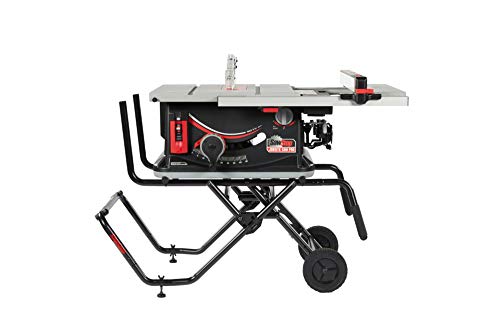
This is the only model in this guide because it is the only Jobsite Saw Pro: a 10-inch, 1-1/2 horsepower portable saw on a folding mobile cart, built around the SawStop brake. The current Pro version brought a larger table and an improved fence over the earlier jobsite model, which matters for sheet support and repeatable rips on site. It fits the contractor or home woodworker who moves the saw between a stored position and a working position every session, wants a real fence rather than a toy one, and has decided the brake system is the feature the whole purchase is organised around.
Specs
- Model JSS-120A60, Jobsite Saw Pro with Mobile Cart Assembly
- 1-1/2 HP, 120V, 60Hz, 15A motor as listed
- 10-inch blade
- SawStop blade-contact brake system
- Mobile cart assembly included in the listing title
Best for: Portable-saw buyers who put the SawStop brake first and need the saw to roll and store between jobs.
Watch out for: A second Amazon listing for this model under a newer ASIN was also found during checking, so confirm you are ordering the JSS-120A60 Jobsite Saw Pro with cart on the listing you use, and confirm current stock there before planning a purchase around it.
ASIN: B07WV5X277
Which One Fits Your Situation
You Run a Crew or Teach New Hands
Choose the Jobsite Saw Pro. A brake that reacts to skin contact changes the consequence of the one distracted moment every busy site eventually produces. The cart keeps the saw a one-person move between setups, and the fence is built for repeat work rather than occasional trimming, so the safety purchase does not cost you a usable contractor saw to get it.
Your Garage Is Also Your Shop
Choose the Jobsite Saw Pro if it will be stored upright against a wall and rolled out per session. Its stowed footprint is the point of the design. Measure your storage spot and your doorway path first, because the saw-plus-cart weight means you will roll it, not carry it, and a tight turn or a step on that path decides whether the routine is easy or miserable.
You Mostly Rip Full Sheets Alone
Think carefully before choosing any jobsite saw, including this one. Mid twenty-inch rip capacity and a portable table mean full sheets are a two-stage job: break them down first, then finish at the saw. If full-sheet ripping alone at the table saw is your daily work, a larger saw class fits better, and no brake system changes that geometry.
You Already Own a SawStop Cabinet Saw
Choose the Jobsite Saw Pro as the site companion only if portable work is frequent. It keeps the same safety approach and a familiar cartridge logic away from the shop, which crews moving between locations value. If site work is rare, the honest answer may be to keep using the cabinet saw and a track saw on site rather than adding a second braked saw.
Common Mistakes
- Confusing the Jobsite Saw Pro with the smaller Compact Table Saw or the Contractor Saw when comparing listings, then judging this saw by the price, weight or capacity of a different model and ordering parts or cartridges that were never meant for it, and in the worst case fitting a cartridge or blade combination the brake system was not designed around, which undermines the safety logic you bought the saw for in the first place and can leave you with a portable saw that behaves like an ordinary one at exactly the wrong moment, on the one cut where everything else also went wrong, which is precisely the scenario the premium was supposed to protect you and everyone working beside you against.
- Forgetting that a fired brake cartridge is single-use and that dado work needs its own cartridge type, so the first firing or the first dado job becomes an unplanned parts order and an idle saw while you wait for the correct cartridge to arrive, which is why owners who cannot afford downtime keep the right spare cartridge on the shelf from the day the saw arrives, not from the day the first one fires.
- Assuming portable means light, and planning to carry by hand a saw and cart that together weigh over one hundred pounds, instead of planning the roll path from storage to working position, the vehicle loading, the storage spot and who moves it when you are tired that the cart design actually expects you to use, including a route without stairs, a doorway it fits through upright, and a vehicle loading method that does not depend on one person dead-lifting the whole assembly at the end of a long day.
- Expecting cabinet-saw rip capacity and cabinet-saw table support from a jobsite fence, then blaming the saw for a two-stage sheet workflow that every portable saw in this class requires when full sheets have to be broken down before they can be ripped, a workflow that is normal and safe when planned for, and frustrating and risky when improvised with an unsupported sheet sagging off a small portable table.
- Disabling or bypassing safety features for convenience cuts, leaving guards off after a awkward setup, or treating the brake as a substitute for push sticks and stance, which removes the entire reason this saw costs what it does and leaves the ordinary risks — kickback, offcuts, eye injury and hearing damage — completely untouched, because a blade brake was only ever designed to answer one specific kind of accident, however well it answers it.
Frequently Asked Questions
Is the Jobsite Saw Pro the same as the Compact Table Saw?
No. They are separate SawStop portables. The Compact is the smaller, lighter model, while the Jobsite Saw Pro is the larger 10-inch saw on a mobile cart assembly with the JSS-120A60 model number used in this guide. Check the model number on any listing, because the two are easy to confuse in search results.
What happens when the brake fires?
The system stops the blade and drops it below the table within milliseconds of skin contact. The brake cartridge is spent and is replaced, and the blade is commonly damaged in the stop and should be inspected or replaced as the manual directs. That parts cost is the designed trade for avoiding a far worse injury.
Can the Jobsite Saw Pro run a dado stack?
SawStop lists dado capacity for this saw with an eight-inch dado set, and dado work requires the dedicated dado brake cartridge rather than the standard cartridge. Confirm the cartridge and blade set requirements in the manual for your exact configuration before ordering accessories, because the brake system depends on the correct pairing.
Does the brake prevent all table saw injuries?
No. The brake addresses blade contact with skin. It does not prevent kickback, eye injury from thrown material, or hearing damage. You still need the guard and riving knife used as directed, eye and hearing protection, push sticks for narrow work, and a stance that keeps your body out of the blade path.
Related guides
More from Amazon
Programs that pair well with the guide above. Offers and eligibility are set by Amazon and may change.
A free business account with business pricing and bulk-buying tools for work, shop or home office.
Create a business accountFree shipping on eligible items, Prime Video and more. Eligible new members can start with a free trial.
Start a Prime free trialAudiobooks and podcasts to listen to on the go. Eligible new members can start with a free trial.
Try Audible freeAd-free music streaming. Eligible new subscribers can start with a free trial.
Try Music Unlimited freeAs an Amazon Associate we earn from qualifying purchases.









