4 Best Dust Collector Systems for Shops (November 2026)
Compare the best dust collector system options for a woodworking shop, from compact WEN units to JET two-stage machines, and pick the right airflow today.
As an Amazon Associate I earn from qualifying purchases. This post may contain affiliate links at no extra cost to you.
A dust collector system keeps a woodworking shop clean, healthy and safe, and it does work a shop vacuum cannot match on a table saw or planer. The collector pulls chips and fine dust straight from the tool through a hose, so the air stays clear and the floor stays walkable. The differences between systems come down to airflow, filtration, bag capacity and whether the machine rolls to the tool or the tool connects to a fixed run of ducting. Good collection also protects finishes, since fine dust settles on fresh stain.
This guide is for woodworkers tired of sweeping after every cut, small-shop owners who want cleaner air, and hobbyists setting up their first dust collection. Every system below was chosen from the name and specifications shown on its Amazon product page, with attention to airflow, motor power, filtration and collection capacity. We compare four dust collectors that cover benchtop tools and full shop setups. Use the sections below to match airflow and filtration to your tools.
Quick Picks
As an Amazon Associate we earn from qualifying purchases
Product
Best for
Key spec from title
WEN DC3401
Small shops and single tools
660 CFM airflow
WEN DC1300
High airflow on a budget
1,300 CFM airflow
JET DC-1100VX-CK
Fine filtration for a small shop
2-micron canister filter
JET DC-1200VX-CK1
Most power in this group
2 HP motor
How to Choose
Airflow and CFM Ratings
Airflow, measured in cubic feet per minute, decides whether the collector captures dust at the tool or lets it escape into the room. A table saw needs roughly 350 to 450 CFM at the hood to capture most of the dust, while a planer or jointer needs more because it throws chips faster. The listed CFM is measured at the inlet with no hose attached, so a long hose run and tight bends will reduce the real airflow at the tool. Choose a collector with more airflow than your hungriest tool needs, and keep hose runs short and straight to preserve it. A larger collector also leaves room to add a second tool later.
Filtration and Fine Dust
Filtration decides what happens to the finest dust, which is the part that harms lungs and settles on every surface. A 5-micron filter bag catches visible chips and most fine dust, while a 2-micron canister filter captures far more of the smallest particles and keeps the shop air cleaner. Canister filters also hold more dust before they clog, which means steadier airflow across a work session. If anyone in the shop has breathing concerns, filtration matters more than raw airflow, and a canister filter is worth the extra cost. A clogged filter chokes airflow quickly, so check the filter often and clean it before suction drops noticeably in the shop.
Bag Capacity and Emptying
Bag capacity sets how often you stop work to empty the collector, and a larger bag suits a shop that runs a planer or jointer for hours at a time. A 12-gallon bag fills quickly on a planer, while a 50-gallon bag handles a full day of milling without attention. Check how the bag attaches and empties, since a fiddly bag change discourages regular emptying and leads to overfilled bags that reduce airflow. A clear bag or a sight window helps you see the fill level before it becomes a problem. A bag that is hard to reach or awkward to detach gets emptied less often, so choose a design you will maintain.
Dust Collector Safety and Upkeep
A dust collector moves a large volume of air and fine dust, so placement and maintenance matter for safety. The machines in this guide list 5-micron and 2-micron filtration, which capture the fine dust that a shop vacuum bag lets through, and that filtration only works when the bags and canisters are cleaned on schedule. Empty the collection bag before it overfills, wear a dust mask when emptying, and keep the collector away from sparks and hot metal. Never collect metal shavings or hot material in a wood dust collector, and check the hose connections regularly so leaks do not fill the shop with fine dust. Keep a spare bag on hand.
The 4 Best Options
WEN DC3401
Top Pick
WEN DC3401
Best for: A small shop with one tool running at a time.
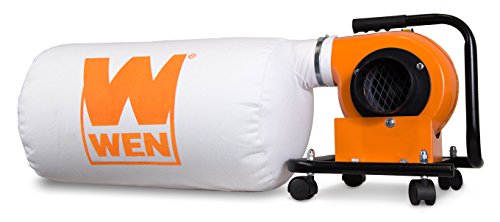
The DC3401 is the compact dust collector for a small shop or a single tool, with 660 CFM of airflow in a machine that rolls where you need it. Its 5.7-amp motor runs on a standard household circuit, and the 5-micron filter bag captures chips and fine dust from a table saw or a benchtop planer. The mobile base with casters lets you wheel it to the tool in use, and the 12-gallon bag empties easily between sessions. It is the right pick when one machine serves one tool at a time in a small space. The compact frame fits a crowded shop and stores against a wall.
Watch out for: The 12-gallon bag fills quickly on a planer, so check the level often during heavy milling.
WEN DC1300
Runner-Up
WEN DC1300
Best for: High airflow and large bag capacity on a budget.
The DC1300 brings high airflow to a shop on a budget, with 1,300 CFM that handles a table saw, jointer and planer through a short hose run. Its 14-amp motor pulls hard enough for the hungriest tools, and the 5-micron filter bag captures the dust that a shop vacuum would leave behind. The 50-gallon collection bag means fewer stops to empty during a long milling session, and the mobile base moves the machine to the tool in use. It is the most airflow per dollar in this group, and the best fit for a shop that mills lumber regularly. The wide inlet accepts a large hose easily.
Watch out for: The larger motor needs a dedicated circuit, and the machine is heavier to move than the compact model.
JET DC-1100VX-CK
JET DC-1100VX-CK
Best for: Fine filtration and cleaner air in a small shop.
The DC-1100VX-CK pairs JET build quality with a 2-micron canister filter, giving a small shop cleaner air than a bag filter alone can deliver. Its 1-1/2 HP motor moves 1,100 CFM through a 6-inch inlet, which suits a table saw or jointer connected with a short hose. The canister filter holds more dust before clogging and captures the fine particles that matter most for lung health. It is the right pick when air quality matters as much as chip collection and the shop has room for a dedicated collector. The rigid canister body also damps vibration from the motor. That steadier airflow means less sweeping after each session.
Watch out for: The canister needs periodic cleaning to hold airflow, so build that into your shop routine.
JET DC-1200VX-CK1
JET DC-1200VX-CK1
Best for: Larger tools and longer duct runs in a growing shop.
The DC-1200VX-CK1 is the most powerful collector in this group, with a 2 HP motor and 1,200 CFM for shops that run larger tools or longer duct runs. Its 2-micron canister filter captures fine dust while the larger motor keeps airflow steady through bends and fittings that would choke a smaller machine. The 6-inch inlet suits a main duct line feeding several tools, and the single-stage design keeps maintenance simple. It suits a shop that is growing toward a fixed duct system and needs a collector that can grow with it. The larger motor also handles blast gates, so one collector can serve several tools.
Watch out for: The 2 HP motor needs a dedicated circuit, and the machine is a permanent installation rather than a portable unit.
Which One Fits Your Situation
A Small Shop With One Tool at a Time
Pick the DC3401 when the shop is small and one tool runs at a time. Its 660 CFM handles a table saw or benchtop planer, and the mobile base rolls it to the tool in use. It is the simplest way into dust collection, and it costs less than a full system while keeping the air far cleaner than a shop vacuum alone. It stores easily against a wall.
Milling Lumber All Day
Pick the DC1300 when the planer and jointer run for hours and the bag needs to last the session. The 1,300 CFM pulls hard from hungry tools, and the 50-gallon bag means fewer stops to empty. It is the best value for a shop that mills rough lumber regularly and wants high airflow without a premium price. The large bag also means less time emptying and more time cutting, which matters on milling days.
Cleaner Air for a Small Shop
Pick the DC-1100VX-CK when fine dust and lung health are the priority. The 2-micron canister filter captures far more of the smallest particles than a bag filter, and the 1,100 CFM covers a table saw or jointer easily. Clean the canister on schedule and the airflow stays strong for years. The canister also holds dust well between cleanings, so suction stays strong even as the bin fills during a session.
A Shop Growing Toward Ducting
Pick the DC-1200VX-CK1 when the shop is moving toward fixed ducting and several tools. The 2 HP motor and 1,200 CFM hold up through bends and fittings, and the 6-inch inlet suits a main duct line. It is the collector to buy when you plan to add ducting later rather than replacing the machine. Add blast gates at each tool so airflow goes only where it is needed, and the collector keeps up.
Common Mistakes
Buying by CFM alone while ignoring filtration, then breathing the fine dust the bag lets through on every job in the shop.
Running long, twisty hose runs that cut the real airflow at the tool to half the listed figure before it reaches the hood.
Letting the collection bag overfill, which chokes airflow and sends dust back into the shop and coats every surface.
Connecting a dust collector to a tool without a proper hood, so most of the dust escapes at the source instead of entering the hose.
Skipping the mask when emptying the bag, especially after sanding MDF or hardwoods that produce fine particles that linger in the air.
Frequently Asked Questions
How much CFM do I need for a table saw?
A table saw needs 350 to 450 CFM at the hood to capture most dust, while a planer needs more because it throws chips faster. Listed CFM is measured at the inlet with no hose attached, so long runs reduce real airflow. Choose a collector with more airflow than your hungriest tool needs.
Is a canister filter better than a bag filter?
A canister filter captures finer dust than a bag filter and holds more before clogging, which keeps airflow steadier. A 2-micron canister catches the smallest particles that matter most for lung health, while a 5-micron bag lets more fine dust through. Canisters cost more and need cleaning, but the cleaner air is worth it.
Can one dust collector serve several tools?
Yes, one collector serves several tools when the hose moves between them or ducting connects them all, but run only one tool at a time unless it is sized for combined airflow. A mobile collector rolls to the tool in use, while fixed ducting suits a larger shop. Size the collector for the hungriest tool.
How often should I empty the collection bag?
Empty the bag before it fills past about three quarters full, since an overfilled bag reduces airflow and can send dust back into the shop. A planer fills a small bag quickly, so check the level often during heavy milling. Wear a dust mask when emptying, and clean the filter on schedule.
J
JD's Woodworks Editorial Team
We compare specs, warranty terms, long-term owner feedback and street pricing before anything earns a spot. Rankings are never paid.
Affiliate disclosure. As an Amazon Associate we earn from qualifying purchases at no extra cost to you. Prices accurate as of the date shown.
Four hobby TIG welders compared for home shops: AC/DC picks for aluminum, a compact DC model for steel, listed specs, included gear and honest tradeoffs.
The best Creality Falcon engravers compared: Falcon A1 10W, CR-Laser Falcon 10W, Falcon2 Pro 22W and Falcon2 Pro S 40W, by power, work area and enclosure.
The best CNC machines for manufacturing compared: large-bed routers and closed-loop desktop mills with the work area, spindle and control for batch work.



 JET DC-1200VX-CK1









