As an Amazon Associate I earn from qualifying purchases. This post may contain affiliate links at no extra cost to you.
If you searched for the best SawStop chop saw, the honest answer has to come first: SawStop does not make a chop saw, a miter saw, or any other kind of sliding or pivoting crosscut saw. There is no SawStop chop saw to buy, at any size, from any seller. Any listing, headline, or roundup that presents a product as a SawStop chop saw is either mistaken about the product type or mistaken about the brand, and a buyer who orders expecting a pivoting crosscut saw with flesh-sensing protection will not receive one.
That does not make the search pointless. Most people using this term want one specific thing: the SawStop safety system, which detects contact with skin and stops a spinning blade in less than five milliseconds, applied to the cuts they make most often. That system exists only on SawStop table saws. This guide explains why the technology lives on table saws and not on chop saws, what a table saw can and cannot do in place of a chop saw, and which real SawStop table saws, verified on Amazon US, come closest to what a chop saw shopper actually needs.
As an Amazon Associate, we earn from qualifying purchases.
How to Choose
Start With the Cut, Not the Brand
A chop saw and a table saw solve different problems, and choosing well starts with naming the cut. A chop saw, including the miter saw family it belongs to, brings a blade down into stock that sits still on a fence. It excels at repeated crosscuts and angled cuts in boards, trim, framing lumber, and molding, especially long pieces that would be awkward to push across a table. A table saw moves the stock into a blade that stays in one place. It excels at ripping boards to width, breaking down sheet goods, cutting dadoes and grooves, and making crosscuts with a miter gauge or a crosscut sled.
If most of the work is cutting long boards to length at square or angled ends, a table saw is a partial substitute, not a full one. Crosscuts on a table saw are limited by the miter gauge travel and by how safely a long board can be supported. If most of the work is ripping, sizing panels, building cabinets, or making furniture parts, the table saw is not a substitute at all. It is the better tool, and it happens to be the only tool that carries the SawStop safety system.
Why Flesh-Sensing Technology Is Not in a Miter Saw
The SawStop system works because a table saw blade sits in a fixed position inside a cabinet or housing that can carry the sensing electronics, the brake cartridge, and the mechanism that drops the blade below the table. An electrical signal runs through the blade. When skin touches the blade, the signal changes, the system fires an aluminum brake into the blade, the blade stops, and its momentum carries it down and away. The whole sequence depends on a stationary blade assembly with room underneath for the blade to retreat.
A chop saw or miter saw head pivots, slides, and tilts, and the blade guard, motor, and arbor all move with it. There is no fixed cabinet beneath the blade and no space for a blade to drop into. No manufacturer currently sells a miter saw or chop saw with flesh-sensing blade-stop technology, from SawStop or from anyone else. Buyers who need angled crosscuts today choose a conventional miter saw and rely on guards, clamps, and technique, or they route the work they can through a table saw that does carry the protection.
Understand the Ongoing Cost of the Safety System
Every SawStop model here uses a replaceable brake cartridge. When the system fires, the cartridge is spent and the blade is usually damaged, so both are replaced before work resumes. Owners should keep a spare cartridge on hand, and dado stacks call for a dedicated dado cartridge. Very wet wood, foil-backed stock, and metal can also complicate sensing, and the saws provide a bypass mode for such cuts, during which the protection is intentionally off.
Match the Saw Class to the Shop
SawStop sells four broad classes of table saw, and the four products below follow that ladder. The Compact Table Saw is the portable entry point, built to move between rooms, benches, and sites. The Jobsite Saw Pro adds a mobile cart, a larger working envelope, and rack-and-pinion style convenience aimed at contractors and serious home shops that still need to roll the saw away. The Contractor Saw moves to a full-size cast-iron table, an open-stand format, and a 1.75 horsepower motor wired for the kind of steady ripping a fixed shop demands. The Professional Cabinet Saw is a closed-cabinet, fully stationary machine with heavier trunnions, stronger fence options, and motor choices that include the 3 horsepower configuration covered here.
Power and wiring separate the classes as much as size does. The compact and jobsite models run on standard 120 volt circuits. The 3 horsepower cabinet saw below is a 230 volt machine that needs a matching circuit, so check the panel before ordering.
Check Fence, Rip Capacity, and Dust Collection
The fence is the accuracy of the saw in daily use. Smaller models use compact fence systems built for portability, while the contractor and cabinet models below use the Professional T-Glide fence, a heavy steel system built to lock without deflection. The 36 inch configurations handle cabinet sides, shelving, and most furniture parts. Dust collection also improves up the range, up to shrouded collection on the cabinet saw, which the manufacturer rates at capturing 99 percent of created dust when guard collection is combined with the cabinet shroud.
The Compact Table Saw is the smallest and lightest way to get the SawStop safety system, and for a chop saw shopper working in a garage, a basement, or a shared space, it is the most realistic starting point. It is a 10 inch table saw with a rack and pinion fence, onboard storage for its accessories, and a footprint that fits on a bench or an optional stand. It will not crosscut a long board the way a miter saw does, but it rips, crosscuts short stock with its miter gauge, and breaks down smaller panels with the blade-stop protection that prompted the original search.
The listing describes a 15 amp, 120 volt motor and a weight of 79 pounds, in the range one person can lift and reposition with care. Included components list a ripping blade installed, a blade guard with spreader and anti-kickback pawls, a riving knife, a miter gauge, a push stick, and the brake cartridge installed. A simple shop-made crosscut sled extends what this saw can crosscut accurately, and the compact table keeps the setup storable.
Who It Suits
This saw suits beginners who want the safety system from day one, woodworkers in small or shared spaces, and anyone whose cutting is mostly ripping and short crosscuts. It should be skipped by buyers who need to crosscut long boards all day, who plan heavy production ripping of thick hardwood, or who specifically need angled cuts in crown molding and trim, because no table saw in this size class replaces a miter saw for that work.
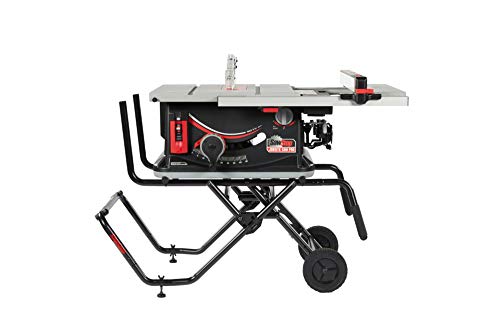
The Jobsite Saw Pro is the portable SawStop built for work that moves. It pairs the same flesh-sensing system with a mobile cart assembly that folds for transport and storage, a larger table than the compact model, and details aimed at site work, including one-turn blade elevation and a fence designed for quick, repeatable adjustment. For a contractor who had hoped a SawStop chop saw existed for framing and finish crosscuts, this is the model most often considered instead, because it travels to the same places a chop saw travels.
In practice, the trade is clear. This saw handles ripping deck boards, sizing sheet material, and crosscutting moderate stock on site, all with blade-stop protection, and it rolls away when the day ends. It does not swing an angled cut through long trim the way a sliding miter saw does, so trim crews will still carry a conventional miter saw alongside it. The listing identifies this configuration as the 1.5 horsepower, 120 volt model with the mobile cart included, rather than sold as an add-on.
Who It Suits
This saw suits contractors, remodelers, and home woodworkers who need one saw that moves between a shop and a site without giving up the safety system. It should be skipped by buyers with a permanent shop who rarely move a saw, because the contractor and cabinet models below offer more table, more fence, and more stability for similar effort, and by trim specialists whose core work is angled crosscutting in long stock.
The Contractor Saw is where SawStop ownership starts to look like a traditional full-size table saw. The configuration listed here combines the 1.75 horsepower contractor saw with the 36 inch Professional T-Glide fence system, cast-iron table surfaces, and an open stand that can accept mobility options. It is a stationary-shop saw in footprint and behavior, even though the contractor name suggests site work, and it is the step where ripping capacity, fence quality, and table size stop feeling like compromises.
For the chop saw shopper, the appeal is stability and repeatability. Long rips stay true against the T-Glide fence, and sheet goods sit on a real table instead of a portable top. Crosscuts remain miter gauge or sled work, accurate for furniture parts, but not a substitute for a miter saw station when the job is cutting a room full of baseboard to length.
Who It Suits
This saw suits home shops moving up from a portable saw, furniture and cabinet hobbyists who want a full-size table and a serious fence, and buyers who want the safety system without stepping to a closed cabinet saw. It should be skipped by buyers who need true portability, by shops ready for a heavier cabinet machine and stronger motors, and by anyone whose main task remains high-volume angled crosscutting.
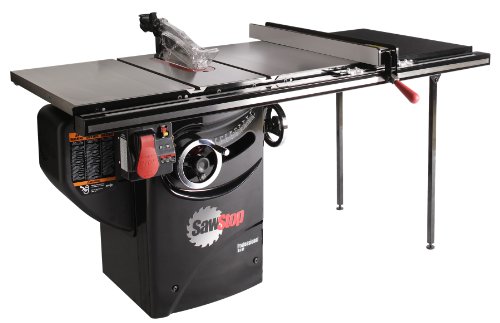
The Professional Cabinet Saw in this 3 horsepower, 36 inch configuration is the most capable saw in this guide and the furthest point from a chop saw in both size and intent. It is a closed-cabinet, stationary machine with a heavy trunnion, gas piston assistance for blade elevation, a cast-iron table with extension wings, and the Professional T-Glide fence. The manufacturer describes true vertical trunnion travel, thick arbors, and a dust collection arrangement that captures 99 percent of created dust when the shroud and blade guard collection are combined.
The safety system works the same way here as on the smallest model, in less than five milliseconds. What changes is everything around it. At an overall weight listed at 426 pounds and with a 230 volt, 13 amp motor, this is a machine that gets placed, wired, and left in position. For a woodworker building cabinets, furniture, and built-ins full time or near it, this is the SawStop that ends the upgrade cycle.
Who It Suits
This saw suits serious hobbyists and professional shops with a permanent space, a suitable 230 volt circuit, and work centered on cabinets, furniture, and sheet goods. It should be skipped by buyers in small or temporary spaces, by anyone who needs a saw that travels, and by shoppers whose real requirement is a miter saw for trim and framing crosscuts, because this machine, for all its capability, does not make that cut in that way.
FAQ
Does SawStop make a chop saw or miter saw?
No. SawStop makes table saws, along with accessories such as router tables, mobile bases, and fences. The company does not sell a chop saw, a miter saw, or a sliding compound miter saw, and no SawStop product offers flesh-sensing protection on a pivoting or sliding crosscut head. A product described anywhere as a SawStop chop saw should be treated as a mislabeled listing until the actual product type and brand are confirmed on the product page itself.
Can a SawStop table saw replace a miter saw for crosscuts?
Partly. A SawStop table saw crosscuts accurately with its miter gauge or with a crosscut sled, and for furniture parts, cabinet components, and short boards, that is often enough. It does not replace a miter saw for long boards, wide trim, crown molding held at an angle, or repetitive angled cuts on a job site, where the stock stays still and the blade moves. Many shops run both: a conventional miter saw for crosscutting long stock, and a SawStop table saw for ripping and sizing, where the blade-stop protection applies.
What happens after the SawStop brake fires?
The brake cartridge drives an aluminum block into the blade, the blade stops and drops below the table, and power to the motor is cut. The cartridge is single-use and the blade is typically damaged, so getting back to work means inspecting the saw, fitting a new cartridge, and fitting a sound blade. The manufacturer presents the reset as a short, user-performed job. Keeping a spare cartridge in the shop avoids downtime, and dado work requires its own dedicated cartridge matched to the dado stack.
Which SawStop class is right for a small shop?
For most small shops, the choice is between the Compact Table Saw and the Jobsite Saw Pro. The compact model is lighter, simpler, and easier to store on or under a bench, while the jobsite model adds a folding mobile cart, a larger working surface, and site-ready handling. A garage shop with a fixed corner and regular furniture work may justify the Contractor Saw instead, provided the footprint is acceptable. The Professional Cabinet Saw belongs in a permanent shop with the floor space and the electrical circuit to support it.
Final Verdict
There is no best SawStop chop saw, because SawStop does not build one, and this guide has not pretended otherwise. What exists is a complete ladder of table saws carrying the only flesh-sensing blade-stop system sold for this kind of work. Choose by shop and by cut: the Compact Table Saw for the smallest spaces, the Jobsite Saw Pro for work that moves, the Contractor Saw for a full-size home shop, and the Professional Cabinet Saw for a permanent, high-capability setup. A buyer whose work is dominated by angled crosscuts in long stock still needs a conventional miter saw, used carefully, because no current miter saw offers that cut with SawStop protection.
Product and ASIN Reference
Product
ASIN
SawStop Compact Table Saw CTS-120A60
B0B2TJFH24
SawStop Jobsite Saw Pro with Mobile Cart Assembly JSS-120A60
B07WV5X277
SawStop 10-Inch Contractor Saw CNS175-TGP236
B006G36VHG
SawStop 10-Inch Professional Cabinet Saw PCS31230-TGP236
B009C7NGTE
J
JD's Woodworks Editorial Team
We compare specs, warranty terms, long-term owner feedback and street pricing before anything earns a spot. Rankings are never paid.
Affiliate disclosure. As an Amazon Associate we earn from qualifying purchases at no extra cost to you. Prices accurate as of the date shown.
Four hobby TIG welders compared for home shops: AC/DC picks for aluminum, a compact DC model for steel, listed specs, included gear and honest tradeoffs.
The best Creality Falcon engravers compared: Falcon A1 10W, CR-Laser Falcon 10W, Falcon2 Pro 22W and Falcon2 Pro S 40W, by power, work area and enclosure.
The best CNC machines for manufacturing compared: large-bed routers and closed-loop desktop mills with the work area, spindle and control for batch work.

 SawStop Compact Table Saw CTS-120A60
 SawStop Jobsite Saw Pro JSS-120A60
 SawStop Contractor Saw CNS175-TGP236
 SawStop Professional Cabinet Saw PCS31230-TGP236









