4 Best Cabinet Table Saws for Woodworking (November 2026)
Our guide to the best cabinet table saw for woodworking compares four 3 HP saws on fence, rip capacity and safety, so you can pick the right one for your shop.
Our guide to the best cabinet table saw for woodworking compares four 3 HP saws on fence, rip capacity and safety, so you can pick the right one for your shop.
As an Amazon Associate I earn from qualifying purchases. This post may contain affiliate links at no extra cost to you.
A cabinet table saw is the centre of a serious woodworking shop, and the four models in this guide all share the same foundation: a 3 HP motor, a cast-iron table and a full cabinet that keeps dust inside. Where they differ is the fence, the rip capacity and the safety system, and those differences decide which saw suits your work. This guide compares them side by side so you can spend once and buy the saw that still fits in ten years.
We chose every saw below from the name and specifications shown on its Amazon page, and we weigh motor power, fence quality, rip capacity and safety features rather than brand names. Whether you build furniture, break down sheet goods or run a small professional shop, the four picks below cover the range, and the advice that follows will help you match the saw to the work you do most.
Quick Picks
As an Amazon Associate we earn from qualifying purchases
Product
Best for
Key spec from title
SawStop PCS31230-TGP236
Shops that want the flesh-detection brake
3 HP, 36-in T-Glide fence
Powermatic PM2000B PM23150K
Large sheet goods and wide rips
3 HP, 50-in rip capacity
JET Deluxe XACTA JTAS-10XL30-1DX
Cabinet power in a shorter fence
3 HP, 30-in rip capacity
Laguna F3 Fusion
Furniture makers who want outfeed support
3 HP, 36-in rip capacity
How to Choose
Motor Power and Voltage
All four saws in this guide run a 3 HP motor, which is the sweet spot for a cabinet saw in a home or small professional shop. Three horsepower rips thick hardwoods without bogging down and handles a full-depth cut in maple or oak without complaint. Every model here needs 230V power, so check your shop wiring before you order and plan for a dedicated circuit with the right breaker. A 120V circuit cannot run these saws, and an extension cord is no substitute for proper wiring. If your shop has only 120V outlets, budget for an electrician alongside the saw.
Fence and Rip Capacity
The fence decides how accurately you rip, and rip capacity decides how wide a sheet you can cut. The Powermatic leads with a 50-inch rip capacity and its Accu-Fence, which suits breaking down full sheets of plywood. The SawStop and Laguna both offer 36 inches, which covers most furniture work and cabinet parts, while the JET gives 30 inches in a shorter footprint for a smaller shop. Test the fence action in your mind: it should lock square to the blade every time without a nudge. A fence that drifts costs you accuracy on every cut, so weigh it as heavily as the motor.
Table, Trunnions and Weight
A cabinet saw earns its price from the iron under the table. Cast-iron trunnions hold the blade true under load, and a heavy cabinet damps vibration so the cut stays clean. The Powermatic weighs 385 lb with a one-piece cast-iron box trunnion, and the JET weighs 407 lb, so both need help to install and a level floor to sit on. Extension tables add support for long boards, and the Laguna includes outfeed and rip tables in the box. Check the overall dimensions on the listing and measure your shop, because a cabinet saw with a 50-inch fence needs real floor space.
Safety Systems and Guards
Safety separates a cabinet saw from a cheaper machine, and the SawStop in this guide leads with a flesh-detection brake that stops the blade on contact. Every saw here ships with a blade guard and a riving knife, and both should stay on the saw for through cuts. Use a push stick for narrow rips and never reach over a spinning blade, and wear eye and hearing protection on every cut. Disconnect the saw before changing a blade, and keep the area behind the saw clear so offcuts cannot catch. A brake system is a backup, not a substitute for careful habits.
The 4 Best Options
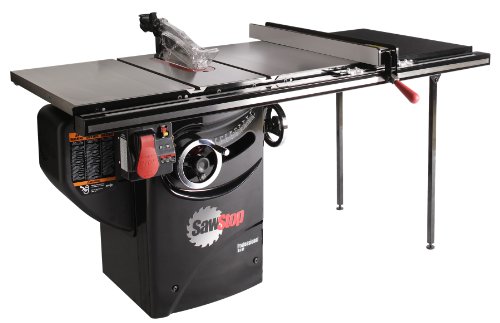
SawStop PCS31230-TGP236 Professional Cabinet Saw
Top Pick
SawStop PCS31230-TGP236 Professional Cabinet Saw
Best for: Shops that want the flesh-detection brake and a precise 36-inch fence.
The SawStop PCS31230-TGP236 is the safety leader in this guide, and its flesh-detection brake is the reason most buyers choose it. The system stops the blade within milliseconds of contact with skin, which turns a serious injury into a minor one. Behind the brake sits a serious saw: a 3 HP motor on 230V power, a 10-inch blade, and a 36-inch Professional T-Glide fence that locks square every time. The cast-iron table stays flat under heavy stock, and the cabinet keeps dust contained. For a shop where hands work close to the blade every day, the brake system is worth more than any other feature on the list.
Watch out for: The brake cartridge is a consumable that needs replacing after it fires, and the saw needs a 230V circuit.
Powermatic PM2000B PM23150K Cabinet Table Saw
Runner-Up
Powermatic PM2000B PM23150K Cabinet Table Saw
Best for: Large sheet goods, wide rips and shops that cut plywood daily.
The Powermatic PM2000B is the heavyweight in this guide, built for shops that break down sheet goods every day. Its 50-inch rip capacity and Accu-Fence handle full sheets of plywood without a second setup, and the extension table supports long boards through the cut. The 3 HP motor runs on 230V single-phase power, and the one-piece cast-iron box trunnion holds the blade true under load. ArmorGlide on the table surface helps stock slide smoothly, and the hydraulic caster system makes a 385 lb saw movable when the shop layout changes. For a shop that rips wide panels daily, the Powermatic is the most capable saw here.
Watch out for: At 385 lb it needs help to install, and the 50-inch fence needs a large shop footprint.
The JET Deluxe XACTA brings cabinet-saw power into a shorter footprint for shops that cannot fit a 50-inch fence. Its 3 HP motor runs on 230V single-phase power, and the XACTA Fence II locks square across a 30-inch rip capacity that covers most furniture and cabinet parts. On-board storage keeps the fence and miter gauge close, and the 407 lb cabinet damps vibration for clean cuts in hardwood. The shorter fence is the trade-off: full sheets need a second setup or a track saw for the first cut. For a small shop that wants cabinet-saw build without the long fence, the JET is the right size.
Watch out for: The 30-inch rip capacity limits wide sheet cuts, and the ASIN comes from a single source, so confirm it before ordering.
Laguna F3 Fusion Cabinet Table Saw
Laguna F3 Fusion Cabinet Table Saw
Best for: Furniture makers who want outfeed support included in the box.
The Laguna F3 Fusion is the furniture maker’s pick in this guide, because it ships with the support tables other saws sell separately. The included outfeed and rip tables catch long boards as they leave the blade, which matters when you rip eight-foot stock alone. Its 3 HP TEFC motor runs on 220V power, and the 36-inch rip capacity with a Hi-Lo European-style fence covers cabinet parts and furniture panels. Cast-iron trunnions hold the blade true, and the 14-gauge steel cabinet keeps the machine rigid. For a one-person shop building furniture, the included tables save both money and setup time.
Watch out for: It needs a 220V circuit, and as a newer model it is worth confirming parts support before ordering.
Which One Fits Your Situation
Furniture and Cabinet Work
Furniture and cabinet work needs accuracy more than raw rip capacity, and a 36-inch fence covers nearly every part you will cut. The SawStop leads here with its brake system and its precise T-Glide fence, while the Laguna answers with included outfeed tables that catch long rails and stiles. Pick the SawStop when safety tops your list, and the Laguna when you rip long stock alone.
Breaking Down Sheet Goods
Breaking down sheet goods is a job for rip capacity, and the Powermatic wins it outright with a 50-inch fence and an extension table. Full sheets of plywood slide through in one setup, and the Accu-Fence stays square across the whole cut. If plywood is your daily material, the Powermatic pays for its footprint in saved hours.
A Small Shop With One Big Saw
A small shop with one big saw needs cabinet power in the smallest footprint that still does the work. The JET XACTA fits that brief with a 30-inch fence and a 407 lb cabinet that damps vibration, and its on-board storage keeps the fence and gauge close. Measure the shop before you order, and leave room behind the saw for offcuts.
Safety-First Buying
If safety tops your list, the choice is straightforward. The SawStop brake system stops the blade on contact with skin, which no fence or motor can match. Keep the blade guard and riving knife on the saw for through cuts, use a push stick for narrow rips, and treat the brake as a backup rather than a licence to work carelessly.
Common Mistakes
Buying a cabinet saw before checking that the shop has 230V power.
Choosing rip capacity for the biggest sheet instead of the work you do most.
Removing the blade guard and riving knife for convenience.
Skipping the push stick on narrow rips.
Placing the saw where offcuts have nowhere to go behind it.
Frequently Asked Questions
What is the difference between a cabinet saw and a contractor saw?
A cabinet saw encloses its motor and trunnions in a full steel cabinet, which damps vibration and holds the blade true under load. A contractor saw mounts its motor outside the cabinet on an open stand, which makes it lighter but less rigid. Cabinet saws run larger motors, usually 3 HP on 230V power.
Do I need 230V power for a cabinet table saw?
Yes, every saw in this guide needs 230V power, and a standard 120V household outlet cannot run them. Plan for a dedicated circuit with the right breaker, and have an electrician install the outlet before the saw arrives. Check the amperage on the listing as well, since the SawStop draws 13 amps at 230V.
How does the SawStop safety brake work?
The SawStop safety system senses contact between the blade and skin and stops the blade within milliseconds, dropping it below the table. The system fires a brake cartridge that must be replaced after it triggers. The brake does not replace the blade guard, the riving knife or careful habits, and it only protects against contact with skin.
What rip capacity do I need for sheet goods?
A 50-inch rip capacity handles full sheets of plywood in one setup, which suits shops that break down sheet goods daily. A 36-inch capacity covers most furniture and cabinet parts, and it fits a smaller shop. A 30-inch capacity suits furniture work but needs a second setup for wide sheets. Measure the widest panel you cut regularly before you choose.
J
JD's Woodworks Editorial Team
We compare specs, warranty terms, long-term owner feedback and street pricing before anything earns a spot. Rankings are never paid.
Affiliate disclosure. As an Amazon Associate we earn from qualifying purchases at no extra cost to you. Prices accurate as of the date shown.
Miter saw vs table saw: compare crosscuts, rip cuts, accuracy, space, and value to choose the right saw for your shop and your first woodworking projects.
Compare five solar portable generators for shops, campsites, and outages, covering battery size, output, solar charging, outlets, and what to check first.
The best portable CNC machines for small shops and shared spaces, compared by footprint, weight, work area, and setup. Compact benchtop picks for wood, acrylic, and soft metal.
Find the best Penn Industries dust collector on Amazon: the PSI Woodworking DC3XX blower and the DC725 tabletop unit, compared on airflow, pressure, and shop fit.
Compare five large stationary horizontal metal band saws for fabrication shops on cutting capacity, motor, power supply, blade speed, and mitering before buying.
Find the best mortising chisel bits for clean square mortises in this guide: hollow-chisel sets and singles compared by size, shank, steel, and machine fit.
Find the best drill press base for your shop. Compare rolling stands and mobile bases by capacity, footprint, casters, locking, and setup before you buy.
Find the best dewalt planer dw734 blades for your 12-1/2-inch thickness planer. Compare OEM and aftermarket 3-knife sets, steel types, and fit before you buy.



 Laguna F3 Fusion Cabinet Table Saw









