Best 80 Gallon Air Compressors for Workshops and Garages
Compare the best 80 gallon air compressors by CFM, motor size, pump type and duty cycle, with two-stage picks for woodworking shops and light industry.
Compare the best 80 gallon air compressors by CFM, motor size, pump type and duty cycle, with two-stage picks for woodworking shops and light industry.
As an Amazon Associate I earn from qualifying purchases. This post may contain affiliate links at no extra cost to you.
An 80 gallon air compressor is the point where a workshop stops rationing air. A tank this size, paired with a two-stage pump, can feed a dual-action sander through a full panel, keep a spray gun at steady pressure, run a blast cabinet, and still have reserve left for the next tool on the line. For woodworking shops that run wide-belt sanders, edgebanders or several pneumatic stations, and for light industrial benches that share one compressor across a shift, this is the class that ends the cycle of waiting for a small tank to recover.
The catch is that 80 gallon models look similar in a listing while differing a lot underneath: motor size, delivered airflow, pump construction, duty cycle and electrical demands all vary. This guide compares four current 80 gallon compressors sold on Amazon US, explains the specs that actually decide whether a unit keeps up, and matches each model to the kind of shop it suits.
As an Amazon Associate, we earn from qualifying purchases.
Quick Picks
Our Short List of 3
Editor’s Choice
Ingersoll Rand 2475N7.5
Best for: Busy woodworking and light industrial shops that run air tools for most of the working day
Delivered airflow matters more than tank size. Every model here stores 80 gallons, so the tank alone does not separate them. What decides whether pressure holds during a long sanding or spraying run is CFM delivered at working pressure. A single dual-action sander or HVLP gun typically draws somewhere in the low teens of CFM; two tools at once, or a blast cabinet, push demand toward 20 CFM and beyond. Add up the tools that will genuinely run at the same time, then choose a compressor whose delivered CFM at 90 or 100 PSI clears that total with headroom to spare.
Two-stage versus single-stage. Two-stage pumps compress air in two steps, reach 175 PSI, and run more efficiently at high pressure, which is why three of the four picks here use them. The higher stored pressure also means more usable air in the same 80 gallon tank. Single-stage and oil-free designs top out lower, around 145 to 155 PSI, but can still suit shops whose tools all work happily at 90 PSI and who value simpler upkeep.
Pump construction and duty cycle. A cast iron, oil-lubricated pump is the long-service choice: it tolerates continuous running, and the Ingersoll Rand below is built around a pump life measured in tens of thousands of hours. Oil-free pumps remove oil changes and oil carryover from the routine, which some finishing shops prefer, but the trade-off is usually a pump that works harder per hour of output. Match the pump to how many hours a day the compressor will actually run.
Electrical supply is a real filter. These are not plug-in appliances. Most 80 gallon two-stage units need a dedicated 230 volt single-phase circuit, hardwired, with a magnetic control fitted, and the 7.5 HP models draw heavy current on every cycle. Three-phase versions of some models exist for industrial buildings. Confirm your panel capacity and the exact voltage and phase of the listing before ordering, because returning a freight-shipped compressor is a painful exercise.
Footprint, weight and delivery. Vertical tanks keep the floor footprint near that of a water heater, but these machines weigh from roughly 265 to over 620 pounds and arrive by freight, usually on a pallet, at the curb. Plan the route from the truck to the final pad, check door widths and ceiling height, and have a pallet jack or several strong helpers ready. The compressor should sit level, anchored or on isolation pads, with clearance for airflow and for reaching the drain valve.
Air quality for finishing work. Any compressor feeding spray equipment needs dry, clean air at the gun. Budget and space for a regulator, a particulate filter and a coalescing filter or dryer downstream of the tank, and drain the tank daily. The best pump in the world cannot fix wet air at the spray gun.
Best Options
Ingersoll Rand 2475N7.5
Top Pick
Ingersoll Rand 2475N7.5
Best for: Busy woodworking and light industrial shops that run air tools for most of the working day
The 2475N7.5 is the benchmark two-stage shop compressor in this class: a 7.5 HP motor driving a cast iron Type 30 pump over an 80 gallon vertical ASME tank. It delivers 24.3 CFM at 90 PSI, the strongest airflow figure in this guide, and Ingersoll Rand builds the line for continuous duty, with pump life designed for over 15,000 hours of use. For a woodworking shop running a wide-belt sander and a second station, or a small production bench that never really stops, this is the unit sized to stay ahead of demand.
It is also the heaviest and most demanding pick here. At about 611 pounds it needs a planned freight delivery, a level pad and a proper 230 volt single-phase supply. Buyers who only run one modest tool at a time will pay for capacity they never use, but shops that have outgrown a 60 gallon unit will recognise exactly what the extra pump buys them.
Watch out for: Freight delivery and hardwired installation are part of the purchase; confirm the listing voltage and phase match your building before ordering
Industrial Air IV7518075
Runner-Up
Industrial Air IV7518075
Best for: Shops that regularly run two air-hungry tools at once on single-phase power
Motor: 7.5 HP Baldor, 230 volt single phase
Pump: two-stage, cast iron, oil-lubricated
Air delivery: 22.1 CFM at 100 PSI; 21.2 CFM at 175 PSI
The IV7518075 pairs a 7.5 HP Baldor motor with a two-stage cast iron pump and an 80 gallon ASME tank, delivering 22.1 CFM at 100 PSI and 21.2 CFM at 175 PSI. That output at full pressure is what lets it hold two demanding tools, or a spray line and a sander, without the gauge sagging mid-job. It ships with a pre-wired magnetic control fitted, which simplifies the electrician’s side of the install, and the extended tank drain valve and ball valve are small details that make daily draining less of a chore.
At roughly 623 pounds and about 80 inches tall in its shipping stance, this is a fixed installation, not a machine you reposition on a whim. The two-cylinder pump runs at a moderate speed for its class, which supports long service intervals, and a two-year limited warranty backs the unit. Shops stepping up from a contractor-grade compressor will feel the difference most in recovery time: the pump refills the big tank quickly even while work continues.
Watch out for: Very heavy and tall; measure ceiling clearance and plan the delivery route before it ships
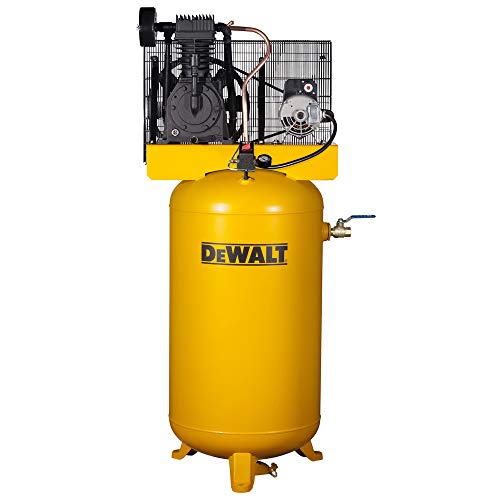
DEWALT DXCMV5048055
DEWALT DXCMV5048055
Best for: Cabinet and furniture shops with strong but mostly single-tool air demand
Motor: 5 HP, 230 volt single phase
Pump: two-stage, cast iron, oil-lubricated
Air delivery: 17.9 CFM at 100 PSI; 17.0 CFM at 175 PSI
The DXCMV5048055 is the 5 HP entry in DEWALT’s two-stage stationary line, and it hits a useful middle ground: 17.9 CFM at 100 PSI and 17.0 CFM at 175 PSI from a cast iron, oil-lubricated pump over an 80 gallon ASME tank. That is comfortably more air than a single sander, spray gun or nail crew consumes, with the big tank smoothing out the peaks. Thermal overload protection guards the motor, and the patented pump design is built to run cooler than a basic two-stage layout.
For a woodworking shop whose air use is heavy but mostly one tool at a time — a cabinet shop spraying finish in the morning and sanding in the afternoon — this size often makes more sense than a 7.5 HP unit, with lower draw on the electrical supply to match. It still weighs about 523 pounds and needs a dedicated 230 volt circuit, so the installation planning is the same; only the running demand is gentler.
Watch out for: Output is a clear step below the 7.5 HP models; two simultaneous high-draw tools will outrun it
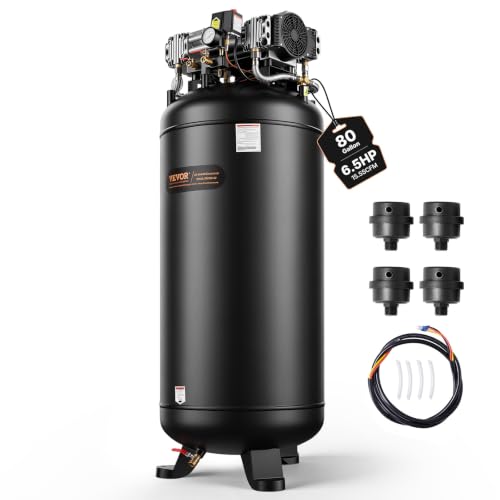
VEVOR 80 Gallon Oil-Free Stationary Compressor
VEVOR 80 Gallon Oil-Free Stationary Compressor
Best for: Workshops that want an 80 gallon tank without oil changes or oil in the air line
The VEVOR takes a different route from the cast iron two-stage models: a 6.5 HP oil-free motor delivering 15.5 SCFM at 90 PSI into an 80 gallon cold-rolled steel tank, with a 145 PSI maximum pressure. The appeal is upkeep. There is no pump oil to check, change or mist into the air line, which simplifies life for shops that want air on tap without a lubrication routine, and at about 265 pounds it is by far the easiest unit here to receive and position.
The compromises are pressure ceiling and positioning. At 145 PSI max it stores less usable air than a 175 PSI two-stage unit, and its 220 volt single-phase supply still needs a proper circuit. Its maker quotes 86 dB in operation, so it is not a quiet machine despite the oil-free design, and long continuous runs are harder on an oil-free pump than on the cast iron designs above. For intermittent, varied shop work rather than all-day production, it is a practical and simpler alternative.
Watch out for: The 145 PSI ceiling and oil-free pump suit intermittent use better than continuous production running
Which One Fits
Running air all day, every day: choose the Ingersoll Rand 2475N7.5. Its continuous-duty build, cast iron pump and class-leading airflow are made for shops where the compressor is effectively a utility, not a tool.
Two demanding tools at once on single-phase power: choose the Industrial Air IV7518075. The Baldor motor and strong delivery at full pressure keep both stations fed, and the pre-wired control simplifies installation.
A serious one-person or small-crew woodworking shop: choose the DEWALT DXCMV5048055. It covers sanding, spraying and nail work with reserve to spare, without the electrical appetite of the 7.5 HP models.
Low-upkeep air for varied, intermittent work: choose the VEVOR oil-free model. No oil routine, the lightest delivery of the group, and enough flow for most single tools, as long as the 145 PSI ceiling fits your work.
Common Mistakes
Buying on tank size alone. All four units here hold 80 gallons; the differences that matter are delivered CFM, pressure ceiling and duty cycle. A big tank on a weak pump only delays the moment pressure falls.
Adding up tool CFM wrong. Check each tool’s consumption at the pressure it actually uses, and count only tools that truly run simultaneously — then still leave headroom, because consumption figures assume a tool in good condition.
Ignoring the electrical supply. Ordering a 230 volt single-phase compressor for a building with only light circuits, or a three-phase unit for a single-phase shop, turns a delivery day into a logistics problem. Verify panel capacity first.
Skipping air treatment. Spray finishing with air straight from the tank invites moisture and oil defects in the finish. Fit filtration and a regulator, and drain the tank every day the compressor runs.
Blocking airflow or the drain. A compressor tucked tight against walls overheats and shortens pump life, and a drain valve you cannot reach is a drain valve that never gets used, which rusts the tank from inside.
FAQ
Is an 80 gallon compressor too much for a home workshop?
For occasional nail-gun and inflation work, yes — a far smaller unit covers it. An 80 gallon model earns its floor space when you sand, spray, grind or run a blast cabinet regularly, or when several people share one air supply. If your current compressor cycles constantly and pressure dips mid-task, this class is the fix.
What electrical supply does an 80 gallon compressor need?
Most models in this class need a dedicated 230 volt single-phase circuit, hardwired by an electrician, and the larger motors draw substantial current. Check the exact voltage, phase and amp requirements on the listing for the specific unit, and confirm your panel has capacity before ordering.
How long should an 80 gallon two-stage compressor last?
A cast iron, oil-lubricated two-stage pump that is kept in clean oil and drained daily is built for many years of shop service; the Ingersoll Rand in this guide is designed around a pump life of over 15,000 hours. Oil-free pumps trade some of that longevity for freedom from oil maintenance.
Do I need a dryer or filter with an 80 gallon compressor?
For sanding, nailing and general tool use, a regulator and a basic particulate filter are usually enough. For spray finishing, add a coalescing filter or a dryer close to the gun, because tank air carries moisture that will show up in the finish. Daily tank draining is the cheapest air-quality habit you can build.
Final Verdict
For most shops moving up to an 80 gallon air compressor, the Ingersoll Rand 2475N7.5 is the safest long-term buy: the strongest airflow in this group, a continuous-duty cast iron pump and a long service record in exactly this role. The Industrial Air IV7518075 runs it close for two-tool work on single-phase power, while the DEWALT DXCMV5048055 trims motor size and electrical demand for smaller crews. Pick the VEVOR when skipping oil maintenance matters more than a 175 PSI ceiling. Whichever you choose, size the circuit, plan the freight delivery, and fit proper filtration — the compressor is only half of a good shop air system.
J
JD's Woodworks Editorial Team
We compare specs, warranty terms, long-term owner feedback and street pricing before anything earns a spot. Rankings are never paid.
Affiliate disclosure. As an Amazon Associate we earn from qualifying purchases at no extra cost to you. Prices accurate as of the date shown.
Miter saw vs table saw: compare crosscuts, rip cuts, accuracy, space, and value to choose the right saw for your shop and your first woodworking projects.
Compare five solar portable generators for shops, campsites, and outages, covering battery size, output, solar charging, outlets, and what to check first.
The best portable CNC machines for small shops and shared spaces, compared by footprint, weight, work area, and setup. Compact benchtop picks for wood, acrylic, and soft metal.
Find the best Penn Industries dust collector on Amazon: the PSI Woodworking DC3XX blower and the DC725 tabletop unit, compared on airflow, pressure, and shop fit.
Compare five large stationary horizontal metal band saws for fabrication shops on cutting capacity, motor, power supply, blade speed, and mitering before buying.
Find the best mortising chisel bits for clean square mortises in this guide: hollow-chisel sets and singles compared by size, shank, steel, and machine fit.
Find the best drill press base for your shop. Compare rolling stands and mobile bases by capacity, footprint, casters, locking, and setup before you buy.
Find the best dewalt planer dw734 blades for your 12-1/2-inch thickness planer. Compare OEM and aftermarket 3-knife sets, steel types, and fit before you buy.


 VEVOR 80 Gallon Oil-Free Stationary Compressor









