3 Best Electric Welders for Home Shops (November 2026)
Compare three plug-in electric welders for home shops: a 205A multiprocess inverter, a 180A MIG with spool gun included, and a 140A 115V Hobart Handler.
Compare three plug-in electric welders for home shops: a 205A multiprocess inverter, a 180A MIG with spool gun included, and a 140A 115V Hobart Handler.
As an Amazon Associate I earn from qualifying purchases. This post may contain affiliate links at no extra cost to you.
An electric welder purchase is really a decision about the circuit it will run on and the processes you will actually use. A 115V machine plugs into a normal shop outlet but tops out on thinner steel, while a dual-voltage inverter asks for a 220V receptacle and repays you with thicker capacity and longer beads. Process coverage matters just as much: a MIG-only box, a multiprocess unit with lift TIG, and a machine with a spool gun in the carton are three different tools wearing similar paint.
This roundup is for home-shop welders, farm repair work, and light fabrication. Every pick below is a plug-in electric machine, chosen from the amperage, voltage, duty cycle, and process details printed on its Amazon listing. Engine-driven welder generators are a separate product type and are not mixed in here.
Quick Picks
As an Amazon Associate we earn from qualifying purchases.
Product
Best for
Key spec from title
YESWELDER MIG-205DS PRO
One machine covering five processes
205A, 110/220V dual voltage
PrimeWeld MIG180
Aluminum work with a spool gun in the box
180 amp, dual voltage 220V/110V
Hobart Handler 140 (500559)
115V-only shops welding steel up to 1/4 inch
140A, operates off 115V household current
How to Choose
Match the machine to your shop circuit first
Voltage decides what an electric welder can do before any other spec does. A 115V-only machine like the Hobart Handler 140 runs on a standard 20-amp household circuit, which makes it the path of least resistance in a garage with no 220V receptacle. Dual-voltage machines such as the YESWELDER MIG-205DS PRO and the PrimeWeld MIG180 run on either input, so they can start life on 115V and unlock their full amperage later when a 220V line goes in. Check which receptacle you truly have, because headline amperage is only reachable on the higher input.
Read duty cycle next to amperage, not instead of it
Amperage tells you the thickest metal a welder can join in a single pass; duty cycle tells you how long it can keep doing it before it needs to rest. The Handler 140 is rated at a 20 percent duty cycle at 90 amps, which suits short beads and tack-heavy assembly but means pauses during long seams. When a listing prints a duty cycle, compare it at the amperage you will actually run, not at the machine’s maximum. A welder that holds a higher duty cycle at working amperage finishes a gate frame faster than a stronger-on-paper unit that keeps tripping its thermal limit.
Decide which processes you need in one box
MIG with gas gives clean beads on steel, flux core skips the gas bottle and handles outdoor work and dirtier metal, stick remains the forgiving choice for thick or rusty stock, and lift TIG adds controlled, tidy welds on thinner material. Multiprocess machines bundle several of these into one case, which saves bench space and one power cord. The trade-off is that a dedicated single-process machine often keeps simpler controls. List the jobs you did last year, not the ones you imagine, and buy the process set that covers those jobs without paying for modes that will never leave the menu.
Plan for wire, consumables, and aluminum separately
Wire feed range and spool size shape daily convenience more than peak amps do. The Handler 140 feeds wire at 40 to 700 IPM and accepts both small and large spools, so it can live on a cart with an 8-inch roll for long projects. Aluminum is its own question: pushing soft aluminum wire through a standard MIG gun invites bird-nesting, which is why the PrimeWeld includes a spool gun and the YESWELDER is spool gun compatible with the gun sold separately. Confirm which contact tips, drive rolls, and nozzles a machine uses, because standard Tweco-style consumables are easier to replace on a Saturday than proprietary ones.
The 3 Best Options
YESWELDER MIG-205DS PRO
Top Pick
YESWELDER MIG-205DS PRO
Best for: Home shops that want MIG, stick, and lift TIG in one dual-voltage machine.
Output: 205A maximum
Input voltage: 110/220V dual voltage
Processes: Gas MIG, flux core MIG, spool gun MIG, lift TIG, stick (5 in 1)
This is the pick for a shop that wants one inverter to cover nearly everything: gas MIG, flux core MIG, spool gun MIG, lift TIG, and stick from a single dual-voltage case. The 205-amp ceiling on 220V gives it the most headroom of the three machines here, while 110V input keeps it usable in a garage that has not been wired for a welder yet. Synergic and manual modes let a beginner lean on presets and an experienced welder override them. The TIG torch and spool gun are separate purchases, so price the complete setup you intend to run, not just the box.
PrimeWeld MIG180
Runner-Up
PrimeWeld MIG180
Best for: Welders who plan to run aluminum and want the spool gun included rather than added later.
The MIG180 earns its place by solving the aluminum problem at purchase time: a dedicated spool gun ships in the carton, so aluminum wire feeds from the gun instead of kinking inside a long torch lead. It runs MIG, flux core, and stick at up to 180 amps on dual 120/240 volt input, and its 2T/4T trigger modes help on long seams where holding a trigger steady gets tiring. It uses standard Tweco-style consumables, which keeps tips and nozzles easy to source locally. At roughly transformer-machine weight it is less of a grab-and-go inverter, but shops that park a welder on a cart will not mind.
Hobart Handler 140 (500559)
Hobart Handler 140 (500559)
Best for: 115V-only garages doing steel repair and light fabrication up to 1/4 inch.
115V-only garages doing steel repair and light fabrication up to 1/4 inch.
Watch out for
Aluminum needs the optional spool gun and straight argon; check the listing’s included-accessory list so the regulator and sample spool are in your variant.
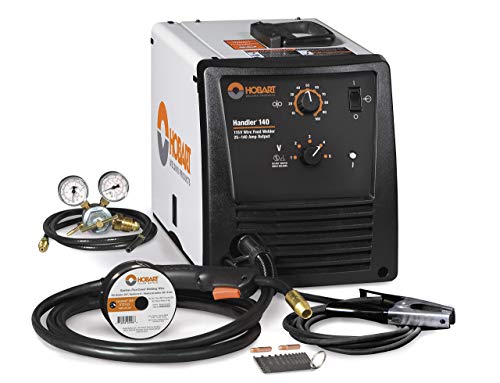
The Handler 140 is the straightforward answer for a shop with only 115V power. It welds from 24 gauge up to 1/4 inch mild steel, runs MIG with gas or self-shielded flux core, and uses a five-position voltage selector that keeps settings simple and repeatable. The included dual-gauge regulator and gas hose mean it is ready for gas MIG out of the carton, and the spool hub takes 4-inch or 8-inch spools. Its 20 percent duty cycle at 90 amps is the honest limit: fine for brackets, patches, and farm repairs, less happy on continuous production seams.
Which One Fits Your Situation
You have no 220V outlet and mostly repair steel
The Hobart Handler 140 was built for exactly this bench. It plugs into a 20-amp household circuit, welds up to 1/4 inch mild steel, and its tapped voltage control removes the guesswork from setup. Accept the modest duty cycle as the price of staying on 115V, and it will handle trailer patches, mower decks, and gate hinges without an electrician visiting first.
You want one machine that grows with your skills
Choose the YESWELDER MIG-205DS PRO. Start with flux core on 110V, add gas MIG when a bottle joins the shop, and keep lift TIG and stick in reserve for thinner or dirtier work. Its 205-amp ceiling on 220V means the machine will not be the bottleneck when your projects move from sheet metal to plate. Budget for the TIG torch separately so the full process set is actually usable.
Aluminum projects are already on your bench
The PrimeWeld MIG180 is the practical route because the spool gun is included, and aluminum feeding is where budget setups usually fall apart. The dual-voltage input lets you run thinner aluminum on household power and step up for thicker sections later. Standard Tweco consumables also mean a worn tip does not end the weekend. If your aluminum work is occasional, compare that against adding a spool gun to the Hobart instead.
You weld outdoors or on rusty farm metal
Flux core and stick tolerate wind and imperfect surfaces better than gas MIG, and all three machines here cover at least one of those processes. The YESWELDER gives you both plus the highest amperage for thick sections, while the Handler 140 covers flux core with simpler controls. Skip any machine whose listing only offers gas MIG if your work regularly leaves the shop, because shielding gas blows away long before the arc does.
Common Mistakes
Buying for maximum amperage when your shop circuit can only feed the machine at 115V, then wondering why output feels weak.
Ignoring duty cycle and planning long continuous seams on a machine rated for short bursts at working amperage.
Assuming aluminum MIG works through the standard gun, then fighting bird-nested wire instead of using a spool gun.
Forgetting the extras: TIG torches, spool guns, gas bottles, and regulators are sold separately on many multiprocess listings.
Choosing a multiprocess machine for processes you never use while giving up the simpler controls of a dedicated MIG unit.
Frequently Asked Questions
Can a 115V electric welder handle real fabrication work?
Yes, within its thickness range. The Handler 140 welds mild steel up to 1/4 inch and runs flux core for outdoor repairs, which covers a large share of home and farm jobs. What 115V cannot do is match the duty cycle and single-pass thickness of a 220V machine, so plan multiple passes and rest periods on heavier sections.
What does duty cycle mean in plain terms?
It is the share of a ten-minute window the welder can run at a stated amperage before it must cool. A 20 percent rating at 90 amps means about two minutes of arc time followed by eight minutes of rest at that setting. Lower amperage usually allows a higher duty cycle, which is why thin-sheet work rarely trips the limit while thick plate work does.
Do I need a spool gun for aluminum?
For MIG welding aluminum, practically yes. Aluminum wire is soft and buckles inside a standard torch lead, causing feed jams. A spool gun carries a small spool at the gun itself, so the wire travels inches instead of feet. That is why the PrimeWeld MIG180 includes one and why the other two machines here treat it as a planned accessory rather than an afterthought.
Is a multiprocess welder better than a dedicated MIG machine?
Only if you will use the extra processes. A multiprocess unit like the MIG-205DS PRO replaces two or three separate machines and saves outlets and bench space. A dedicated MIG such as the Handler 140 offers simpler tapped controls and a lower learning curve. Match the process list to your actual project history, and the better choice usually becomes obvious.
J
JD's Woodworks Editorial Team
We compare specs, warranty terms, long-term owner feedback and street pricing before anything earns a spot. Rankings are never paid.
Affiliate disclosure. As an Amazon Associate we earn from qualifying purchases at no extra cost to you. Prices accurate as of the date shown.
Miter saw vs table saw: compare crosscuts, rip cuts, accuracy, space, and value to choose the right saw for your shop and your first woodworking projects.
Compare five solar portable generators for shops, campsites, and outages, covering battery size, output, solar charging, outlets, and what to check first.
The best portable CNC machines for small shops and shared spaces, compared by footprint, weight, work area, and setup. Compact benchtop picks for wood, acrylic, and soft metal.
Find the best Penn Industries dust collector on Amazon: the PSI Woodworking DC3XX blower and the DC725 tabletop unit, compared on airflow, pressure, and shop fit.
Compare five large stationary horizontal metal band saws for fabrication shops on cutting capacity, motor, power supply, blade speed, and mitering before buying.
Find the best mortising chisel bits for clean square mortises in this guide: hollow-chisel sets and singles compared by size, shank, steel, and machine fit.
Find the best drill press base for your shop. Compare rolling stands and mobile bases by capacity, footprint, casters, locking, and setup before you buy.
Find the best dewalt planer dw734 blades for your 12-1/2-inch thickness planer. Compare OEM and aftermarket 3-knife sets, steel types, and fit before you buy.