
Our Top Picks
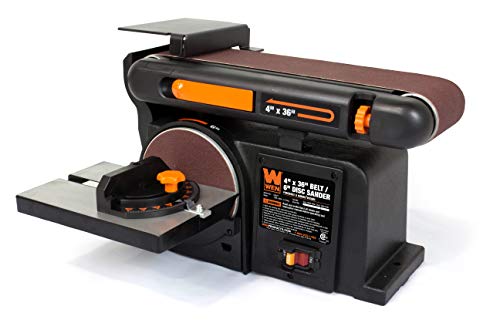 WEN Benchtop Belt and Disc Sander with 46-inch Disc w/ Cast Iron Base22 x 11 x 12.5 InchesCheck on Amazon
 Makita 9903 3" x 21" Belt Sander3" x 21" (76 x 533 mm)11.63 x 5.63 x 6.19 inches9.5 poundsCheck on Amazon


What's inside
As an Amazon Associate I earn from qualifying purchases. This post may contain affiliate links at no extra cost to you.
A belt sander will fix a bad glue-up faster than anything else in my garage, and it will ruin one just as fast. That is the real problem with shopping for the best belt sander for woodworking: most guides treat it like a sanding tool when it is actually a stock-removal machine that happens to use abrasive. Go in expecting a finish-ready surface and you get a dished panel, scratch lines under your first coat of oil, and a shop vac full of walnut.
I work out of a two-car garage with one bench and an optimistic dust situation. I have used a handful of handheld belt sanders and one benchtop combo, and my honest opinion is that most hobby woodworkers need exactly one, picked for the work they actually do instead of the work they picture doing.
As an Amazon Associate we earn from qualifying purchases at no extra cost to you.




Belt sander sizes and what each one is for
The numbers on the box are belt width by belt length in inches, and they tell you most of what you need to know about the tool’s intended job.
| Belt size | Where it shines in a small shop | What you give up | |
|---|---|---|---|
| 3× | 18 in. | Light leveling, one-handed work, tight spots | Short platen wanders off a line more easily |
| 3× | 21 in. | Glue-ups, door edges, benchtops, general shop work | Still heavy enough to dig in if you stall it |
| 4× | 24 in. | Fast leveling of wide panels and slabs | Weight, cost, clumsy on narrow stock |
| 4× | 36 in. benchtop belt and disc | Small parts, squaring ends, curves | Not made for large surfaces |
| 6× | 48 in. stationary | Jigs, shaping, near-production work | Footprint and dust volume in a garage |
For furniture, cabinets, and the occasional cutting board, the 3×21 has been the default answer for decades and I have never found a good reason to argue with it.
What makes the best belt sander for woodworking
Three things matter more than anything printed on the box.
A flat, rigid platen
The plate behind the belt decides whether you get a flat surface or a shallow bowl. Press on it in the store. If the shoe flexes under hand pressure it will flex on your tabletop too, and it gets worse once the tool heats up.
Tracking that holds its setting
A good sander keeps the belt centered for the life of the belt. A cheap one needs a nudge every few minutes, which is irritating on small work and a real problem when you are trying to hold a line on a door edge.
Variable speed
Full speed is right for leveling hardwood and wrong for softwood, paint, thin edge banding, and anything near veneer. Slowing the belt down is what turns a scary tool into a controllable one, and it is usually what separates the entry model from the next one up.
What I quit caring about: peak horsepower claims and the belts in the box, which are mediocre and gone in a weekend. And do not shop for the lightest sander. Weight low in the frame does the cutting so your arms do not, and hand pressure is exactly what makes a surface uneven.
Corded 3x21 belt sander
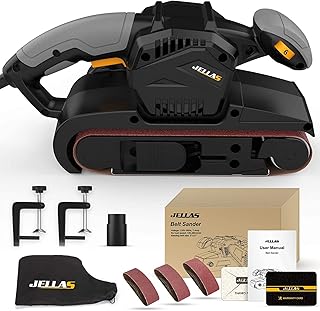
If you are buying one belt sander for a garage shop, this is the class to buy: corded, 3×21, variable speed, with a lever belt release and a port that accepts a shop vac hose. The mainstream lines from Makita, Bosch, Metabo HPT, and Porter-Cable all compete here, and any of them will outlive a hobby workload.
Corded or cordless in a garage shop
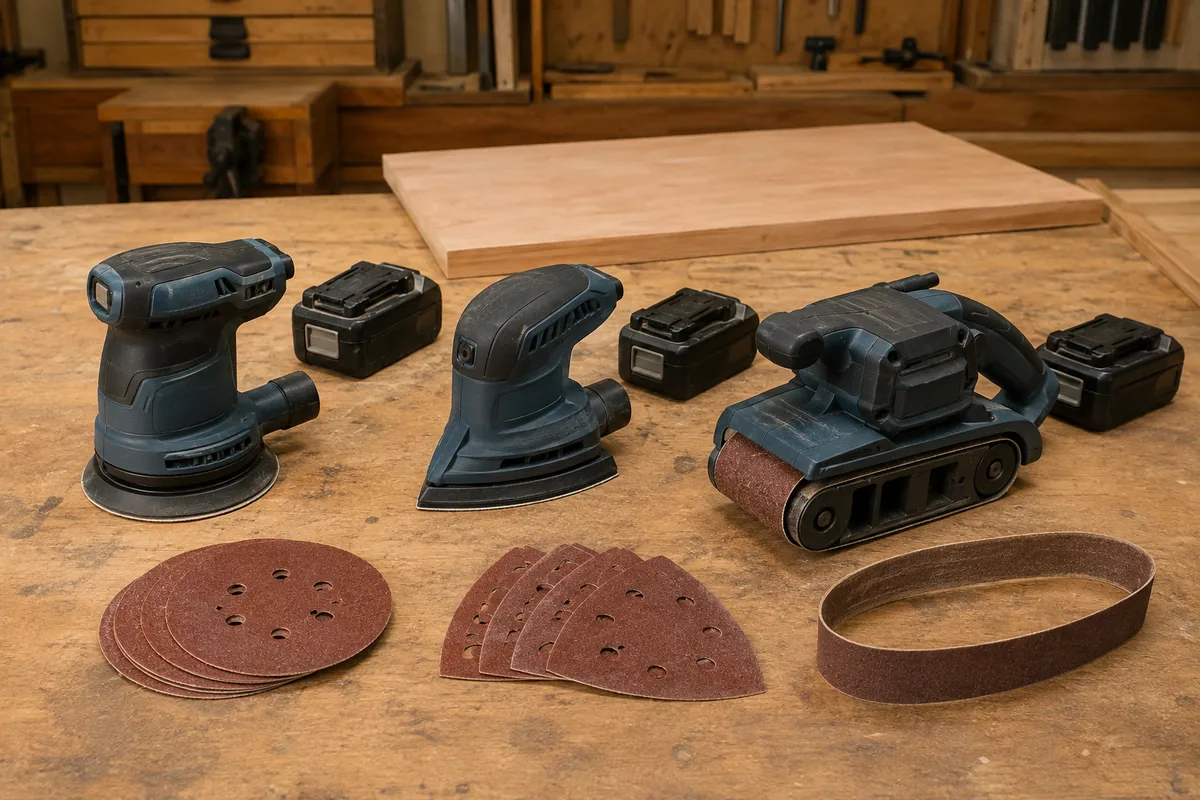
Cordless belt sanders are real tools now, and you will find them in the DeWalt XR, Milwaukee FUEL, and Makita LXT families. They also answer one specific question: how do I sand away from an outlet.
- ✔ Brushless motors handle hardwood stock removal properly
- ✔ No cord to drag over fresh finish or snag on a clamp
- ✔ Ideal for deck rails, treads, and remodel trim
- ✔ Runs on a battery platform you probably already own
- ✘ Runtime under real load is minutes per battery, not hours
- ✘ Costs more than a better corded sander in the same size
- ✘ Mostly 3×18 and 3×21, so no wide-panel option
- ✘ The battery end changes how the tool balances
My take: if you already own a pile of batteries and mostly sand edges and small parts, cordless is a fair luxury. If you are leveling glue-ups and benchtops, buy corded and put the difference into dust collection and better abrasives.
Cordless brushless belt sander
Worth it mainly if you are already committed to a battery platform. Credible for edge work, scribing, and remodel jobs, and not the tool I would reach for to flatten a wide tabletop. Bring your highest amp-hour packs and expect to swap them.
Dust, noise, and being honest about your shop
A belt sander makes more dust per minute than anything I own except the router. The cloth bag fills in about a minute and leaks fine dust the whole time, so pull it, hook up a shop vac, and use a cheap step adapter if the port and hose do not match. A vac that auto-starts with the tool is the upgrade you notice every day.
Wear a real respirator instead of a paper cone, because a closed garage in January is a dust chamber. Empty the vac rather than letting fine dust pack around a warm motor. And know that these tools are loud in a way that carries down the street, which is why my rough leveling happens Saturday afternoon and not at 7 a.m.
How I keep from wrecking the workpiece
Almost every belt sander mistake is the same mistake: the tool was standing still. My routine, learned by ruining a walnut panel and most of a maple benchtop.
Start it in the air. Bring the belt up to speed off the work, set it down moving, and lift it while it is still moving. A running sander set down flat leaves a divot you will chase for twenty minutes.
Cross the grain, then chase the scratches out. On a mismatched glue-up I run 20 to 30 degrees across the grain at 80 grit to bring the high board down, then straighten to with-the-grain passes at the same grit, then 120. Skip the middle step and those cross-grain scratches show up under finish.
Scribble a pencil grid. Sand until the pencil is gone, then stop. Dumb trick, and it has saved more of my panels than anything else.
Quit at 120 and change tools. I level with the belt sander and finish with a random orbit sander. Chasing a finish-ready surface with a belt is how you end up with straight-line scratches under oil.
Is a benchtop belt and disc sander worth the space?
For small parts, jigs, and curves it does things a handheld sander physically cannot, starting with squaring an end against a disc table. Not a first purchase, but a satisfying second one.
Benchtop belt and disc sander
The 4×36 belt with a 6 in. disc is the classic hobby size and it fits a garage bench. Look for a cast table with a usable miter slot, a tilt that locks without flexing, and a dust port you can actually connect. Budget units vibrate, so bolt it down or mount it to a plywood base you can clamp.
Frequently asked questions
Belt sander or random orbit sander first? Random orbit, no hesitation. It covers most hobby sanding and it is far more forgiving. The belt sander is what you add once you are doing your own glue-ups and you are tired of chasing flat with a small sander.
Which grit belts should I keep on the shelf? 80 and 120 handle nearly everything, plus a few 60s for paint and rough reclaimed stock. Zirconia or ceramic belts cost more each and last several times longer, so they work out cheaper in practice.
Can I flatten a workbench top with one? Yes, and it is one of the best uses for the tool, but check with a straightedge and winding sticks constantly instead of trusting your eyes. Work diagonally in both directions and aim for flat enough to work on.
If someone setting up a garage shop asked me for one answer: a corded 3×21 with variable speed, a shop vac connected to it, a pack of quality 80 and 120 belts, and a random orbit sander to do the finishing. That covers glue-ups, benchtops, and door edges, and it leaves money for wood. The 4×24 is a fine machine, but in a small shop it mostly sits on a shelf being heavy.
Check prices on Amazon →