3 Best 3500W Gas Generators for Home Backup (November 2026)
We compared 3500-watt gasoline generators for home backup, RV trips, and camping, and picked three for quiet running, RV-ready outlets, and electric start.
We compared 3500-watt gasoline generators for home backup, RV trips, and camping, and picked three for quiet running, RV-ready outlets, and electric start.
As an Amazon Associate I earn from qualifying purchases. This post may contain affiliate links at no extra cost to you.
A 3500-watt gas generator sits in a useful middle ground: strong enough to keep a refrigerator, lights, and a few small appliances running during an outage, yet small enough to load into a truck bed for a camping trip or a job site. The real decision is not the headline wattage, because most models in this class advertise the same starting number while delivering very different running watts, noise levels, and runtimes. Buyers need to match the generator to the loads they actually plan to run, the fuel they are willing to carry, and how close other people will be when it runs.
This guide is for homeowners preparing for outages, RV owners who need to run an air conditioner, and campers who want quiet power for sensitive electronics. We chose the three generators below from their published names and specifications on Amazon product pages, focusing on gasoline models in the 3500-watt class with distinct strengths rather than near-identical clones.
Quick Picks
As an Amazon Associate we earn from qualifying purchases
Product
Best for
Key spec
Champion 100571 Inverter Generator
Quiet camping and sensitive electronics
3500 starting watts, 58 dBA, 57.8 pounds
Champion 100555 RV Ready Generator
RV air conditioning and home backup
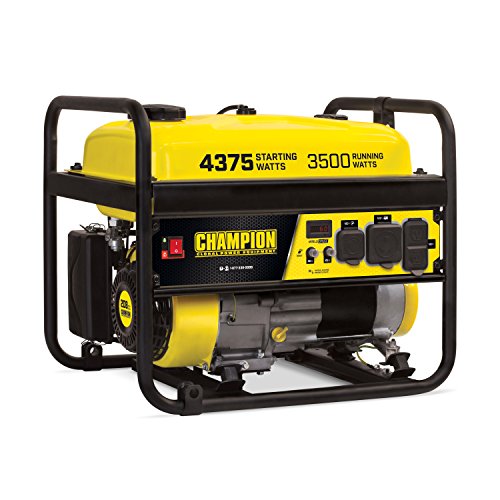
4375 starting watts, 3500 running watts
Generac iQ3500 Inverter Generator
Easy electric start for RV and home use
3500 starting watts, 3000 running watts, electric start
How to Choose
Running Watts Matter More Than Starting Watts
Starting watts describe the brief surge a generator can supply when a motor kicks on, while running watts describe what it can sustain for hours. A model advertised as a 3500-watt generator may deliver only 2300 running watts, which changes what it can power at the same time. Add up the running watts of everything you plan to run together, then check that the total sits comfortably below the generator’s running rating, leaving headroom for a refrigerator compressor or a well pump to start. If your list includes an RV air conditioner, a microwave, or power tools, running watts become the number that decides whether the generator copes or trips.
Noise Level Decides Where You Can Use It
Generator noise is measured in decibels from a set distance, and a small difference on paper feels large in practice because the scale is logarithmic. An enclosed inverter generator running near 58 decibels can sit near a campsite without drowning out conversation, while an open-frame unit near 68 decibels sounds closer to a vacuum cleaner and will draw complaints at crowded campgrounds. Check the published noise figure and the distance it was measured from, since figures taken at different distances are not comparable. If you camp, tailgate, or run a generator near neighbors, put a quiet inverter model at the top of your list and keep the louder open-frame machines for job sites and open yards.
Fuel Tank Size and Runtime
Runtime depends on tank size, engine size, and how hard the generator works. A small 1.2-gallon tank can still run for ten hours at a light load, while a 4.8-gallon tank stretches to twelve hours at half load on a larger engine, so compare runtime figures at the same load level before judging one model against another. A bigger tank means fewer refueling trips during an overnight outage, but it also means more weight and more fuel to keep fresh. Think about how long you need power between refills, whether you can safely store extra gasoline, and whether you will be awake to refuel. For overnight backup, tank size matters as much as wattage.
Outlets, Start Type, and Safety Features
Outlets decide what you can plug in without adapters. An RV owner needs a 30-amp RV outlet, while someone running power tools may want a locking outlet, and a camper charging phones will use household outlets and USB ports. Recoil start is simple and reliable, but electric start saves effort, especially in cold weather or for anyone who struggles with a pull cord. Look for a low-oil shutoff sensor, covered outlets, and a carbon monoxide shutoff system, since these features protect both the engine and the people nearby. Also check whether the generator is parallel ready, because pairing two compatible inverters can double your output later without buying a larger machine.
The 3 Best Options
Champion 100571 3500-Watt Inverter Generator
Top Pick
Champion 100571 3500-Watt Inverter Generator
Best for: Campers and tailgaters who want quiet power for phones, laptops, and small appliances.
Champion’s 100571 is the quietest generator in this group, producing 3500 starting watts and 2300 running watts from a small 122cc engine at 58 decibels from 23 feet, which is about as loud as normal speech. It runs for up to ten hours at quarter load on a 1.2-gallon tank, and its clean power output suits laptops, phones, and other sensitive electronics. The EZ Start Dial, Economy Mode, and Intelligauge keep operation simple, while CO Shield shuts the engine down if carbon monoxide builds up. A wheel kit and telescoping handle make the 57.8-pound unit easy to move.
Watch out for: The 2300 running watts limit how much you can run at once, so add up your loads first.
Champion’s 100555 is an open-frame generator built for RV use and home backup, with 4375 starting watts and a full 3500 running watts from a 208cc engine. Its 4.8-gallon tank delivers up to twelve hours at half load, and the outlet panel includes a 30-amp RV outlet, a 30-amp locking outlet, and two household outlets, so an RV air conditioner and several smaller loads can run at once. Intelligauge tracks voltage, frequency, and operating hours, while Volt Guard protects connected equipment from surges. At 68 decibels and 103.4 pounds, it trades quiet operation and light weight for raw running power.
Watch out for: At 68 decibels and 103.4 pounds, it is louder and heavier than the inverter models in this guide.
Generac iQ3500 3500-Watt Gas Powered Inverter Generator
Generac iQ3500 3500-Watt Gas Powered Inverter Generator
Best for: Buyers who want electric start and a quiet enclosed design for home backup, camping, and RV use.
Starting watts: 3500
Running watts: 3000
Fuel type: Gasoline
Ignition: Electronic, electric start with PowerDial, battery included
Generac’s iQ3500 is a fully enclosed inverter generator that pairs 3500 starting watts with 3000 running watts, placing it between the two Champions on sustained output. Its standout feature is the PowerDial, which combines start, run, and stop into one control, plus electric start with an included battery, so getting it running takes far less effort than a pull cord. Two engine speeds let the generator run quieter at light loads or respond faster when demand rises. A carbon monoxide sensor, automatic voltage regulation, and three outlets round out a package aimed at home backup, camping, and RV use.
Watch out for: At 109.1 pounds it is the heaviest model here, so plan how you will load and move it.
Which One Fits Your Situation
You Need Backup Power at Home During Outages
When the power goes out, running watts and tank size matter most, because you need the refrigerator, lights, and a few essentials to keep going for hours. The Champion 100555 delivers a full 3500 running watts from a 4.8-gallon tank, with twelve hours at half load, so it can carry a household through an evening outage. Its household outlets suit home essentials, though its 68-decibel sound level means placing it well away from windows.
You Camp or Tailgate Near Other People
At a campsite or tailgate, noise is the first thing other people notice, and a loud generator can ruin the evening for everyone nearby. The Champion 100571 runs at 58 decibels from 23 feet, about as loud as normal speech, and its size and wheel kit make it easy to carry from the truck to the site. With 3500 starting watts and a ten-hour runtime at quarter load, it handles lights, fans, and phone charging without drawing attention.
You Want the Easiest Start for an RV
Pull-starting a generator gets old fast, especially in cold weather or when the unit sits low in a storage bay. The Generac iQ3500 uses electric start with a PowerDial that combines start, run, and stop in one control, plus an included battery, so one turn of the dial gets it going. With 3000 running watts and three outlets, it can power several RV loads at once, and its enclosed design keeps noise down at the campsite.
You Run Sensitive Electronics
Laptops, phones, and modern electronics need clean, stable power, and an ordinary open-frame generator can feed them a rough signal. Both inverter models in this guide produce clean power suited to sensitive devices, but the Champion 100571 is the lighter and quieter of the two, at 57.8 pounds and 58 decibels, with a dual port USB adapter built in. The Generac iQ3500 is the alternative when you also want electric start and a little more running power.
Common Mistakes
Buying on starting watts alone and then overloading the generator once the running watts fall short.
Running a generator indoors or in a garage, where carbon monoxide can build up even with the door open.
Forgetting to add up all the loads that will run at the same time, including a refrigerator compressor starting up.
Skipping the break-in oil change and first service steps in the manual, which shortens engine life.
Storing gasoline for months without stabilizer, then wondering why the generator will not start.
Frequently Asked Questions
What can a 3500-watt gas generator run?
A 3500-watt generator can run a refrigerator, lights, fans, phone chargers, and a television, as long as the combined running watts stay below its running rating. Larger loads such as an RV air conditioner or a well pump need careful planning, because their starting surge can push the total past the limit. Add up your loads first and leave room for the biggest motor to start.
How long will a 3500-watt generator run on a full tank?
Runtime depends on tank size and load. The Champion 100571 runs up to ten hours at quarter load on its small tank, while the Champion 100555 runs twelve hours at half load on 4.8 gallons. A heavier load drains the tank faster, so a generator that lasts all night at a light load may need refueling sooner. Keep spare gasoline handy and refuel only after the engine cools.
Is a 3500-watt generator enough for an RV air conditioner?
It depends on the air conditioner and the generator’s running watts. The Champion 100555 is listed as able to start and run a 15,000 BTU RV air conditioner, thanks to its 3500 running watts and 4375 starting watts. Smaller inverter models with around 2300 running watts may struggle with a large air conditioner, especially if other loads run at the same time. Check both ratings before you buy.
Can I use a 3500-watt generator indoors or in a garage?
No. Gasoline generators must always run outdoors, far from buildings, with exhaust pointed away from people. Carbon monoxide is colorless and odorless, and it builds up quickly in a garage or shed, even with a door open. The carbon monoxide sensors in this guide shut the engine down when levels rise, but they are not a substitute for safe placement. Use an outdoor-rated extension cord instead.
J
JD's Woodworks Editorial Team
We compare specs, warranty terms, long-term owner feedback and street pricing before anything earns a spot. Rankings are never paid.
Affiliate disclosure. As an Amazon Associate we earn from qualifying purchases at no extra cost to you. Prices accurate as of the date shown.
Table saws under the 1500 mark compared: the Grizzly G0771Z and Shop Fox W1837 hybrid saws with cast iron tables, 2 HP motors and T-square fences, specs from their listings.
Table saws for fine woodworking compared: the SawStop Professional Cabinet Saw and Powermatic PM1000, judged on fence precision, table flatness and vibration from listing specs.
Table saw combos explained: saws sold with a stand and accessories in one listing, what to check in the box, and which bundle fits your shop or jobsite.
Compare the best planer digital thickness gauges and digital readout kits for portable planers, with fit, resolution and mounting checks before you buy.
Model table saws for scale modelling and hobby work compared: the precision Proxxon FET 37070 and the compact Saker mini table saw, with specs taken from their Amazon listings.
Three CoreXY 3D printers for product development, each with the architecture stated on its listing: an enclosed multicolor machine, a large-format enclosed model and a heated-chamber model.