5 Best Cabinet Base Jointers for Furniture (November 2026)
Five cabinet-base jointers for furniture makers compared: 6-inch, 8-inch, and 12-inch helical models, with beds, fences, and dust collection explained.
As an Amazon Associate I earn from qualifying purchases. This post may contain affiliate links at no extra cost to you.
A cabinet-base jointer is a permanent decision, not a portable tool you swap out next month. Once it sits on your shop floor, it sets the widest board you can flatten, the longest board you can straighten, and the quality of every edge that follows. For furniture makers, that matters more than for general woodworkers, because table tops, cabinet doors, and chair parts all start with a flat face and a square edge. The real choice is how much width, bed length, and power your work needs, and whether your shop wiring can support it.
This guide is for furniture makers in a home shop or small professional shop, from solo builders making dining tables to two-person shops building cabinets and beds. It also suits anyone upgrading from a benchtop jointer that runs out of capacity. The five machines below were chosen from their names and specifications on Amazon product pages, with an emphasis on enclosed cabinet bases, long beds, helical cutterheads, and fences that hold square.
Quick Picks
As an Amazon Associate we earn from qualifying purchases
Product
Best for
Key spec
JET JJ-6HHDX
Small shops jointing boards up to 6 inches wide
6-inch helical head, 56-inch cast iron bed
JET JJ-8HH
Furniture makers moving up to 8-inch capacity
8-inch helical head, 2 HP motor, 230V
Powermatic 60HH
All-round professional furniture work
8-inch helical head, 73-inch table
Powermatic PJ-882HH
Shops that want parallelogram bed adjustment
8-inch helical head, parallelogram beds
Powermatic 1285
Wide panels and long boards in a large shop
12-inch helical head, 84-inch table
How to Choose
Bed length and width
Bed length decides how long a board you can flatten accurately, and width decides the widest face you can surface in one pass. A 56-inch bed handles most chair and cabinet parts, but dining-table boards and long bed rails want 66 inches or more so the board stays supported at both ends. Width is harder to work around: a 6-inch jointer cannot flatten an 8-inch-wide tabletop board in one pass, so you either rip the board narrower or accept a visible seam. Furniture makers building wide panels should treat 8 inches as the practical minimum and 12 inches as the comfortable standard, then check the bed suits the longest boards they buy.
Helical cutterhead or straight knives
A helical cutterhead carries small four-sided carbide inserts set at an angle, while a straight-knife head carries two or three long blades that must be set dead level. Helical heads cut more quietly, handle figured grain with less tear-out, and let you rotate a single nicked insert instead of resharpening a whole knife. That matters for furniture work, where curly maple, quartersawn oak, and walnut crotch figure show every tear-out mark. Straight knives cost less up front and can leave a fine finish when sharp, but they demand careful setup and more frequent attention. For a machine that will see daily furniture use, the helical head is the safer long-term choice.
Power and shop wiring
Jointers in this class run on either 115-volt or 230-volt single-phase power, and the biggest machines may need three-phase supply. A 1 HP motor on a 115-volt circuit suits a small shop jointing boards up to 6 inches wide, but it will labour on wide hardwood. A 2 HP motor on a dedicated 230-volt circuit is the sweet spot for most furniture shops, giving steady torque through 8-inch maple and white oak. Before buying, check the motor voltage and amperage, and whether your panel has room for a dedicated circuit. A jointer that trips a breaker mid-pass leaves a stop mark on the board, so wiring is part of the purchase decision.
Fence quality and dust collection
The fence is what keeps edges square, so it deserves as much attention as the cutterhead. Look for a long fence, at least 32 inches on a 6-inch machine and 38 inches or more on an 8-inch machine, with positive stops at 90 degrees and 45 degrees each way. A fence that flexes or drifts under pressure will produce edges that look square until glue-up, when the gaps appear. Dust collection matters just as much: every machine here has a 4-inch dust port, and a jointer without extraction throws chips across the shop and clogs its own cabinet. Confirm the minimum airflow the maker calls for and match it to your collector before the machine arrives.
The 5 Best Options
JET JJ-6HHDX 6-Inch Long Bed Jointer
Top Pick
JET JJ-6HHDX 6-Inch Long Bed Jointer
Best for: Small furniture shops jointing boards up to 6 inches wide on standard household wiring.
6-inch cutting width
Helical cutterhead with 27 four-sided carbide inserts
The JJ-6HHDX is the compact entry into cabinet-base jointing, and it suits furniture makers whose boards rarely exceed 6 inches in width. Its long cast iron tables give more support than most 6-inch machines, which helps when you are flattening chair legs, drawer fronts, and cabinet door frames. The helical head with 27 carbide inserts keeps noise down and handles figured grain better than straight knives, and the enclosed steel cabinet keeps the motor and dust chute out of the way. It runs on standard household wiring, so it fits a garage or basement shop without an electrician.
Watch out for: The 6-inch width cannot flatten wide tabletop boards in one pass, so check the widest stock you use before choosing this size.
JET JJ-8HH 8-Inch Helical Head Jointer
Runner-Up
JET JJ-8HH 8-Inch Helical Head Jointer
Best for: Furniture makers who want 8-inch capacity and steady power for dense hardwoods.
8-inch cutting width, 1/2 inch maximum depth of cut
The JJ-8HH is the step up most furniture makers eventually make, adding 2 inches of width and a stronger motor over the 6-inch class. That extra width covers most tabletop glue-ups and cabinet door stock, while the 2 HP motor holds its speed through dense hardwoods. The helical head carries 36 carbide inserts, and the long cast iron bed supports long boards without tipping. It needs a 230-volt circuit, which is the main thing to plan for, but in return it behaves like a true professional machine. For a one-person furniture shop, this is often the last jointer ever needed.
Watch out for: It requires a dedicated 230-volt circuit, so confirm your shop wiring before ordering.
Powermatic 60HH 8-Inch Jointer
Powermatic 60HH 8-Inch Jointer
Best for: Professional furniture shops that joint long boards often and want the longest 8-inch bed in this group.
8-inch cutting width, 1/2 inch maximum depth of cut
Helical cutterhead with 54 four-sided carbide inserts
The Powermatic 60HH is the all-round professional pick in this group, built around a 73-inch table that supports long boards better than most 8-inch machines. The extra bed length shows up every time you flatten a dining-table apron or a long bed rail, because the board stays registered instead of tipping at the ends. Its helical cutterhead uses 54 four-sided carbide inserts, which spreads wear across more cutting edges and keeps the finish consistent. The 2 HP motor on single-phase 230-volt power fits most small professional shops, and the enclosed cabinet base gives the machine a solid, low-vibration stance.
Watch out for: At 20 amps on a 230-volt circuit, check that your panel and wiring can carry the load with headroom to spare.
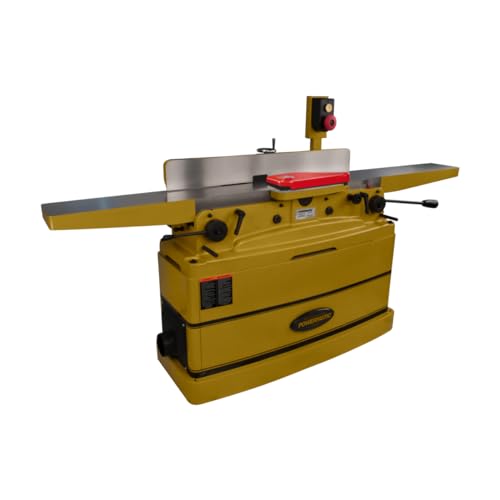
Powermatic PJ-882HH 8-Inch Parallelogram Jointer
Powermatic PJ-882HH 8-Inch Parallelogram Jointer
Best for: Furniture makers who adjust table height often and want beds that stay parallel with minimal setup.
8-inch parallelogram jointer
Helical cutterhead with 54 four-sided knife inserts
The PJ-882HH takes the same 8-inch helical format as the 60HH and adds parallelogram bed adjustment, which moves the tables on pivoting arms instead of sliding them on dovetail ways. In practice, that means table height changes stay parallel with less fiddling, and the tables hold their setting over years of use. For furniture makers who adjust depth of cut often between face jointing and edge jointing, that convenience adds up. It shares the 54-insert helical cutterhead and 2 HP single-phase motor of its stablemate, so the cutting performance is familiar, while the bed mechanism is the reason to choose it over a conventional dovetail machine.
Watch out for: The parallelogram mechanism adds complexity, so confirm that local service and replacement parts are available before buying.
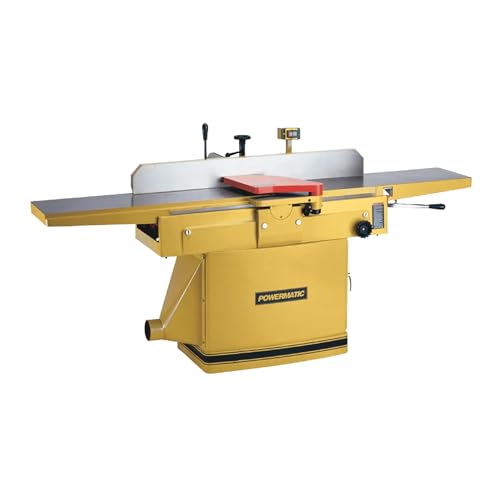
Powermatic 1285 12-Inch Parallelogram Jointer
Powermatic 1285 12-Inch Parallelogram Jointer
Best for: Large furniture shops with three-phase power that flatten wide panels and long boards.
12-inch cutting width, 11.75 inches actual
Helical cutterhead with 42 two-sided knife inserts
The 1285 is the wide-capacity machine for furniture shops that build large panels and long casework. Its 12-inch width flattens most tabletop boards in a single pass, and the 84-inch table supports full-length boards without extra roller stands. The helical cutterhead carries 42 two-sided knife inserts, and the parallelogram beds keep the tables parallel through adjustment. The trade-off is power: this version runs on three-phase 230/460-volt supply, so it belongs in a shop that already has three-phase service or a suitable converter. If your shop qualifies, no other machine here matches its capacity for wide, long furniture stock.
Watch out for: Three-phase power is a hard requirement for this version, so verify your shop supply before considering it.
Which One Fits Your Situation
Small shop on standard household wiring
Choose the JET JJ-6HHDX. It runs on a 115-volt circuit, fits a garage or basement shop, and still gives you a real cabinet base with long cast iron tables. Its 6-inch width covers chair parts, drawer fronts, and cabinet frames, which is most of what a small-shop furniture maker joints. Add a mobile base if you need to move it, and plan an upgrade path for the day your boards get wider.
Building dining tables and wide panels
Choose the Powermatic 1285 if your shop has three-phase power, or the Powermatic 60HH if it does not. Wide tabletops and large cabinet panels need width first and bed length second, and both machines deliver on those counts. The 1285 flattens a 12-inch board in one pass, while the 60HH covers 8-inch stock with the longest bed in its class.
Working figured hardwoods most days
Choose the Powermatic PJ-882HH or the JET JJ-8HH. Both carry helical cutterheads with carbide inserts that shear figured grain cleanly instead of tearing it, which matters when curly maple or crotch walnut is your daily material. The PJ-882HH adds parallelogram beds for makers who change settings often, while the JJ-8HH is the simpler machine of the two.
A growing shop that needs one jointer for years
Choose the Powermatic 60HH. Its 8-inch width, 73-inch table, and 2 HP motor cover the broadest range of furniture work without demanding three-phase power. It handles long boards, dense hardwoods, and daily use, and its enclosed cabinet base keeps it stable for years. Buy it once, wire a dedicated 230-volt circuit, and it will not be the limiting machine in your shop.
Common Mistakes
Buying a 6-inch jointer when most of your boards are 8 inches or wider, then trying to flatten wide panels in two passes that never quite match.
Ignoring the power requirement and discovering after delivery that the shop has no 230-volt circuit, or no three-phase supply for the largest machines.
Choosing by width alone and ending up with a short bed that lets long boards tip, leaving a hollow in the middle of every long edge.
Skipping dust collection and letting chips pack into the cabinet, which dulls the finish and forces constant cleaning.
Setting the fence once and never checking it again, so edges drift out of square and glue-ups show gaps that no amount of clamping will close.
Frequently Asked Questions
What size jointer does a furniture maker need?
Most furniture makers do well with an 8-inch jointer with a 66-inch bed. That width covers tabletop glue-ups, cabinet doors, and chairs, while the bed supports boards for dining tables and bed rails. A 6-inch machine suits small shops, and a 12-inch machine suits shops that flatten wide panels in one pass. Match size to the widest board you joint often.
Is a helical cutterhead worth it for furniture work?
Yes, for most furniture makers. A helical head uses small carbide inserts that cut figured grain with less tear-out than straight knives, runs more quietly, and lets you rotate a single nicked insert instead of resetting a full knife. That saves setup time and keeps the finish consistent. Straight knives cost less, but they need more frequent attention and careful setting to match a helical finish.
Can a cabinet-base jointer run on standard household power?
Some can, and some cannot. The 6-inch machines in this guide run on a 115-volt circuit, which most household shops already have. The 8-inch machines need a dedicated 230-volt circuit, which many shops can add with an electrician. The largest 12-inch machine here needs three-phase power, which most home shops lack. Always check the motor voltage, phase, and amperage before ordering.
How much floor space does a cabinet-base jointer need?
Plan for the machine footprint and room to feed boards. An 8-inch machine with a 66 to 73-inch bed needs about 10 to 12 feet of run in front and behind, plus space beside the fence for push blocks. A 12-inch machine needs more, for the 84-inch bed and wide panels. Measure your longest board, add space at each end, and keep the run clear.
J
JD's Woodworks Editorial Team
We compare specs, warranty terms, long-term owner feedback and street pricing before anything earns a spot. Rankings are never paid.
Affiliate disclosure. As an Amazon Associate we earn from qualifying purchases at no extra cost to you. Prices accurate as of the date shown.
Table saws under the 1500 mark compared: the Grizzly G0771Z and Shop Fox W1837 hybrid saws with cast iron tables, 2 HP motors and T-square fences, specs from their listings.
Table saws for fine woodworking compared: the SawStop Professional Cabinet Saw and Powermatic PM1000, judged on fence precision, table flatness and vibration from listing specs.
Table saw combos explained: saws sold with a stand and accessories in one listing, what to check in the box, and which bundle fits your shop or jobsite.
Compare the best planer digital thickness gauges and digital readout kits for portable planers, with fit, resolution and mounting checks before you buy.
Model table saws for scale modelling and hobby work compared: the precision Proxxon FET 37070 and the compact Saker mini table saw, with specs taken from their Amazon listings.
Three CoreXY 3D printers for product development, each with the architecture stated on its listing: an enclosed multicolor machine, a large-format enclosed model and a heated-chamber model.


 Powermatic PJ-882HH 8-Inch Parallelogram Jointer
 Powermatic 1285 12-Inch Parallelogram Jointer









