Key takeaways
- Compare the best MIG welders under 1000 for home shops, checking input power, duty cycle, wire capacity and steel thickness before you buy.
What's inside
As an Amazon Associate I earn from qualifying purchases. This post may contain affiliate links at no extra cost to you.
Shopping for a MIG welder under the 1000 mark is really a decision about what kind of shop machine you want to own for the next decade. At this level the welders stop being disposable starter boxes and become real equipment: transformer machines from established welding brands, with duty cycles and steel capacities that cover fabrication, trailer work, and farm repair. The catch is that this class runs on 230V-class power, so the machine decision and the circuit decision arrive together, and the honest total includes a gas cylinder, wire, and protective gear.

This guide is for home shop owners ready to move past entry-level flux-core boxes, and for buyers comparing a traditional brand-name machine against a feature-loaded alternative. Both welders below were checked against their Amazon listings for output range, duty cycle, input voltage, and what is included, and both sit inside the price frame at the time of checking, using indexed listing prices. The article prints no prices, so confirm the current figure on the listing before you buy.
Quick Picks
As an Amazon Associate we earn from qualifying purchases.
| Product | Best for | Key spec from title |
|---|---|---|
| Hobart Handler 190 | A dedicated 230V shop corner and thicker steel | Output range of 25 to 190 amps |
| LOTOS MIG175 | Aluminum work without buying a separate spool gun | Aluminum spool gun included |
How to Choose
Start with the circuit, not the machine
Both welders in this guide need 230V or 240V input, and that is typical for the class: a machine that welds 5/16 inch steel in one pass draws more than a household 120V circuit delivers. Before falling for any machine in this bracket, confirm you have, or can add, a suitable 230V outlet where the welder will live, with a breaker sized to the machine’s input draw. If the shop cannot support that circuit, the correct move is down to a dual-voltage machine, not into this category at all. Buyers with the circuit already in place, often from a compressor or a table saw, can shop this class with confidence.
Read duty cycle next to output, not output alone
Peak amperage is the headline number, but duty cycle is the working number: the share of a ten-minute period the machine can weld at a given output before it needs to rest. The Hobart below states a duty cycle of 30% at 130 amps, which suits stop-and-start fabrication where you fit, tack, check, and weld in rhythm. Production-style long seams are where duty cycle bites. Match the rating to your real work pattern rather than to the thickest weld you might attempt once. A machine loafing below its rating also runs cooler and treats its internal components kindly for years.
Decide how much process flexibility you need
A traditional MIG machine like the Hobart runs gas-shielded MIG and gasless flux-core wire from the same gun, and that covers the overwhelming majority of steel work in a home shop. The LOTOS adds a synergistic control scheme and bundles an aluminum spool gun, which changes the setup math for anyone planning aluminum projects. Neither approach is wrong; the question is whether aluminum is a real plan or a someday thought. Spool guns, regulators, and gas cylinders each add cost and shelf space, so a bundle that includes the spool gun is worth more to a buyer with aluminum on the project list than to one welding steel gates forever.
Count wire capacity and included hardware
Wire spool capacity decides how often you stop to reload and which wire sizes you can buy economically. Machines in this class typically accept larger spools than starter boxes, and the LOTOS below accepts 4 inch and 6 inch spools per its listing materials. Included hardware matters just as much: a regulator and gas hose in the box, as with established brand packages, removes a separate purchase before your first shielded weld. Read the included-components list on the listing carefully, because two machines at similar money can differ by everything you still need to buy before striking an arc.
The 2 Best Options
Hobart Handler 190
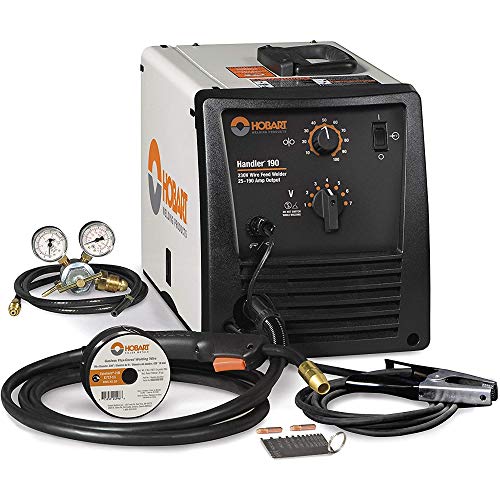
The Handler 190, model 500554, is the traditional choice in this pair: a 230V transformer MIG welder from one of the established American welding brands, built around simple, proven controls. Output runs from 25 to 190 amps across 7 voltage selections, with infinite wire feed speed control, so dialing in a setting for a given thickness is a matter of two knobs and the chart inside the door. The stated capacity is mild steel from 24 gauge up to 5/16 inch, which spans sheet, tube, angle, and plate for most home fabrication. It weighs 68 pounds, so it belongs on a cart in a fixed shop corner rather than in a truck bed. For buyers who value a deep dealer and parts network, this is the machine in the guide.
Specs
- Brand: Hobart
- Model: Handler 190 (500554)
- Input voltage: 230V
- Output range: 25 to 190 amps
- Duty cycle: 30% at 130 amps
- Weld capacity: mild steel 24 gauge to 5/16 inch
- Voltage selections: 7
- Wire feed speed control: infinite
- Item weight: 68 pounds
Best for: Home fabricators with a 230V outlet who weld steel regularly and keep machines for years.
Watch out for: It needs a 230V circuit — there is no 120V fallback — and at 68 pounds it is a shop-corner machine, not a portable one.
LOTOS MIG175
The MIG175 takes the opposite approach to the same bracket: a 240V inverter machine with a synergistic auto setting that pairs voltage to wire feed, plus manual voltage fine tuning for welders who want to trim the arc themselves. Output is 175 amps, and the listing covers both gas MIG and gasless flux-core MIG, so it runs shielded or unshielded wire depending on whether the work is indoors or outside in wind. The package’s headline is the included aluminum spool gun, the accessory aluminum MIG welding requires, bundled instead of sold separately. Stated capacity runs up to 1/4 inch steel, and the machine accepts 4 inch and 6 inch wire spools. For a buyer whose project list includes aluminum, this box arrives unusually complete.
Specs
- Brand: LOTOS
- Model: MIG175
- Output: 175 amps
- Input voltage: 240V
- Settings: synergistic auto setting with voltage fine tuning
- Processes: gas MIG and gasless flux-core MIG
- Included: aluminum spool gun
- Weld capacity: up to 1/4 inch steel
- Wire spools: accepts 4 inch and 6 inch spools
Best for: Buyers who want aluminum capability in the box and prefer synergistic setup help.
Watch out for: Input is 240V only, and the stated steel capacity tops out at 1/4 inch, a step below the Hobart — check your thickest regular material before choosing.
Which One Fits Your Situation
You weld steel fabrication projects most weekends
Choose the Hobart Handler 190. Its 5/16 inch single-pass capacity, 7 voltage selections, and 30% duty cycle at 130 amps fit the rhythm of cutting, fitting, and welding steel at home, and the brand’s parts network matters on a machine you plan to keep for a decade. Put it on a cart next to the 230V outlet and it becomes fixed shop infrastructure rather than a tool you set up each time.
Aluminum is genuinely on your project list
Choose the LOTOS MIG175. Aluminum MIG requires a spool gun because soft aluminum wire buckles in a standard gun liner, and this package includes that gun instead of leaving it as a second purchase. The synergistic setting also shortens the learning curve on a metal that punishes wrong settings quickly. If your aluminum work is occasional — a boat fitting, a trailer rail — the bundle covers it without a separate accessory hunt.
You are upgrading from a small flux-core-only box
Either machine is a large step up, so decide by material. If your projects have outgrown the upgrade candidate’s wire and duty limits, the Hobart’s extra capacity and tapped voltage control teach traditional MIG skills that transfer to any machine. If the old box frustrated you mainly with setup guesswork, the LOTOS’s synergistic control removes much of that friction. Both run flux-core wire as well as gas MIG, so your existing wire stock is not wasted.
Your shop power is limited or shared
Stop and solve the circuit first. Both of these welders need 230V-class input, and running one on an undersized or heavily shared circuit means tripped breakers mid-weld and poor arc starts. If adding a proper outlet is not possible, this category is the wrong one and a dual-voltage machine from a lower bracket will serve you better. If the circuit is going in anyway, the Hobart’s fixed shop-corner role makes the outlet location easy to plan around the welding table.
Common Mistakes
- Budgeting for the welder alone and forgetting the gas cylinder, regulator if not included, wire, helmet, and gloves that stand between the box arriving and the first weld.
- Ordering a 230V machine for a shop with only household outlets, then discovering the electrician’s visit costs as much as stepping down to a dual-voltage welder.
- Comparing peak amperage only, while ignoring duty cycle, which decides how the machine behaves ten minutes into a real project.
- Buying aluminum capability twice — a machine bundle that includes a spool gun, then a second spool gun bought separately out of habit.
- Assuming a spool of flux-core wire means gas is unnecessary for everything, when clean indoor steel work is exactly where shielded MIG earns its cylinder.
Frequently Asked Questions
Do I really need a 230V circuit for a welder in this class?
Yes, for the machines in this guide. Both the Hobart Handler 190 and the LOTOS MIG175 are 230V or 240V input machines, and their steel capacities depend on that input. A standard household outlet cannot supply the current their rated outputs require. Many shops add one 230V outlet near the welding area and run the welder, and sometimes a compressor, from it on a suitable breaker.
Can these welders run flux-core wire without gas?
Yes. Both listings cover gasless flux-core operation alongside gas-shielded MIG, which makes them usable outdoors or in drafty spaces where shielding gas blows away. Flux-core wire leaves slag to chip and produces more spatter, so for clean indoor work on visible parts, gas-shielded solid wire is usually the better finish. The flexibility to run both is part of what this class of machine is for.
Is the included spool gun with the LOTOS a real advantage?
For aluminum, yes. Aluminum wire is soft and tends to tangle when pushed through a long standard gun cable, so a spool gun that carries a small spool at the gun is the standard solution. Buying one separately is a meaningful extra cost, so having it in the box changes the value calculation for anyone planning aluminum work. For steel-only buyers it is simply an accessory that will sit in the drawer.
What else should I budget for besides the welder?
Plan on a gas cylinder and fill if you intend to run shielded MIG, a regulator if the package does not include one, solid and flux-core wire in the sizes your machine accepts, contact tips and nozzles as consumables, and proper protection: an auto-darkening helmet, gloves, and a jacket. None of that appears in this article’s prices because the article prints none, but the honest cost of welding is the machine plus the kit that makes it usable.
Related guides
More from Amazon
Programs that pair well with the guide above. Offers and eligibility are set by Amazon and may change.
A free business account with business pricing and bulk-buying tools for work, shop or home office.
Create a business accountFree shipping on eligible items, Prime Video and more. Eligible new members can start with a free trial.
Start a Prime free trialAudiobooks and podcasts to listen to on the go. Eligible new members can start with a free trial.
Try Audible freeAd-free music streaming. Eligible new subscribers can start with a free trial.
Try Music Unlimited freeAs an Amazon Associate we earn from qualifying purchases.