As an Amazon Associate I earn from qualifying purchases. This post may contain affiliate links at no extra cost to you.
Buying a MIG welder for a shop with no 240-volt receptacle is really a decision about honesty: how thick is the steel you actually weld, and how long are your typical seams? A 110-volt machine tops out around 140 amps, which covers sheet metal, angle iron, tubing and light plate well, but no control layout or display changes that ceiling. The useful differences are whether the machine runs gas-shielded wire or flux core only, what arrives in the box, and how much working time the duty cycle allows before a pause.
This roundup is for garage and basement shops running on ordinary household circuits: first-time welders setting up a starter kit, woodworkers adding metal frames and brackets to their work, and repair-minded owners who need a machine that plugs in anywhere. Every pick below was chosen from its Amazon listing name and stated specifications, and each one runs on 110, 115 or 120 volts as the listing states.
Quick Picks
As an Amazon Associate we earn from qualifying purchases
Household-power MIG machines cluster between 88 and 140 amps of output, and that range maps directly onto steel thickness. The Lincoln below is rated for plate up to 1/8 inch, the Hobart for 3/16 inch, and the 140-amp Forney for quarter-inch mild steel with flux-core wire. Buy for the thickest job you do every month, not the one you imagine doing once a year. If trailer frames or thick brackets are routine work, a 110-volt machine will leave you making slow multi-pass welds, and a dual-voltage model belongs on your list instead.
Decide Between Gas MIG and Flux Core Only
Three of the five machines here are gasless: they run flux-cored wire only, which shields the puddle from the wire itself and works outdoors where wind would blow shielding gas away. The trade is more spatter and slag to clean. The Forney and the Lincoln also run solid wire with gas, which leaves cleaner beads on thin sheet and painted-body work. Check the listing carefully, because several compact machines wear a MIG label while offering no gas valve at all. If clean indoor sheet-metal work matters to you, gas capability is not optional.
Read the Duty Cycle Before the Amp Headline
Duty cycle states how many minutes in ten a machine can weld at a given output before it needs to cool. The Lincoln lists 20 percent at 70 amps, meaning two minutes of arc time followed by eight minutes of rest at that setting. Long seams on a gate or a table frame hit that limit quickly, while tacks and short brackets never will. Listings that print a big amp number with no duty cycle figure are asking you to guess, so treat a missing rating as a real cost and plan shorter sessions around it.
Count What the Box Includes, Not Just the Machine
A bare welder is rarely the whole purchase. The Lincoln kit ships with a gas regulator, hose, and spools of both solid and flux-cored wire, while the Forney needs a regulator and gas hose bought separately before its gas MIG mode works at all. Spool size matters too: machines that accept larger spools save changeovers on longer projects. Add up the gun length, the included wire, and any adapter plugs the listing names, because those extras decide whether you weld the day the box arrives.
The 5 Best Options
Forney Easy Weld 140 MP Multi-Process Welder
Top Pick
Forney Easy Weld 140 MP Multi-Process Welder
Best for: Shops that want gas MIG plus stick and TIG options on one household circuit.
Input voltage: 120 volts
Output range: 10 to 140 amps
Processes: MIG, DC TIG and stick
Controls: infinite voltage and wire feed speed adjustment
The Forney 140 MP is the pick for a buyer who wants one household-outlet machine that covers several jobs: MIG with gas or gasless wire, stick welding for dirty or thicker stock, and DC TIG capability in the same metal case. Infinite voltage and wire feed controls let you fine-tune the arc instead of choosing between fixed taps, and at under 26 pounds it moves between bench and driveway without a cart. For a woodworker adding steel bases, hinges and frames to shop projects, that flexibility on a single 120-volt plug is the whole appeal.
Lincoln Electric K2185-1 Handy MIG Welder
Runner-Up
Lincoln Electric K2185-1 Handy MIG Welder
Best for: First-time welders who want gas MIG capability and the full starter kit in one box.
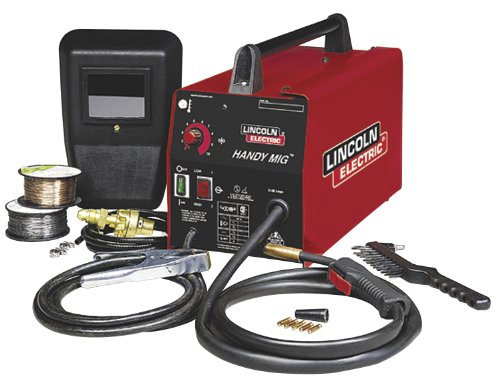
Lincoln packages the Handy MIG as a true starter kit rather than a bare power source. The box includes the gas regulator and hose, a spool of solid MIG wire, a spool of flux-cored wire, contact tips for both, and a hand shield, so a first-time buyer can run gas-shielded beads on thin steel the day it arrives. Output is modest, and the listing rates it for mild steel up to 1/8 inch, which suits auto body patches, exhaust work, mower decks and light brackets. The cold contactor feature keeps the wire electrically cold until the trigger is pressed, a thoughtful touch for beginners.
Hobart Handler 140EZ MIG Welder
Hobart Handler 140EZ MIG Welder
Best for: Outdoor repair work where a gas bottle is impractical and setup speed matters.
The Handler 140EZ is Hobart’s straightforward answer for gasless work: a 120-volt, flux-core-only machine with a 30 to 140 amp range and a stated capacity of 3/16 inch steel. Skipping the gas bottle, regulator and hose entirely makes it easy to store and quick to set up for fence, gate and equipment repairs where the work happens outdoors. It is also spool gun ready, which gives aluminum wire a cleaner feed path than a long push lead if you add the gun later. This is the heaviest machine in the group, so plan on a cart or a fixed bench spot.
YESWELDER 135A MIG Welder FLUX-135PRO
YESWELDER 135A MIG Welder FLUX-135PRO
Best for: Tight spaces and mobile repair work where the welder gets carried and stored often.
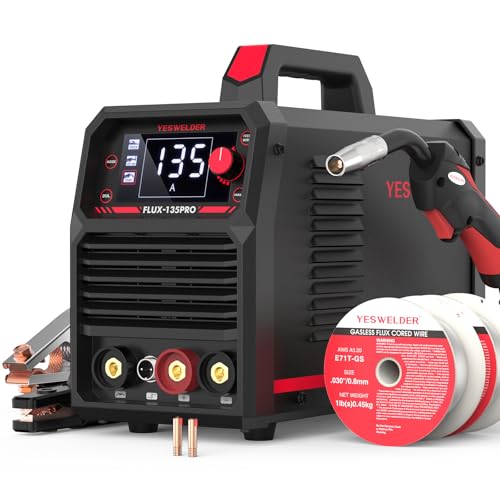
At roughly eleven and a half pounds, the FLUX-135PRO is the machine in this group you carry to the work instead of wheeling the work to it. The 135-amp inverter runs flux-cored MIG, lift TIG and stick modes from a 110-volt outlet, with a large LED display and synergic control that pairs wire feed speed with the settings you select. That combination suits apartment garages, rental properties and farm outbuildings where the welder lives in a cabinet between jobs. Output is honest light-duty territory: brackets, tubing, sheet and general repairs rather than structural plate.
ARCCAPTAIN 130A MIG Welder MIG130
ARCCAPTAIN 130A MIG Welder MIG130
Best for: Beginners who want wire and accessories included at the lowest commitment.
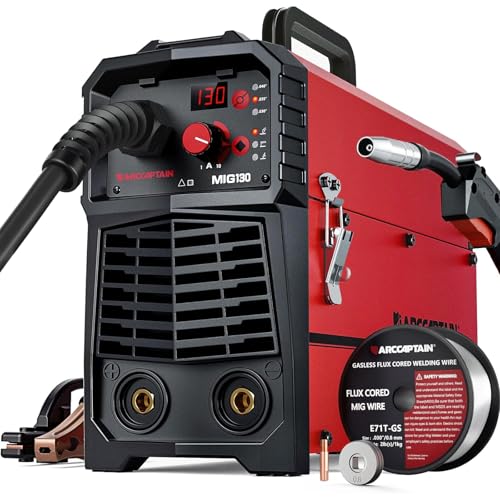
The MIG130 is a compact first-welder package built around a single idea: plug into any 110-volt outlet and start laying practice beads. The box includes a 2-pound spool of flux-cored wire along with the torch, ground clamp and electrode holder, and the synergic control automatically matches current and wire feed speed once you pick a wire diameter. With a 20 to 130 amp range it handles the same light repair territory as the other budget inverters here, and its small footprint fits a crowded bench. Stick and lift TIG modes are on board for the day a repair calls for them.
Which One Fits Your Situation
You Are Setting Up Your First Welding Corner
Start with the Lincoln Handy MIG. The regulator, hose and both wire types are already in the box, so your first session is about learning the arc rather than shopping for missing parts. Its 1/8 inch ceiling matches the sheet and light stock most beginners practice on, and the cold contactor wire adds a margin of safety while you build habits.
Your Shop Has One Free Outlet and Many Kinds of Jobs
The Forney 140 MP earns its place when the same machine must run gas MIG on a table frame in the morning and stick on a rusty bracket after lunch. It is the only pick here with all three processes plus full infinite controls on a 120-volt plug. Budget for the regulator and gas hose, since that separate purchase unlocks the gas MIG mode.
Most of Your Welding Happens Outdoors
Flux core is the practical choice where wind strips shielding gas away, and the Hobart Handler 140EZ is built for exactly that work. It skips the bottle entirely, covers steel up to 3/16 inch, and adds spool gun readiness for later. Accept the extra spatter cleanup as the price of welding a gate where it stands instead of hauling it indoors.
The Welder Has to Live in a Cabinet or a Truck Box
Pick one of the two small inverters. The YESWELDER FLUX-135PRO is the lightest at about 11.4 pounds and adds a clear LED display, while the ARCCAPTAIN MIG130 includes a starter spool of wire in the box. Either one handles brackets, tubing and sheet repairs, and both store on a shelf that a transformer machine would never fit.
Common Mistakes
Buying by the amp headline and ignoring duty cycle, then discovering the machine rests longer than it welds on seam-heavy projects.
Assuming every welder labeled MIG runs gas-shielded wire, when several compact models are flux-core only with no gas valve.
Plugging into a 15-amp circuit and tripping the breaker mid-bead, when the listing specifies a 20-amp outlet.
Forgetting the regulator, gas hose and bottle in the budget for a machine that ships without them.
Running long, thin extension cords that starve the machine of voltage and make arc starts inconsistent.
Frequently Asked Questions
Can a 110V MIG welder handle quarter-inch steel?
Only at the top of the class, and usually with flux-cored wire and careful technique. The Forney in this group is rated for quarter-inch mild steel, while the Lincoln tops out at 1/8 inch. For most 110-volt machines, 3/16 inch is a realistic single-pass ceiling, and thicker joints call for multiple passes or a dual-voltage welder instead.
Do I need a gas bottle to start MIG welding?
No. Flux-cored wire carries its own shielding and needs no bottle, which is why three of these five machines skip gas entirely. Gas-shielded solid wire leaves cleaner beads with less spatter on thin sheet, but it requires a regulator, hose and cylinder. The Lincoln includes the regulator and hose; on the Forney those are separate purchases.
What circuit does a 110V welder actually need?
Most listings in this class specify a 20-amp household circuit, and the machines draw close to that at full output. A shared 15-amp circuit with lights or a compressor on it will trip breakers and starve the arc. Keep extension cords short and heavy-gauge, and give the welder a dedicated outlet whenever the panel allows it.
Can these welders handle aluminum?
Only with the right setup. Aluminum MIG needs a spool gun so the soft wire feeds without tangling, and the Hobart lists spool gun readiness while the others do not claim it. None of these machines offers AC TIG, which is the usual route for quality aluminum work, so treat aluminum as an occasional spool-gun job rather than a core use.
J
JD's Woodworks Editorial Team
We compare specs, warranty terms, long-term owner feedback and street pricing before anything earns a spot. Rankings are never paid.
Affiliate disclosure. As an Amazon Associate we earn from qualifying purchases at no extra cost to you. Prices accurate as of the date shown.
Miter saw vs table saw: compare crosscuts, rip cuts, accuracy, space, and value to choose the right saw for your shop and your first woodworking projects.
Compare five solar portable generators for shops, campsites, and outages, covering battery size, output, solar charging, outlets, and what to check first.
The best portable CNC machines for small shops and shared spaces, compared by footprint, weight, work area, and setup. Compact benchtop picks for wood, acrylic, and soft metal.
Find the best Penn Industries dust collector on Amazon: the PSI Woodworking DC3XX blower and the DC725 tabletop unit, compared on airflow, pressure, and shop fit.
Compare five large stationary horizontal metal band saws for fabrication shops on cutting capacity, motor, power supply, blade speed, and mitering before buying.
Find the best mortising chisel bits for clean square mortises in this guide: hollow-chisel sets and singles compared by size, shank, steel, and machine fit.
Find the best drill press base for your shop. Compare rolling stands and mobile bases by capacity, footprint, casters, locking, and setup before you buy.
Find the best dewalt planer dw734 blades for your 12-1/2-inch thickness planer. Compare OEM and aftermarket 3-knife sets, steel types, and fit before you buy.



 YESWELDER 135A MIG Welder FLUX-135PRO
 ARCCAPTAIN 130A MIG Welder MIG130









