Best 10 Drill Press Picks for Small Woodworking Shops
Find the best 10 drill press for a small shop with this guide to 10-inch benchtop models, covering swing, motor, speeds, table tilt, and build quality.
WEN 4212T — Best variable-speed 10-inch press. A 5-amp motor, cast iron benchtop build, and laser guide suit woodworkers who change bits and materials often.
SKIL DP9505-00 — Best current 10-inch press for beginners. A 6.2-amp motor, five speeds, a laser guide, and a work light cover general bench drilling in a small footprint.
BUCKTOOL DP25016A2 — Best 10-inch press for stronger motors. A 6.2-amp induction motor with 3/4 HP and five speeds from 650 to 3100 RPM handles hardwoods and light metalwork with more torque.
WEN DP1062V — Best 10-inch press with variable speed and a 6.2-amp motor. Continuous speed adjustment suits mixed work where belt changes slow the job down.
WEN 4212T — Best variable-speed 10-inch press. A 5-amp motor, cast iron benchtop build, and laser guide suit woodworkers who change bits and materials often.
SKIL DP9505-00 — Best current 10-inch press for beginners. A 6.2-amp motor, five speeds, a laser guide, and a work light cover general bench drilling in a small footprint.
BUCKTOOL DP25016A2 — Best 10-inch press for stronger motors. A 6.2-amp induction motor with 3/4 HP and five speeds from 650 to 3100 RPM handles hardwoods and light metalwork with more torque.
As an Amazon Associate I earn from qualifying purchases. This post may contain affiliate links at no extra cost to you.
As an Amazon Associate I earn from qualifying purchases.
The Short Answer
The best 10 drill press for most small woodworking shops is a 10-inch benchtop model with a cast iron base and table, a motor of at least 3.2 amps, five speeds or a variable-speed dial, a tilting table, and a laser guide or work light for lining up holes. A 10-inch swing means the chuck sits 5 inches from the column, so the machine drills to the center of a board up to 10 inches wide. That capacity covers shelf pin holes, dowel joints, mortises drilled with a Forstner bit, pen blanks, small boxes, and hardware installation. The four models below all share the same 10-inch swing, so the choice comes down to motor strength, speed control, table features, and build.
Our Top Picks
Top Pick
Our Top Picks
WEN 4212T — Best variable-speed 10-inch press. A 5-amp motor, cast iron benchtop build, and laser guide suit woodworkers who change bits and materials often.
SKIL DP9505-00 — Best current 10-inch press for beginners. A 6.2-amp motor, five speeds, a laser guide, and a work light cover general bench drilling in a small footprint.
BUCKTOOL DP25016A2 — Best 10-inch press for stronger motors. A 6.2-amp induction motor with 3/4 HP and five speeds from 650 to 3100 RPM handles hardwoods and light metalwork with more torque.
WEN DP1062V — Best 10-inch press with variable speed and a 6.2-amp motor. Continuous speed adjustment suits mixed work where belt changes slow the job down.
WEN 4212T — Best variable-speed 10-inch press. A 5-amp motor, cast iron benchtop build, and laser guide suit woodworkers who change bits and materials often.
SKIL DP9505-00 — Best current 10-inch press for beginners. A 6.2-amp motor, five speeds, a laser guide, and a work light cover general bench drilling in a small footprint.
BUCKTOOL DP25016A2 — Best 10-inch press for stronger motors. A 6.2-amp induction motor with 3/4 HP and five speeds from 650 to 3100 RPM handles hardwoods and light metalwork with more torque.
WEN DP1062V — Best 10-inch press with variable speed and a 6.2-amp motor. Continuous speed adjustment suits mixed work where belt changes slow the job down.
Swing is easy to misread. A 10-inch swing means the distance from the center of the chuck to the column, doubled, equals 10 inches, so the throat depth is 5 inches. When a board is wider than 10 inches, its center cannot reach the bit. For cabinet parts, drawer boxes, cutting boards, and turning blanks, a 5-inch throat is enough. Work that regularly involves wide panels needs a larger swing, because no 10-inch press can reach past its own column.
Motor strength
Motor strength decides how the press behaves with large bits. A Forstner bit in oak asks far more of a motor than a small twist bit in pine. The models here range from 3.2 amps to 6.2 amps. A 3.2-amp motor suits light bench work, small bits, and softwoods. A 5-amp or 6.2-amp motor holds speed under load better with large bits and dense hardwoods, and it is the safer pick when the shop also drills aluminum or thin steel.
Speed range and speed changes
Large bits need low speeds, small bits need high speeds, and metal needs lower speeds than wood at the same diameter. A five-speed belt system gives five fixed steps, typically from around 570 RPM to around 3300 RPM, and changing speeds means opening the belt cover and moving the belt between pulleys. A variable-speed model changes speed with a dial or lever, which saves time when the work switches between bit sizes all day. Either works when the range covers the smallest and largest bits in the shop.
Spindle travel and depth stop
Spindle travel is how far the chuck moves down in one stroke. The 10-inch presses in this guide move about 2 inches per stroke, so a hole deeper than 2 inches needs the table raised or the work repositioned. Deep mortises and thick stock call for more travel, while shelf pin holes and dowel holes rarely need more than 2 inches. Check the travel figure on the listing, since it varies between models that look alike. A depth stop matters just as much: it locks the quill at a set depth so repeated holes come out identical, which is the whole point of a drill press over a hand drill.
Table, chuck, and build
A slotted cast iron table accepts clamps and fences, which keep small parts from spinning when the bit catches. A table that tilts 45 degrees in either direction handles angled holes for chairs, boxes, and joinery without shims. All four picks use a 1/2-inch keyed chuck, which accepts Forstner bits, spade bits, and brad point bits up to 1/2-inch shanks. Cast iron bases and tables damp vibration and keep the column rigid, which shows up as cleaner hole walls and less chatter. The presses here weigh roughly 40 to 55 pounds, heavy enough to stay put and light enough to shift across the bench. Bolt the press down whenever possible.
Laser guides, lights, and safety
A laser guide projects beams onto the work to show where the bit will land, and a two-beam system marks the center from two directions. An LED work light fills the shadow under the chuck so layout lines stay visible. Treat both as aiming aids, not measuring tools, and confirm the bit position against a marked center before drilling. A bump-off switch with a safety key stops the machine from switching on by accident and lets the user lock it off when changing bits. A chuck key with onboard storage prevents a common accident: a key left in the chuck becomes a projectile when the machine runs. Clamp small parts, keep hands clear of the chuck, and wear eye protection for every drilling job.
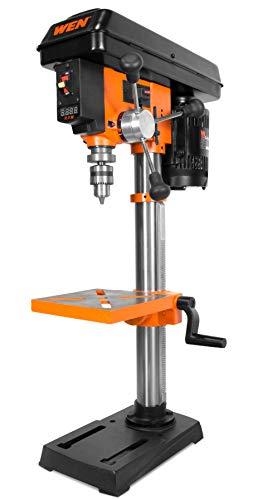
The WEN 4212T pairs a 5-amp motor with variable speed control on a cast iron benchtop frame, plus a laser guide for lining up holes. Instead of opening the belt cover and moving a belt between pulleys, the speed changes with a control, so switching from a large Forstner bit to a small twist bit takes seconds. The 5-amp motor sits between the light 3.2-amp class and the stronger 6.2-amp class: enough torque for large bits in hardwoods, without the bulk of a floor machine. Confirm the exact speed range, spindle travel, and table tilt range on the listing before ordering, since WEN revises these figures between production runs.
Pros:
– Variable speed control avoids belt changes between bit sizes
– 5-amp motor handles large bits in hardwoods better than lighter motors
– Cast iron benchtop build damps vibration for cleaner holes
– Laser guide helps line up holes on marked centers
Cons:
– Speed range and spindle travel vary by production run, so confirm on the listing
– Variable speed mechanisms add parts that belt-only presses do not have
– Heavier than the smallest 10-inch presses, so plan bench space before ordering
2. SKIL DP9505-00 — Best current 10-inch press for beginners
Runner-Up
2. SKIL DP9505-00 — Best current 10-inch press for beginners
The SKIL DP9505-00 is the current SKIL 10-inch press in this guide, and it replaces the older 3320-01. A 6.2-amp motor drives five speeds from 610 to 2800 RPM through a belt system, and a laser guide and work light help line up holes on marked centers. The stronger motor holds speed better with large bits than the 3.2-amp motor in the older model, so it suits softwoods, plywood, plastics, and light metalwork, and it handles large Forstner bits in dense hardwoods better than a lighter press. Confirm the chuck size, table tilt range, spindle travel, weight, and warranty on the listing before ordering, since published figures for this model vary.
Pros:
– Five speeds from 610 to 2800 RPM cover wood, plastic, and light metal
– Laser guide and work light help aim the bit on marked centers
– 6.2-amp motor holds speed better with large bits than the older 3.2-amp model
Cons:
– Belt changes are manual, so speed changes take a minute
– Confirm chuck size, table tilt range, and spindle travel on the listing before ordering
3. BUCKTOOL DP25016A2 — Best 10-inch press for stronger motors
3. BUCKTOOL DP25016A2 — Best 10-inch press for stronger motors
The BUCKTOOL DP25016A2 brings the strongest motor in this guide to the 10-inch class: a 6.2-amp induction motor with 3/4 HP, driving five speeds at 650, 1100, 1700, 2300, and 3100 RPM. Spindle travel is 2 inches, the chuck is a 1/2-inch keyed chuck, and an LED work light keeps the drilling area visible. The cast iron base and table give the machine a stable footing. This is the pick for the shop that drills hardwoods with large bits, or that splits time between wood and light metal. The stronger motor holds speed under load, which keeps large bits cutting instead of rubbing, and rubbing is what dulls bits and scorches wood. The trade is manual belt changes between speeds. Confirm the table tilt range and the exact weight on the listing before ordering, and bolt the press down for the best results.
Pros:
– 6.2-amp, 3/4 HP induction motor holds speed with large bits
– Five speeds from 650 to 3100 RPM cover large and small bits
– LED work light keeps layout lines visible under the chuck
– Cast iron base and table damp vibration during heavy drilling
Cons:
– Speed changes are manual belt moves, so switching speeds takes time
– Spindle travel is 2 inches, so deep holes need the table raised
– Confirm table tilt range and weight on the listing before ordering
4. WEN DP1062V — Best 10-inch press with variable speed and a 6.2-amp motor
4. WEN DP1062V — Best 10-inch press with variable speed and a 6.2-amp motor
The WEN DP1062V combines the two features that matter most in this guide: a 6.2-amp variable-speed motor and a 10-inch swing on a cast iron benchtop frame, with a laser guide for aiming. Variable speed means the speed changes without opening the belt cover, and the 6.2-amp motor means the speed holds when a large bit meets dense wood. That combination suits a shop where the work changes constantly, from small pilot holes to large Forstner bits, and where stopping to move a belt would break the rhythm of the job. It is the most capable all-rounder in this guide. Confirm the exact speed range, spindle travel, chuck details, and table tilt range on the listing before ordering, since these figures are not spelled out in every listing for this model.
Pros:
– 6.2-amp variable-speed motor combines power with fast speed changes
– Cast iron benchtop build keeps vibration low for cleaner holes
– Laser guide helps aim the bit on marked centers
– 10-inch swing covers joinery, hardware, and small parts work
Cons:
– Confirm speed range, spindle travel, and table tilt on the listing
– Variable-speed models cost more than fixed-speed models in this class
– Heavier build needs a firm bench and proper bolting
Who Should Choose What
First benchtop press for a small shop: the SKIL DP9505-00. Its 6.2-amp motor, five speeds, laser guide, and work light cover general drilling without demanding a large bench.
Mixed work with frequent bit changes: the WEN 4212T. Variable speed removes the belt-change pause, so switching between large and small bits stays quick all day.
Hardwoods and large bits: the BUCKTOOL DP25016A2. The 6.2-amp, 3/4 HP motor and five well-spread speeds hold up where lighter motors slow down.
One press to cover everything: the WEN DP1062V. A 6.2-amp variable-speed motor with a 10-inch swing and laser guide is the most capable combination in this guide.
Tight bench space: measure first and confirm each model’s footprint on the listing before ordering.
Common Mistakes
Buying on swing alone. A 10-inch swing says nothing about motor strength, spindle travel, or table quality. Compare motor amps, speed range, travel, and table features before choosing.
Running large bits at high speed. A Forstner bit at 3000 RPM in oak will overheat, dull, and scorch the wood. Drop to the lowest speed for large bits, feed slowly, and back the bit out to clear chips.
Skipping the clamp. A hand-held part can spin the moment the bit catches. Clamp the work to the table, use a fence for repeated holes, and keep hands away from the chuck.
Drilling without a depth stop. Set the depth stop once, drill a trial hole in scrap, and check the depth before drilling the real part, so repeated holes come out identical.
Ignoring runout. A wobbling chuck makes oversized, rough holes. Check the chuck seating, center the bit, and drill a trial hole in scrap when the machine is new or after a chuck change.
Leaving the chuck key in the chuck. A chuck key left in place becomes a projectile when the machine runs. Store the key in its onboard holder every time, without exception.
Bolting nothing down. A press that is not bolted to the bench can walk during a cut, especially with large bits. Bolt the base down, or clamp it firmly, before any serious drilling.
FAQ
What does a 10-inch drill press mean?
A 10-inch drill press has a 10-inch swing, which is twice the distance from the center of the chuck to the column. The chuck sits 5 inches from the column, so the machine drills to the center of a board up to 10 inches wide. All four models in this guide share that 10-inch swing.
Is a 10-inch drill press enough for furniture work?
For most furniture work, yes. A 10-inch swing covers dowel joints, mortises drilled with a Forstner bit, shelf pin holes, hardware installation, and small parts. Wider panels need a larger swing or a different setup.
How many speeds does a 10-inch drill press need?
Five speeds cover the common range, from around 570 RPM for large bits to around 3300 RPM for small bits. Variable-speed models cover the same range without fixed steps, which is faster when the work changes bits often. Either setup works when the low end is low enough for the largest bit in the shop.
Can a 10-inch drill press drill metal?
Yes, with limits. Light metalwork such as aluminum brackets and thin steel suits a 10-inch press when the speed is low, the bit is sharp, and cutting fluid is used. Heavy steel plate and production metalwork need a larger, heavier machine.
What is the difference between a 10-inch benchtop press and a floor press?
A benchtop press sits on a bench and suits small shops, while a floor press stands on the floor and usually carries a larger swing, a stronger motor, and longer spindle travel. A 10-inch benchtop press covers small parts and joinery; a floor press covers larger work and deeper holes.
How do I keep holes precise on a drill press?
Mark the center clearly, line the bit up with the mark using the laser guide, clamp the work, set the depth stop, and drill a trial hole in scrap first. Check the table lock, the chuck seating, and the bit centering before the real cut. Precision comes from setup, not from the machine alone.
Conclusion
The best 10 drill press for a small woodworking shop is a 10-inch benchtop model matched to the work it will do. The SKIL DP9505-00 suits a first press and a compact bench. The WEN 4212T suits mixed work with frequent bit changes. The BUCKTOOL DP25016A2 suits hardwoods and large bits with its stronger motor. The WEN DP1062V suits a shop that wants power and variable speed in one machine. All four share the same 10-inch swing, so the decision rests on motor strength, speed control, table features, and build. Measure the bench, confirm the specs on the listing, and bolt the press down. A 10-inch press chosen this way will handle joinery, hardware, and small parts for years.
J
JD's Woodworks Editorial Team
We compare specs, warranty terms, long-term owner feedback and street pricing before anything earns a spot. Rankings are never paid.
Affiliate disclosure. As an Amazon Associate we earn from qualifying purchases at no extra cost to you. Prices accurate as of the date shown.
Miter saw vs table saw: compare crosscuts, rip cuts, accuracy, space, and value to choose the right saw for your shop and your first woodworking projects.
Compare five solar portable generators for shops, campsites, and outages, covering battery size, output, solar charging, outlets, and what to check first.
The best portable CNC machines for small shops and shared spaces, compared by footprint, weight, work area, and setup. Compact benchtop picks for wood, acrylic, and soft metal.
Find the best Penn Industries dust collector on Amazon: the PSI Woodworking DC3XX blower and the DC725 tabletop unit, compared on airflow, pressure, and shop fit.
Compare five large stationary horizontal metal band saws for fabrication shops on cutting capacity, motor, power supply, blade speed, and mitering before buying.
Find the best mortising chisel bits for clean square mortises in this guide: hollow-chisel sets and singles compared by size, shank, steel, and machine fit.
Find the best drill press base for your shop. Compare rolling stands and mobile bases by capacity, footprint, casters, locking, and setup before you buy.
Find the best dewalt planer dw734 blades for your 12-1/2-inch thickness planer. Compare OEM and aftermarket 3-knife sets, steel types, and fit before you buy.

 2. SKIL DP9505-00 — Best current 10-inch press for beginners
 3. BUCKTOOL DP25016A2 — Best 10-inch press for stronger motors









