As an Amazon Associate I earn from qualifying purchases. This post may contain affiliate links at no extra cost to you.
A thirty-amp outlet is the detail that turns a quiet inverter generator from a camping companion into a real RV and backup power source. Small quiet inverter generators usually carry only household duplex outlets, and each of those caps one cord at twenty amps. A thirty-amp outlet lets one cord carry the full output of the generator, which is what a travel trailer shore cord or a transfer inlet expects. This guide covers five quiet inverter generators that each carry a thirty-amp outlet, and it judges them on the things that matter once that outlet is in place: surge and running watts, noise at light load, runtime, weight, and carbon monoxide safety.
OUR TOP PICK
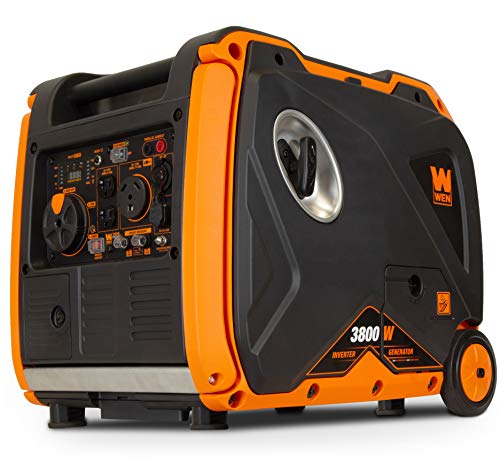
WEN 56380i Super Quiet 3800-Watt Inverter Generator
Every pick in this guide is a gasoline inverter generator, and every pick is 120-volt only. None of the five gives 240-volt output, so none of them feeds a 240-volt well pump or a 240-volt range. A thirty-amp outlet can look like a whole-home answer when it is really a single-phase 120-volt answer. All five make clean inverter power with low total harmonic distortion, safe for phones, laptops, and modern furnace boards.
Quiet needs a plain definition here. The noise figures in this guide are maker figures, measured at light load, and makers do not all measure the same way. A figure taken at quarter load cannot be compared directly with a figure taken at rated load. Treat the numbers below as a rough guide to the enclosed inverter class, not as a laboratory ranking. All five are far quieter than an open-frame generator of the same watts, and the differences among them are smaller than the difference between any of them and an open-frame unit.
This guide is also distinct from two other guides on this site. The small quiet camping generator guide covers light units for tents and tailgates, and those units have no thirty-amp outlet. The large inverter generator guide covers whole-home backup, where 240-volt output and transfer-switch readiness lead the choice. This guide sits between them: quiet inverter power with a thirty-amp outlet, for RV use, home backup of 120-volt loads, and workshop use where a long cord run to one tool matters more than raw watts.
What to look for
Outlet type comes first, because two different thirty-amp receptacles exist and they are not interchangeable. A travel-trailer receptacle takes a straight-blade RV shore cord, while a twist-lock receptacle takes a locking cord that cannot pull loose. Know which cord you own before you buy. An adapter can bridge the two, but an adapter plugged into a twenty-amp household receptacle caps that cord at twenty amps, which defeats the point of the thirty-amp outlet.
Surge watts and running watts are the second check, and the gap between them matters more than either number alone. Surge watts cover the brief draw when a motor spins up, such as an air conditioner compressor. Running watts cover the steady load after that. A generator with 4800 surge watts and 4000 running watts has far more headroom for a motor load than one with 3500 surge watts and 3000 running watts. Add up the running watts of the loads you will run at the same time, then check the biggest motor load against the surge figure.
Noise figures need the conditions read alongside the number. A 52 dBA figure at quarter load and a 62 dBA figure at rated load describe different situations, and the louder number may belong to the quieter machine at the same load. Weight and tank size are the next practical checks: a 98-pound unit with wheels and a telescoping handle moves very differently from a 109-pound unit with a fixed handle, and a 3.4-gallon tank at light load runs far longer than a 1.9-gallon tank at half load.
Carbon monoxide safety is now a standard feature on most new inverter generators, but the names differ: CO-Minder, CO Watchdog, and COsense are maker systems that shut the engine down when carbon monoxide builds up near the unit. None of them makes indoor use safe. Every generator in this guide must run outdoors, away from windows and doors, with the exhaust pointed away from people. Finally, check ignition type and parallel capability. Keyless ignition and remote ignition save a pull cord on a cold morning, and a parallel kit lets two matching units join for twice the watts, though the kit itself is a separate purchase on every pick here.
The WEN 56380i is the value pick in this guide, and it earns that spot with a complete panel rather than with raw watts. It gives 3800 surge watts and 3400 running watts from a 212cc engine, with a thirty-amp travel-trailer receptacle, two household duplex receptacles, a 12-volt DC receptacle, and two USB ports. The thirty-amp receptacle is the point of this guide, and the 56380i is the least expensive way in this group to get one on a quiet inverter unit. WEN lists noise at 57 dBA at quarter load, which the maker compares to a window air conditioner or an average conversation, and the enclosed frame keeps that figure honest at light load.
Electric ignition with a recoil pull as backup means no pull cord on a cold morning when the battery holds a charge, and the fuel shut-off drains the carburetor at shutdown, which helps the unit sit between uses without gummed fuel. A digital load and fuel display shows how hard the generator is working and how much fuel remains, which is more useful than a simple low-fuel light when you are deciding whether to refuel before nightfall. The 2.2-gallon tank gives up to 8.5 hours at half load, and the two-year warranty covers the unit.
Weight is the one figure to check before buying. The listing gives 99.2 pounds, while one roundup lists 111 pounds for the same model, and this guide uses the listing figure. Either way, the 56380i is a two-person lift onto a truck bed, and the built-in wheels and folding handle carry it across flat ground. At 3400 running watts it sits in the middle of this group, so it runs a typical RV air conditioner fitted with a reduced-draw add-on, a refrigerator, and lights at the same time, but it has less headroom than the two larger picks below. A mirror 12 days ago showed the listing in stock and fulfilled by Amazon, with a tracker crawl on November 27, 2026 showing it live on Amazon US.
The Westinghouse iGen4500 is the quietest pick in this guide on maker figures, at 52 dBA, and it pairs that with the second-highest output here: 4500 peak watts and 3700 running watts. The panel carries a thirty-amp travel-trailer receptacle, a household duplex receptacle, and two USB ports, and the unit adds remote ignition with a key fob, electric ignition, and a recoil pull as backup. The 3.4-gallon tank gives up to 18 hours in Economy mode, which is the longest runtime in this group, and the three-year warranty is the longest here too. At 98 pounds with wheels and a telescoping handle, it moves well for its size.
The iGen4500 is the best-selling RV inverter on Amazon in recent roundups, and a live Amazon check on September 28, 2026 tied the listing to this model. One flag needs stating: the listing title now reads 5000 peak watts for the refreshed iGen5000 variant, so confirm the listing names iGen4500 and shows 4500 peak watts and 3700 running watts before buying. The model confusion is real, and the two models share a listing family. With 3700 running watts, the iGen4500 has the most headroom in this guide for a 13,500-BTU RV air conditioner alongside lights and a refrigerator, and its thirty-amp receptacle takes a travel-trailer shore cord directly with no adapter.
The trade-off against the WEN picks is fuel type and weight. The iGen4500 runs on gasoline only, with no propane option, and at 98 pounds it is not a one-person lift. The parallel capability needs a separate Westinghouse parallel cord, which is not in the box.
The Honda EU3000iS is the premium pick in this guide, and its case rests on the engine and the enclosure rather than on watts. It gives 3000 maximum watts and 2800 running watts from the Honda GX200 196cc engine, with a thirty-amp 125-volt locking plug and a 20-amp duplex receptacle. Honda lists noise at 50 to 57 dBA, the lowest range in this group, and the Eco Throttle system slows the engine at light load, which is where most of the quiet comes from. Electric ignition with a recoil pull as backup, a 3.4-gallon tank, and up to 19.6 hours of runtime round out a unit built for long, quiet runs.
The thirty-amp outlet here is a locking plug, not a travel-trailer receptacle, so check your cord: a travel-trailer shore cord needs an adapter, while a locking cord plugs straight in. The CO-Minder system shuts the engine down when carbon monoxide builds up, and the current model number is EU3000IS1AN. One flag matters for buyers: an older listing under a different ASIN carries the pre-CO-Minder EU3000is, so confirm the listing names the 1AN model with CO-Minder before buying.
At 2800 running watts, the EU3000iS has the lowest output in this guide, and that is its real limit. It runs lights, a refrigerator, chargers, and small tools with ease, but a 13,500-BTU RV air conditioner sits near its surge ceiling, so check the air conditioner surge draw against the 3000-watt surge figure before counting on it. In return it gives the quietest enclosure here, the longest runtime alongside the Westinghouse, and a parts and service network that outlasts most other makers in this group.
The Generac iQ3500 is the most feature-rich control panel in this guide. It gives 3500 surge watts and 3000 running watts, with a thirty-amp twist-lock receptacle, a 20-amp duplex receptacle, USB ports, and a digital smart LCD that shows wattage, runtime remaining, generator status, hour meter, and fuel level. The PowerDial combines choke, run, and stop into one dial, and the COsense system shuts the engine down on carbon monoxide buildup. Electric ignition with a recoil pull as backup, a 2.6-gallon tank, 14.1 hours at 25 percent load, and 8.9 hours at 50 percent load complete the picture. At 109.1 pounds it is the heaviest pick here, with wheels and a handle for moving it.
Two flags need stating. First, the maker publishes no noise figure for the iQ3500, so this guide gives none; the unit is marketed as ultra-quiet, but a missing number is not a number, and buyers who need a published figure should pick one of the other four. Second, an ASIN conflict exists: one import mirror ties a different ASIN to the model 7723 CO version, while the Amazon listing ties the ASIN used here to the model 77232. This guide uses the Amazon listing ASIN, and buyers should confirm the listing names the iQ3500 with COsense before buying.
The iQ3500 is parallel-ready, and the parallel kit is a separate purchase. Its thirty-amp twist-lock receptacle takes a locking cord directly, and a travel-trailer shore cord needs an adapter. At 3000 running watts it matches the Honda on output, so the choice between them comes down to noise figure, weight, and the digital display.
The WEN 56480iX is the most powerful pick in this guide, at 4800 surge watts and 4000 running watts from a 224cc engine, and it is also the loudest pick on maker figures, at 62 dBA. Both facts belong in the same sentence, because the 56480iX trades some quiet for watts. A 62 dBA figure is still far quieter than an open-frame generator of the same size, but it is ten decibels above the Westinghouse on maker figures, and that gap is audible. Buyers who need maximum watts for a large RV air conditioner and a microwave at the same time will accept the trade; buyers who need the quietest possible unit should pick the Westinghouse or the Honda instead.
The panel is generous: four household receptacles across two duplexes, a thirty-amp travel-trailer receptacle, a 12-volt DC receptacle, and two USB ports. Keyless electric ignition with a recoil pull as backup, the Watchdog carbon monoxide shutdown sensor, and a fuel shut-off round out the feature list, and the three-year warranty matches the Westinghouse. The 1.9-gallon tank gives up to 7 hours at half load, the shortest runtime in this group, so plan on refueling during a long outage. At 77 pounds with onboard wheels and a telescoping pull handle, it is the lightest pick here by a wide margin, and that weight matters when one person loads it into a truck bed.
A mirror 17 days ago showed the listing in stock and fulfilled by Amazon. The 4000 running watts give the most headroom in this guide for motor loads, and the thirty-amp receptacle takes a travel-trailer shore cord directly.
Comparison
Model
Surge / Running watts
Thirty-amp outlet
Noise (maker figure)
Tank / Runtime
Weight
WEN 56380i
3800 / 3400
Yes, travel-trailer receptacle
57 dBA at quarter load
2.2 gal, up to 8.5 h half load
99.2 lb
Westinghouse iGen4500
4500 / 3700
Yes, travel-trailer receptacle
52 dBA
3.4 gal, up to 18 h Economy mode
98 lb
Honda EU3000iS
3000 / 2800
Yes, twist-lock plug
50 to 57 dBA
3.4 gal, up to 19.6 h
Not stated
Generac iQ3500
3500 / 3000
Yes, twist-lock receptacle
Not published
2.6 gal, 14.1 h at 25 percent load
109.1 lb
WEN 56480iX
4800 / 4000
Yes, travel-trailer receptacle
62 dBA
1.9 gal, up to 7 h half load
77 lb
Frequently asked questions
What does a thirty-amp outlet change compared with a household outlet?
A household duplex receptacle caps each cord at twenty amps, so a generator with 3400 running watts cannot push its full output through one household cord. A thirty-amp outlet takes one cord rated for the full output, which is what a travel-trailer shore cord or a transfer inlet expects. The outlet type matters too: a travel-trailer receptacle takes a straight-blade RV cord, while a twist-lock receptacle takes a locking cord, and an adapter between them is fine only when the adapter itself is rated for thirty amps. Check your cord first, then match the receptacle to it.
Can noise figures be compared across brands?
Not directly. Makers measure at different loads and different distances, and a figure taken at quarter load describes a different situation from a figure taken at rated load. The useful comparison is inside one maker line, or between figures taken under the same conditions. In this guide the Westinghouse 52 dBA figure and the WEN 56480iX 62 dBA figure are both maker figures, but the loads behind them may differ, so treat the gap as a rough guide rather than a laboratory result. When a maker publishes no figure, as Generac does for the iQ3500, that absence is itself information.
Can a quiet inverter generator run an RV air conditioner?
It depends on the air conditioner surge draw and the generator surge watts. A 13,500-BTU RV air conditioner can draw well over 3000 watts for the brief moment its compressor spins up, so a 3000-watt-class generator sits near its ceiling while a 3700- or 4000-running-watt generator has more headroom. An add-on that lowers that brief draw makes a smaller generator viable. Check the air conditioner nameplate and the generator surge figure together, and run the air conditioner alone for its first minute before adding other loads.
How to choose
Match running watts to the biggest load first, then check the surge figure against the biggest motor in the group. For a travel trailer with one air conditioner, the Westinghouse iGen4500 and the WEN 56480iX have the most headroom, while the Honda EU3000iS and the Generac iQ3500 suit lighter loads such as lights, a refrigerator, and chargers. Next, match the receptacle to your cord: travel-trailer cords plug straight into the two WEN picks and the Westinghouse, while a locking cord plugs straight into the Honda and the Generac.
Then weigh noise against watts and weight. The Westinghouse is the quietest pick on maker figures and the Honda has the lowest noise range, while the WEN 56480iX gives the most watts and the lightest weight at the cost of a higher noise figure. Check tank size against how long you need to run between refuels, and confirm the carbon monoxide shutdown system is named on the listing. Finally, open each product page live before buying and confirm the model number, the thirty-amp receptacle type, and a new-unit buy option.
Disclosure: As an Amazon Associate, we may earn a commission from qualifying purchases made through links in this article, at no additional cost to you.
J
JD's Woodworks Editorial Team
We compare specs, warranty terms, long-term owner feedback and street pricing before anything earns a spot. Rankings are never paid.
Affiliate disclosure. As an Amazon Associate we earn from qualifying purchases at no extra cost to you. Prices accurate as of the date shown.
Table saws under the 1500 mark compared: the Grizzly G0771Z and Shop Fox W1837 hybrid saws with cast iron tables, 2 HP motors and T-square fences, specs from their listings.
Table saws for fine woodworking compared: the SawStop Professional Cabinet Saw and Powermatic PM1000, judged on fence precision, table flatness and vibration from listing specs.
Table saw combos explained: saws sold with a stand and accessories in one listing, what to check in the box, and which bundle fits your shop or jobsite.
Compare the best planer digital thickness gauges and digital readout kits for portable planers, with fit, resolution and mounting checks before you buy.
Model table saws for scale modelling and hobby work compared: the precision Proxxon FET 37070 and the compact Saker mini table saw, with specs taken from their Amazon listings.
Three CoreXY 3D printers for product development, each with the architecture stated on its listing: an enclosed multicolor machine, a large-format enclosed model and a heated-chamber model.

 WEN 56380i Super Quiet 3800-Watt Inverter Generator
 Westinghouse iGen4500 Super Quiet Inverter Generator
 Honda EU3000iS Super Quiet Inverter Generator
 Generac iQ3500 Inverter Generator
 WEN 56480iX Quiet 4800-Watt Inverter Generator









