As an Amazon Associate I earn from qualifying purchases. This post may contain affiliate links at no extra cost to you.
A battery-powered air compressor trades the extension cord for a tool battery, and for a lot of woodworking jobs that trade is worth making. Punch-list trim work, a brad nailer carried from room to room, blowing dust off a workpiece before finishing, topping up a tire in the driveway: none of these need a big corded machine humming in the corner, and all of them get faster when the compressor goes wherever the work is. The catch is that cordless compressors are a small, specialised corner of the compressor market. Tank sizes run small, air delivery is modest, and the battery platform you pick matters as much as the pump itself.
OUR TOP PICK
DEWALT 20V MAX 2.5 Gallon Cordless Air Compressor (DCC2520B)
This guide lines up the battery-powered tank compressors that are actually sold for tool work, and sorts them by the numbers that decide a purchase: tank capacity, air delivery at working pressure, maximum pressure, noise, weight and which battery family each unit belongs to. Every model below stores air in a tank and runs pneumatic tools such as brad nailers, finish nailers and staplers. Handheld tire inflators are a different product type and are not covered here.
As an Amazon Associate, we earn from qualifying purchases.
Quick Picks
Our Short List of 3
Editor’s Choice
DEWALT 20V MAX 2.5 Gallon Cordless Air Compressor (DCC2520B)
Best for: DEWALT 20V MAX owners who want one cordless compressor for trim, finish nailing and general shop air without running a cord
Battery platform: DEWALT 20V MAX, also accepts FLEXVOLT batteries
Begin with the battery platform, not the pump. A cordless compressor is a long-term tenant of one battery family. The two DEWALT units below draw from the 20V MAX and FLEXVOLT pools, and the RYOBI runs on 18V ONE+ packs. If your shop shelves already hold chargers and spare packs from one of these systems, that system is the sensible default, because a bare-tool compressor plus batteries you already own is a very different purchase from a compressor plus two new packs and a charger. Cross-platform shoppers should price the whole setup, not the tool alone.
Match air delivery to the tool, in SCFM at 90 PSI. Air delivery is the figure that decides whether a nailer keeps up or waits on the pump. Brad and finish nailers sip air in short bursts and work comfortably with the delivery figures in this guide. Framing nailers fired in long runs, air sanders, die grinders and spray guns that draw continuous air sit beyond what any battery tank compressor in this class can feed. Read the SCFM at 90 PSI line, since that is the pressure most nailers actually run at, and ignore headline numbers quoted at lower pressures.
Tank size sets the rhythm of the work. The tank is a buffer: a larger tank means more fasteners between pump cycles and fewer interruptions while the motor refills. The 2.5-gallon tanks below suit a full run of trim or a set of cabinets. A 1-gallon tank cycles more often, which is fine for short punch-list jobs and inflation, but it will have you pausing on longer nailing sessions. None of these tanks turns a cordless unit into a production shop compressor, and none is meant to.
Check maximum pressure against your tools. Most brad, finish and framing nailers regulate down to working pressures well under the maximum figures here, so all three models clear the bar for nailing. Max pressure matters more for inflation work and for tools with higher demands. Note that the DEWALT DCC2520B reaches its full 140 PSI maximum on a FLEXVOLT battery; on a plain 20V MAX pack its cut-out pressure is lower, which is worth knowing if high-pressure inflation is part of your plan.
Weigh noise and weight together. These machines live close to the work, often in finished rooms. A figure around 80 dBA is roughly the volume of a loud conversation held nearby: noticeable, but workable indoors for short cycles. Weight matters just as much, because the whole point of the category is carrying the compressor to the work instead of running a long hose back to a stationary machine. Every model here is built to be moved by one person with one hand on the handle.
Decide between a bare tool and a kit. Two of the three listings below are bare tools, which reward buyers already holding batteries and punish everyone else with a second purchase. The FLEXVOLT kit includes its battery and a fast charger, which makes it the cleaner entry point for a shop that owns no DEWALT cordless gear at all. Whichever route you take, plan on at least one spare pack for longer sessions: a compressor cycling through a morning of trim work will empty a small battery.
Best Options
DEWALT 20V MAX 2.5 Gallon Cordless Air Compressor (DCC2520B)
Top Pick
DEWALT 20V MAX 2.5 Gallon Cordless Air Compressor (DCC2520B)
Best for: DEWALT 20V MAX owners who want one cordless compressor for trim, finish nailing and general shop air without running a cord
Battery platform: DEWALT 20V MAX, also accepts FLEXVOLT batteries
DEWALT 20V MAX owners who want one cordless compressor for trim, finish nailing and general shop air without running a cord
Watch out for
It is a bare tool, so the value case depends on batteries you already own; the 2.5-gallon tank and 1.0 SCFM delivery are sized for nailing, not for continuous-draw tools
The DCC2520B is the mainstream answer in this category: a brushless, oil-free compressor on the DEWALT 20V MAX platform with a 2.5-gallon tank and a heavy-duty roll cage around the pump and gauges. It delivers 1.0 SCFM at 90 PSI, which covers brad and finish nailing at a comfortable pace, and DEWALT rates it at over 850 nails per charge on a 6.0Ah battery. The OneTurn regulator is a genuinely useful touch: one knob sets output pressure quickly and repeatably as you move between tools.
FLEXVOLT Advantage is the detail that separates this unit from a basic 20V tool. Run it on a FLEXVOLT battery and the compressor draws more from the pack, lifting cut-out pressure to the full 140 PSI maximum and stretching the nails-per-charge figure. On ordinary 20V MAX packs it still does the trim and finish work it was built for. At 21.5 pounds and 80 dBA, it carries easily and cycles without dominating a quiet room, though it is not a silent machine.
Watch out for: It is a bare tool, so the value case depends on batteries you already own; the 2.5-gallon tank and 1.0 SCFM delivery are sized for nailing, not for continuous-draw tools
DEWALT FLEXVOLT 60V MAX Air Compressor Kit (DCC2560T1)
Runner-Up
DEWALT FLEXVOLT 60V MAX Air Compressor Kit (DCC2560T1)
Best for: Buyers who want the strongest cordless output in this guide and a complete, ready-to-work kit in a single purchase
Buyers who want the strongest cordless output in this guide and a complete, ready-to-work kit in a single purchase
Watch out for
It commits you to the FLEXVOLT battery family, which is a smaller pool than 20V MAX; even with the best delivery here, it remains a nailing compressor, not a substitute for a corded shop unit on continuous-draw tools
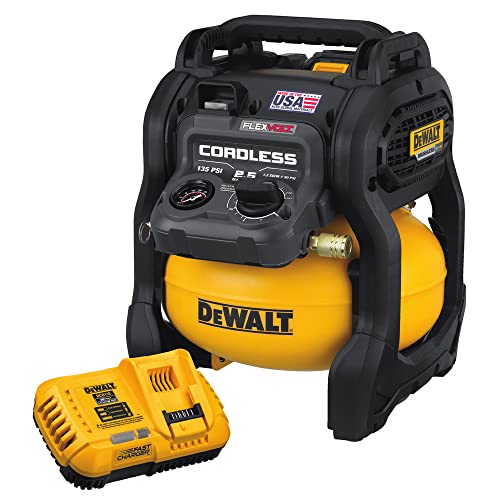
The DCC2560T1 is the heavy end of the cordless compressor class. It runs on a 60V FLEXVOLT battery and posts the strongest delivery figure in this guide at 1.2 SCFM at 90 PSI, with a 135 PSI maximum and the same 2.5-gallon tank size as its 20V sibling. DEWALT rates it at up to 1,220 nails per charge with the included 6.0Ah FLEXVOLT battery, which is the kind of runtime that covers a long day of trim without a midday battery hunt.
Unlike the other two listings here, this one is a full kit: the compressor, a FLEXVOLT battery and a fast charger arrive in one box, so it works as a first DEWALT cordless purchase rather than an add-on to an existing fleet. The brushless motor and oil-free pump keep maintenance to draining the tank and keeping the intake clear. At 79 dBA it is marginally the quieter of the two DEWALT units, and at 21.5 pounds it gives up nothing in portability for the extra output.
Watch out for: It commits you to the FLEXVOLT battery family, which is a smaller pool than 20V MAX; even with the best delivery here, it remains a nailing compressor, not a substitute for a corded shop unit on continuous-draw tools
RYOBI 18V ONE+ 1 Gallon Air Compressor (P739)
RYOBI 18V ONE+ 1 Gallon Air Compressor (P739)
Best for: RYOBI ONE+ owners with light nailing, stapling and inflation work who value a compact second source of shop air
RYOBI ONE+ owners with light nailing, stapling and inflation work who value a compact second source of shop air
Watch out for
The 1-gallon tank cycles often on longer nailing runs, and the delivery figure is the lowest here; confirm your nailer’s air needs before relying on it for finish work
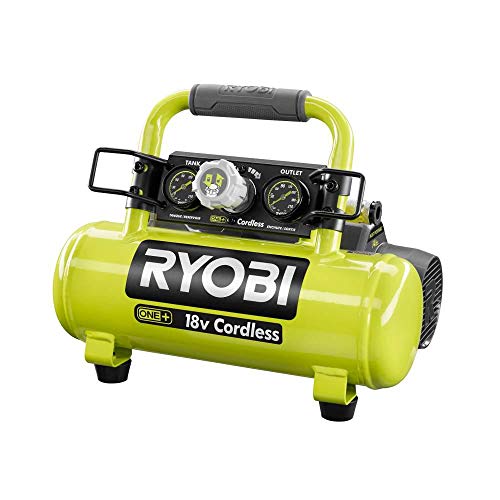
The P739 is the small, simple option: a 1-gallon cordless compressor on RYOBI’s 18V ONE+ platform, aimed at light work rather than full trim days. Its 0.5 CFM delivery at 90 PSI and 120 PSI maximum suit a brad nailer or stapler used in short bursts, along with the inflation jobs that fill the gaps in a home shop: tires, sports gear, and the occasional pool float. The single-gallon tank is the honest limit of the design, and the machine is best understood as air supply for quick jobs.
For a shop already running ONE+ tools, the appeal is obvious. The same packs that drive your drills and saws run this compressor, and as a bare tool it slots into the fleet with no new charger on the bench. It also works as a grab-and-go second compressor for anyone whose main machine is a larger corded unit parked across the shop: hose runs get shorter when the little tank comes to the workpiece. Buyers expecting to run a finish nailer through a whole room of baseboard in one stretch should look at the 2.5-gallon models above instead.
Watch out for: The 1-gallon tank cycles often on longer nailing runs, and the delivery figure is the lowest here; confirm your nailer’s air needs before relying on it for finish work
Which One Fits
You already own DEWALT 20V MAX batteries. The DCC2520B is the natural pick. It runs on the packs on your shelf, steps up in pressure and runtime when a FLEXVOLT battery goes in, and covers the trim and finish work that makes up most cordless compressor use.
You own no DEWALT cordless gear and want the most capable machine. The DCC2560T1 kit is the complete purchase: strongest delivery in this guide, the longest nails-per-charge figure, and a battery and charger in the box. It also plants your flag in the FLEXVOLT system for future tools.
You run RYOBI ONE+ tools and your air jobs are light. The P739 matches your batteries and handles stapling, brad nailing in short runs and inflation. It is the compact second compressor rather than the main event.
Your work is continuous-draw: sanding, grinding, spraying. None of these. Battery tank compressors are built around the burst demand of nailers. A corded shop compressor with a larger tank is the right tool, and buying a cordless unit for that work ends in disappointment.
You work in occupied, finished interiors. All three are reasonable; the FLEXVOLT kit’s 79 dBA and the DCC2520B’s 80 dBA are close, and both let you keep the compressor in the room instead of behind a closed door at the end of a hose.
Common Mistakes
Buying the compressor and forgetting the batteries. Two of the three listings here are bare tools. A cordless compressor with no charged pack is furniture. Budget for at least one large-capacity battery, and a second if the machine will work full sessions.
Reading the maximum pressure and ignoring delivery. Max PSI is the easy headline, but SCFM at 90 PSI decides whether a tool keeps pace. A compressor can post a fine pressure figure and still leave a busy nailer waiting on recovery.
Expecting cordless to replace a shop compressor. These units are trim and punch-list machines. Framing crews in full stride, air sanders and spray finishing all want sustained airflow that no battery tank in this class delivers.
Mixing up inflators and compressors. A handheld inflator fills tires and nothing else; it has no tank and cannot run a nailer. If the tool list includes pneumatic fasteners, buy a tank compressor like the three here.
Never draining the tank. Compressed air leaves moisture in the tank after every session. Open the drain valve when the work is done, on cordless units exactly as on corded ones, or the tank corrodes from the inside.
FAQ
Can a battery-powered air compressor run a framing nailer?
Occasionally and slowly, yes; as a daily framing setup, no. The delivery figures here suit brad and finish nailers, which draw air in short bursts. A framing nailer fired in long runs empties a small tank faster than a battery pump refills it, so the work rhythm breaks. For framing, use a larger corded compressor.
How long does a battery last in a cordless compressor?
It depends on pack capacity and how often the pump cycles. The makers’ own figures give a useful scale: over 850 nails per charge for the DEWALT 20V MAX unit on a 6.0Ah battery, and up to 1,220 for the FLEXVOLT kit. Bigger packs and lighter work stretch those numbers; small packs and constant cycling shrink them.
Are battery-powered compressors quieter than corded ones?
Generally, yes, in this class. The units here are rated at 79 to 80 dBA, which is below the roar of a typical jobsite pancake compressor, and the pump only runs in short refills rather than continuously. They are still power tools, not silent appliances, so hearing protection remains sensible for long sessions nearby.
Do I need a special hose or fittings for a cordless compressor?
No. These machines use the same quarter-inch couplers and hoses as corded compressors, and the nailers and accessories you already own connect as usual. The only compatibility that matters is the battery platform, since packs do not interchange between brands.
Final Verdict
Battery-powered compressors earn their place on trim work, punch lists and anywhere a cord is more trouble than the job. The DEWALT DCC2520B is the default recommendation: it fits the largest battery pool, delivers enough air for finish work, and gains pressure and runtime when a FLEXVOLT pack goes in. The FLEXVOLT DCC2560T1 kit is the step up for buyers who want the strongest cordless output here with nothing else to purchase. The RYOBI P739 is the light-duty option for ONE+ owners whose air jobs come in short bursts. Pick by the batteries you already own, check the delivery figure against your thirstiest nailer, and any of the three will do the work it was designed for.
J
JD's Woodworks Editorial Team
We compare specs, warranty terms, long-term owner feedback and street pricing before anything earns a spot. Rankings are never paid.
Affiliate disclosure. As an Amazon Associate we earn from qualifying purchases at no extra cost to you. Prices accurate as of the date shown.
Miter saw vs table saw: compare crosscuts, rip cuts, accuracy, space, and value to choose the right saw for your shop and your first woodworking projects.
Compare five solar portable generators for shops, campsites, and outages, covering battery size, output, solar charging, outlets, and what to check first.
The best portable CNC machines for small shops and shared spaces, compared by footprint, weight, work area, and setup. Compact benchtop picks for wood, acrylic, and soft metal.
Find the best Penn Industries dust collector on Amazon: the PSI Woodworking DC3XX blower and the DC725 tabletop unit, compared on airflow, pressure, and shop fit.
Compare five large stationary horizontal metal band saws for fabrication shops on cutting capacity, motor, power supply, blade speed, and mitering before buying.
Find the best mortising chisel bits for clean square mortises in this guide: hollow-chisel sets and singles compared by size, shank, steel, and machine fit.
Find the best drill press base for your shop. Compare rolling stands and mobile bases by capacity, footprint, casters, locking, and setup before you buy.
Find the best dewalt planer dw734 blades for your 12-1/2-inch thickness planer. Compare OEM and aftermarket 3-knife sets, steel types, and fit before you buy.