
Our Top Picks
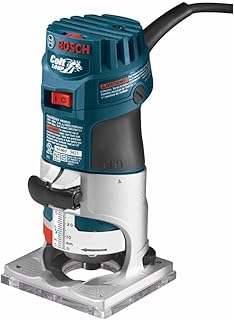
 BOSCH PR20EVS Colt 1.0 HP Variable-Speed Palm Router35 in9.41 x 7.43 x 4.7 inches3.3 poundsCheck on Amazon


What's inside
As an Amazon Associate I earn from qualifying purchases. This post may contain affiliate links at no extra cost to you.
My full-size router sat under the bench for most of last year. Not because it was bad, but because hauling out a 3 HP machine to round over the edge of a shelf is like starting a car to move it six feet. That is the whole argument for a compact router, and it is why picking the best compact router for woodworking matters more than most people think. This is the tool you will reach for a hundred times a month, so the small annoyances compound fast.
Compact routers, palm routers, trim routers, whatever your region calls them, all live in roughly the same box: a 1 to 1.25 HP motor, a single 1/4 inch collet, and a body you can steer with one hand. The gap between a mediocre one and a great one is not power. It is the base, the depth adjustment, the light, and whether the whole thing stays put once you set it. I have owned a few, I have broken one, and I have wasted more time than I want to admit fighting a base that would not hold a setting.
As an Amazon Associate we earn from qualifying purchases at no extra cost to you.




| What you’ | re doing | Compact router good enough? | What actually matters most |
|---|---|---|---|
| Roundovers and chamfers | Yes, ideal | Smooth base edge, good visibility | |
| Flush trimming veneer and edge banding | Yes, ideal | Low center of gravity, offset base option | |
| Hinge and hardware mortises | Yes, with a plunge base | Repeatable depth stop, plunge accuracy | |
| Dados and grooves in plywood | Mostly | Edge guide quality, motor holding RPM | |
| Template routing small parts | Yes | Bearing bits, tight base-to-bit alignment | |
| Large panel raising or deep mortises | No | Buy a 2 HP+ router instead |
Why a compact router is the right first router for most garage shops
If you only own one router and your projects are furniture-sized rather than kitchen-cabinet-shop-sized, I would put a compact router in the shop before a big one. The reason is simple: you will actually use it. A one-handed router that lives on a shelf at eye level with a roundover bit already chucked in gets grabbed constantly. A heavy plunge router in a case gets grabbed when there is no other option.
The trade-off is real and you should hear it plainly. A 1/4 inch collet limits your bit selection, especially for anything with a large cutting diameter. Long bits chatter. Panel bits and big rail-and-stile cutters are off the table entirely, and you should not try to make them work. The motor also does not like hogging material, so you will take three passes where a bigger router takes one. In a garage where I am not on the clock, three passes costs me a minute. In a production shop it would be unacceptable.
Where a compact router genuinely outperforms a big one is anywhere you need to see the cut. Small body, bit close to your hand, base you can look over. Flush trimming edge banding on a plywood carcass with a big router is a wrestling match. With a palm router it is pleasant.
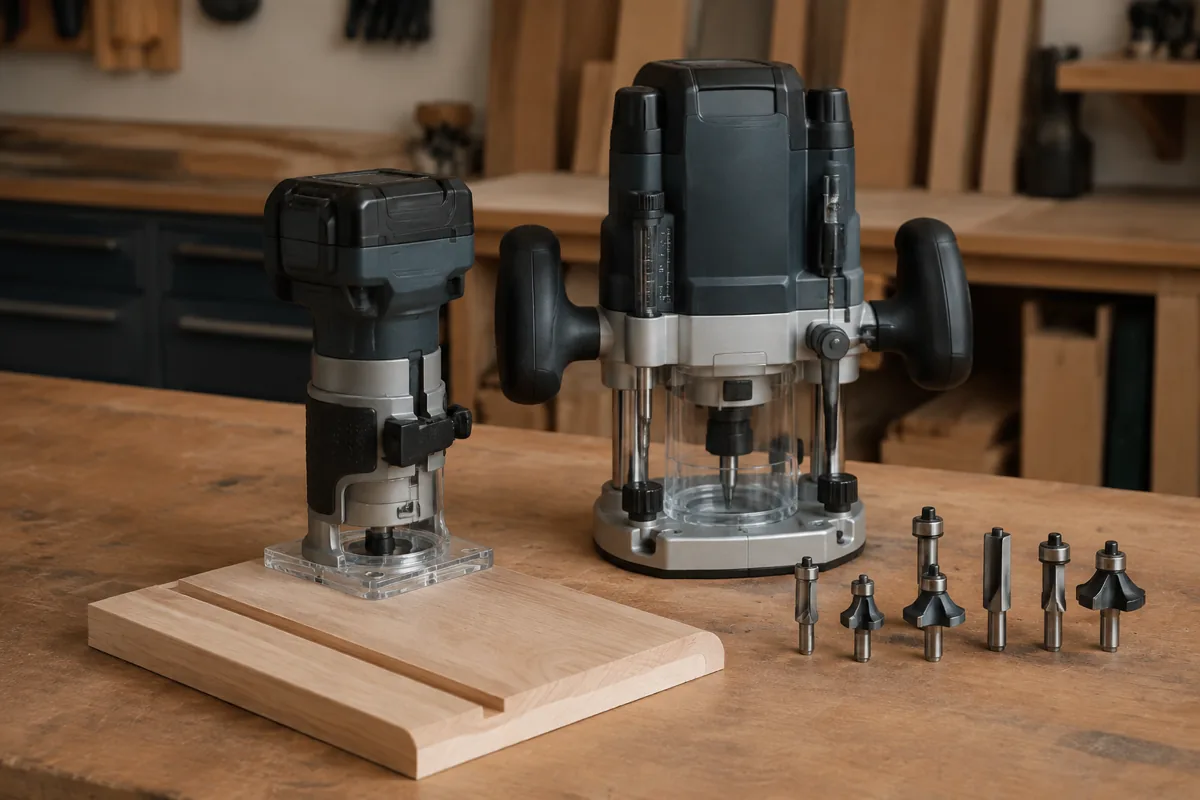
Compact router with fixed and plunge base kit
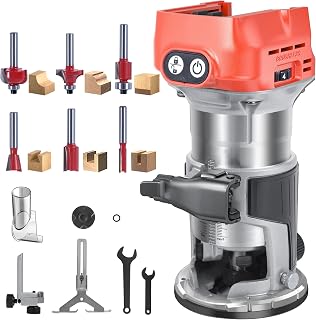
If your budget stretches, buy the kit with both bases rather than the bare fixed-base router. The plunge base is what turns a palm router into a mortising tool, and buying it separately later almost always costs more than getting it in the kit up front. Look for kits that also include an edge guide and at least one sub-base, because those accessories are priced strangely high on their own.
The five things I actually check before buying
Depth adjustment that holds
This is the whole ballgame. Cheap compact routers use a friction clamp and a coarse ring, and they creep. You set a 1/8 inch roundover, make four passes, and the fifth one is deeper. Look for a rack-and-pinion or micro-adjust ring with a positive lock, and a scale you can read without a flashlight. If a router has a fine-adjust knob that moves in identifiable clicks or clear graduations, that is a good sign someone thought about repeatability.
Base flatness and base size
Cast or machined aluminum bases stay flat. Thin stamped ones can tip. Also check how far the base extends past the bit, because a small base means a small footprint, which means a router that wants to dive off the edge of a narrow board. Some manufacturers sell an offset or oversized sub-base, and it is one of the cheapest accuracy upgrades in the shop.
Soft start and variable speed
A compact router that jumps when you pull the trigger will scar a workpiece. Soft start is not a luxury. Variable speed matters less than the marketing implies for small bits, but it earns its keep with larger diameter bits and with plastics or melamine where the top speed burns the material.
Dust and light
Nobody advertises this well. LED lights around the collet are genuinely useful for following a pencil line, and a dust port that actually captures chips instead of blowing them into your face changes how long you want to keep working. Check whether the dust attachment is included or extra, because on some lines it is a separate purchase that feels insulting.
Collet quality
You want a self-releasing collet with a decent length of grip, not a tiny sleeve. If a router has a reputation for bits slipping or seizing, walk away. The professional cordless lines from DeWalt, Milwaukee and Makita generally get this right, and so do the better corded compact routers from Bosch and Porter-Cable’s older designs.
Corded or cordless: the honest answer for the best compact router for woodworking
I run cordless now, and I will explain the reasoning rather than just recommending it. A compact router is a short-burst tool. You edge a tabletop for ninety seconds, put it down, do something else. That duty cycle is perfect for a battery, and cutting the cord means no more dragging an extension lead across a workpiece or catching it on a clamp. If you are already invested in DeWalt XR, Milwaukee FUEL or Makita LXT, the compact router is one of the easiest bare-tool additions you can justify.
Corded still wins on two counts. It is cheaper if you own no batteries, often meaningfully so once you price in a charger and a pair of packs. And it will not sag on a long session of template work. There is also something to be said for a corded router mounted permanently in a small router table or a jig, where a battery is just something else to charge.
- ✔ One-handed control makes edge work genuinely enjoyable
- ✔ Light enough that you use it instead of avoiding it
- ✔ Excellent visibility of the bit and the pencil line
- ✔ Plunge base kits handle hinge mortises well
- ✔ Cordless versions kill the extension cord dance
- ✘ 1/4 inch collet only, so big bits are off limits
- ✘ Needs multiple shallow passes on hardwood
- ✘ Small base can tip on narrow stock without an offset sub-base
- ✘ Cheap models creep out of depth setting mid-project
- ✘ Dust collection attachments are often sold separately
Cordless compact router, bare tool
Only worth it if you already have two or more batteries on the same platform, ideally a higher capacity pack for longer sessions. Buying into a new battery system purely for a trim router rarely makes financial sense. Brushless is worth the small premium here because it holds speed better as the pack drains.
Bits, jigs and the mistakes I made
My first mistake was buying a cheap 15-piece bit set. Half of them I have never used, and the ones I did use dulled quickly and burned cherry. Buy three good carbide bits instead: a 1/8 inch roundover, a flush trim bit with a quality bearing, and a straight bit around 1/4 inch. Add a chamfer bit when you need one. Good bits cut cleaner at the lower power a compact router puts out, which means the bit quality matters more here than on a big machine.
My second mistake was routing full depth in one pass on white oak. The router bogged, the bit chattered, and I got a burn mark I had to sand out of a visible edge. Compact routers reward patience. Take a shallow pass, then another. Move left to right against the bit rotation on an outside edge so the cutter pulls the base into the work rather than trying to run away.
Third mistake, and the expensive one: I used a compact router freehand for a hinge mortise instead of clamping a simple plywood template. The mortise wandered, the hinge sat proud, and the door never closed right. Templates and a bushing set cost very little and turn a palm router into something that behaves predictably. If you do a lot of hinges, a plunge base plus a shop-made template is faster than a dedicated jig and far cheaper.
One more practical note for small shops: a compact router can live in a small router table insert plate for light work like grooves and small profiles. It is not a substitute for a proper table router, and I would not run raised panels through it. But for a single-car garage where floor space is the real constraint, it is a reasonable compromise that I have been happy with.
Router bit starter set, carbide tipped
Skip the giant bargain sets. A small set of solid carbide or carbide-tipped bits with quality bearings will cut cleaner and last longer, which matters more on a lower-power router. Check that every bit is 1/4 inch shank before ordering, since some sets mix shank sizes.
Frequently asked questions
Is a compact router powerful enough for hardwood? Yes, for edge profiles, flush trimming, dados and mortises, as long as you take shallow passes. Where it struggles is deep cuts in one go and any bit with a large cutting diameter. If you regularly need to remove a lot of material at once, that is a job for a 2 HP or larger router, not a reason to be disappointed in your palm router.
Do I need the plunge base or can I skip it? You can skip it if you only ever work on edges. The moment you want a stopped dado, an inlay recess or a hinge mortise, you want the plunge base. Because separate bases are priced high, I think the combo kit is the better value for anyone who is not certain, and most people end up wanting it eventually.
Can one compact router replace a full-size router entirely? For a lot of hobby furniture work, honestly yes. The limit is the 1/4 inch collet and the modest motor. If your project list includes cope-and-stick door frames, raised panels or deep mortising in thick stock, you need a second, bigger router. If it is boxes, shelves, small tables and repairs, one good compact router covers almost everything.
What I would buy today
If I were starting over with no batteries in the shop, I would buy a corded compact router combo kit with both bases from one of the established lines, plus three good bits. That setup handles the overwhelming majority of what a garage woodworker actually does, and it leaves budget for clamps, which you always need more of. If I already had a battery platform, I would go cordless and never look back, accepting that I would keep a corded router around for anything table-mounted.
The one thing I would not do is buy the cheapest option on the shelf. Not out of snobbery, but because the money you save shows up as depth creep, a base that tips, and a collet you do not trust, and those cost you finished workpieces rather than dollars.
Check prices on Amazon →